




























Views
Downloads
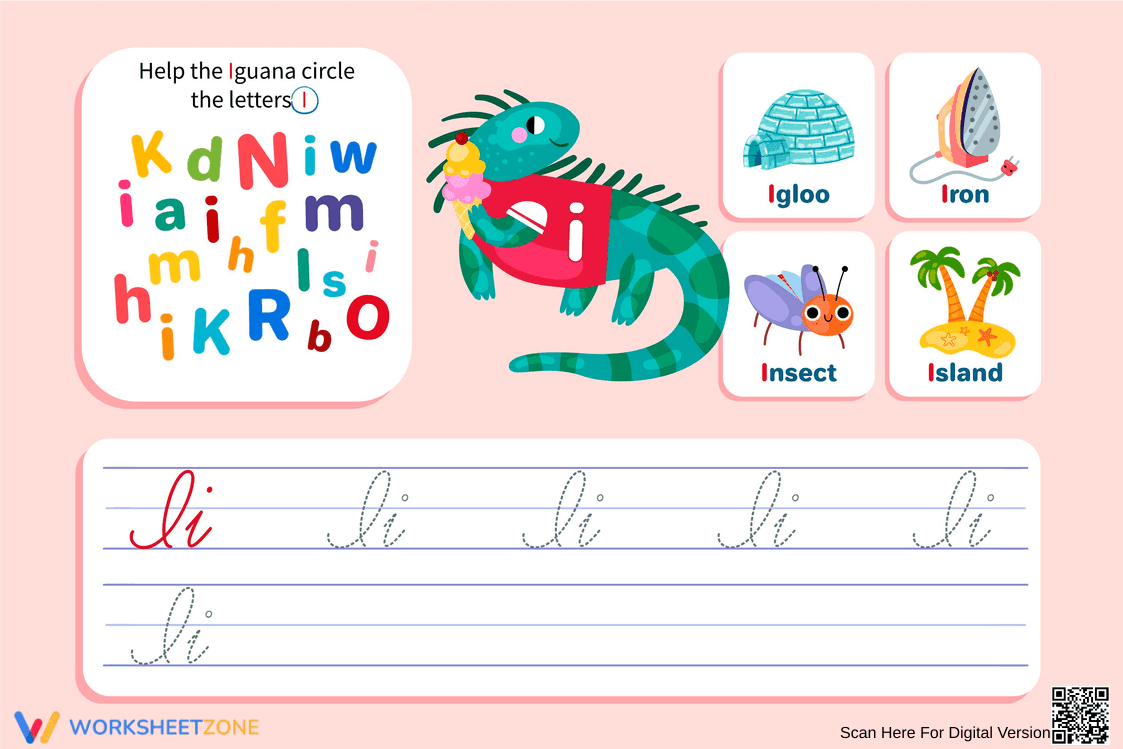

Cursive Letter I Worksheet | Grade 1 Essential Practice

Paste this activity's link or code into your existing LMS (Google Classroom, Canvas, Teams, Schoology, Moodle, etc.).
Students can open and work on the activity right away, with no student login required.
You'll still be able to track student progress and results from your teacher account.
This Grade 1 handwriting worksheet provides a comprehensive approach to mastering the cursive letter I. Students engage in multi-sensory learning by identifying the letter within a character-rich environment, connecting it to beginning sounds, and practicing precise motor movements through tracing and independent writing. It ensures students develop the muscle memory required for fluid cursive penmanship.
At a Glance
- Grade: 1 · Subject: Handwriting
- Standard:
CCSS.ELA-LITERACY.L.1.1.A— Print all upper- and lowercase letters accurately and legibly- Skill Focus: Cursive Letter I Formation
- Format: 1 page · 10 tasks · Answer key included · PDF
- Best For: Daily morning work or literacy centers
- Time: 10–15 minutes
The worksheet is divided into three distinct zones. First, a "Find the Letter" section features an iguana character and a letter cloud where students must discriminate between uppercase and lowercase 'I' and other similar characters. Second, a vocabulary quadrant introduces four words—Igloo, Iron, Insect, and Island—to reinforce phonemic awareness. Finally, the bottom half provides dedicated handwriting lines with 5 guided tracing pairs and a blank space for independent cursive practice.
This resource is designed for immediate classroom implementation. First, print the single-page PDF for your entire class or small group. Second, distribute the sheets during your handwriting block; the visual cues and "Help the Iguana" prompt allow students to begin with minimal verbal instruction. Third, review the completed work by checking for proper slant and connection points in the cursive strokes, providing instant feedback on letter legibility.
This worksheet aligns with CCSS.ELA-LITERACY.L.1.1.A, which requires students to demonstrate command of the conventions of standard English grammar and usage when writing, specifically by printing all upper- and lowercase letters. While focusing on cursive, it supports the foundational requirement of letter differentiation and legible production. Both standard codes can be copied directly into lesson plans, IEP goals, or district curriculum mapping tools.
Use this worksheet as a formative assessment during the "You Do" phase of a gradual release lesson on cursive vowels. It is particularly effective when placed in a literacy center after students have practiced the letter "I" in the air or with sand trays. Completion typically takes 12 minutes. This allows teachers to circulate and provide one-on-one support to students struggling with the specific loop and tail of the cursive 'I'.
This resource is ideal for first-grade students transitioning from print to cursive, as well as second-grade students needing remedial handwriting support. The inclusion of visual vocabulary makes it an excellent tool for English Language Learners (ELLs) who are building their lexicon while practicing fine motor skills. It serves as a perfect bridge between simple letter recognition and complex sentence writing.
Research by Fisher & Frey (2014) emphasizes the importance of the gradual release of responsibility model in foundational literacy skills, moving from guided identification to independent production. This worksheet facilitates that transition by providing a structured environment where students first recognize the cursive letter 'I' among distractors before attempting the motor-heavy task of tracing and writing. By integrating phonemic awareness through beginning-sound vocabulary like "Igloo" and "Island," the resource reinforces the connection between graphemes and phonemes. According to the NAEP, consistent handwriting practice in early grades is directly correlated with improved compositional fluency in later years. This specific resource addresses the CCSS.ELA-LITERACY.L.1.1.A standard by ensuring students can produce legible uppercase and lowercase cursive forms. The 10 distinct tasks provided offer enough repetition to build muscle memory without causing cognitive fatigue in young learners.


