


























Views
Downloads
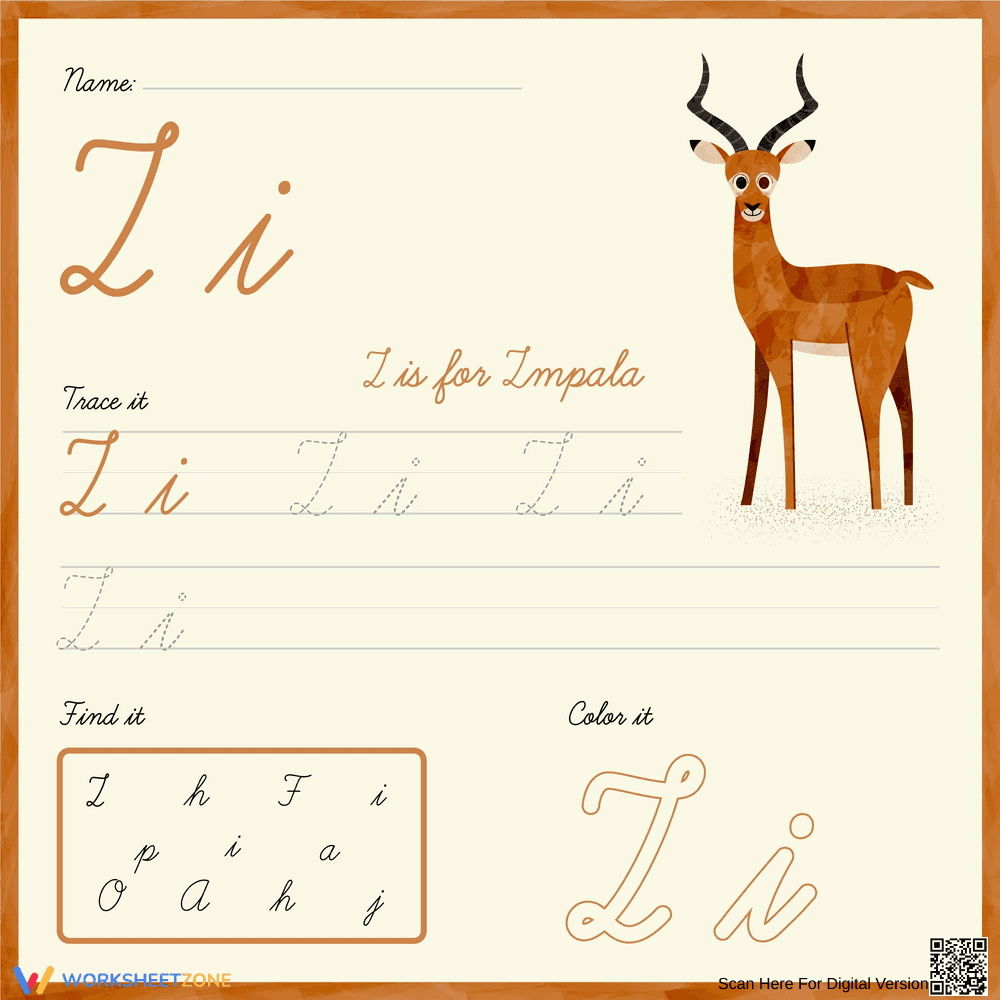

Printable Cursive Letter I Worksheet | Grade 1
Paste this activity's link or code into your existing LMS (Google Classroom, Canvas, Teams, Schoology, Moodle, etc.).
Students can open and work on the activity right away, with no student login required.
You'll still be able to track student progress and results from your teacher account.
This printable cursive letter I worksheet provides early learners with targeted handwriting practice to build fine motor control and letter recognition. Students trace, identify, and color the uppercase and lowercase cursive letter I, establishing foundational muscle memory for fluid writing.
At a Glance
- Grade: 1 · Subject: Handwriting
- Standard:
CCSS.ELA-LITERACY.L.1.1.A— Form upper- and lowercase letters- Skill Focus: Cursive Letter I Formation
- Format: 1 page · 3 tasks · No answer key needed · PDF
- Best For: Independent morning work
- Time: 10–15 minutes
This single-page resource features three distinct task types to reinforce cursive letter mastery. The page begins with a guided tracing section where students follow dotted lines to form both uppercase and lowercase cursive I. Next, a visual discrimination box challenges students to find and circle the target letter among other cursive characters. Finally, a coloring section allows students to shade bubble-letter versions of the cursive I, adding a creative element to their practice.
This worksheet is designed for immediate classroom implementation with zero teacher setup required.
- Print (30 seconds): Generate the PDF and print a class set directly from your computer.
- Distribute (30 seconds): Hand out the single-page sheets alongside pencils and crayons.
- Review (1 minute): Briefly model the cursive I strokes on the board before students begin.
Total teacher prep time is under two minutes, making this an ideal, self-explanatory activity for emergency sub plans or quick transitions.
This resource aligns with CCSS.ELA-LITERACY.L.1.1.A, requiring students to print all upper- and lowercase letters. While the standard focuses on print, this worksheet adapts the foundational expectation to early cursive instruction, ensuring students maintain proper proportion and line placement. Both standard codes can be copied directly into lesson plans, IEP goals, or district curriculum mapping tools.
Deploy this worksheet during morning work to establish a calm, focused start to the school day. It also functions perfectly as an independent literacy center activity while the teacher conducts small group reading instruction. As a formative assessment tip, observe students while they complete the tracing section to ensure they are starting their pencil strokes at the correct baseline or midline, rather than working backward. Expected completion time ranges from 10 to 15 minutes.
This practice sheet is primarily designed for first-grade students beginning their cursive handwriting journey. For students needing extra support, provide a textured surface underneath the paper to increase tactile feedback during tracing. Advanced learners can turn the paper over and attempt to write simple words starting with I, such as "Ice" or "Igloo," in cursive. Pair this activity with a whole-class anchor chart demonstrating the continuous stroke patterns of cursive vowels.
Developing automaticity in letter formation is a critical component of early literacy and written expression. According to Fisher & Frey (2014), explicit handwriting instruction reduces the cognitive load required for transcription, allowing young writers to allocate more mental resources to idea generation, vocabulary selection, and sentence composition. This worksheet directly supports that essential cognitive transition by targeting the specific motor patterns needed to form upper- and lowercase letters accurately. By isolating the cursive letter I through guided tracing, visual identification tasks, and creative coloring, students build the precise muscle memory required for fluent, legible writing. Aligned with CCSS.ELA-LITERACY.L.1.1.A, this targeted practice ensures that foundational transcription skills become automatic. Establishing these physical writing habits early ultimately supports broader reading and writing proficiency as students progress through the primary grades and encounter more complex academic demands.


