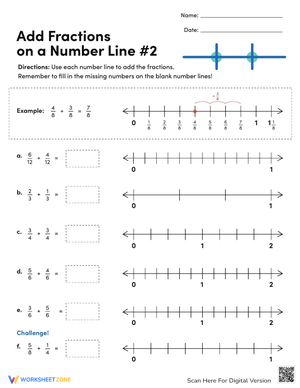
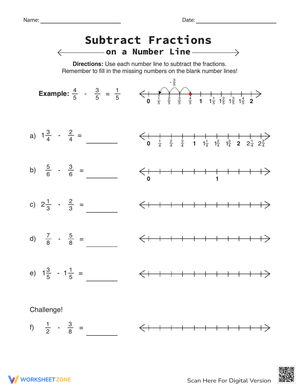
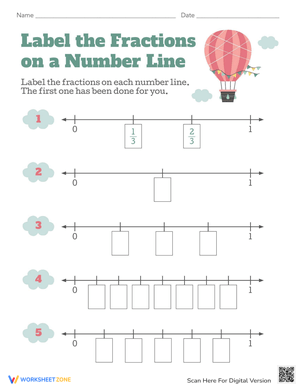
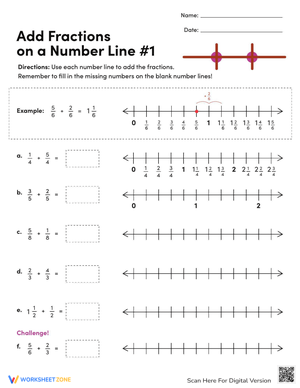
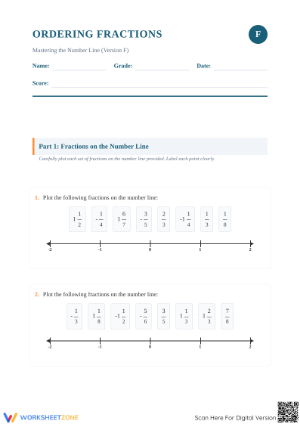
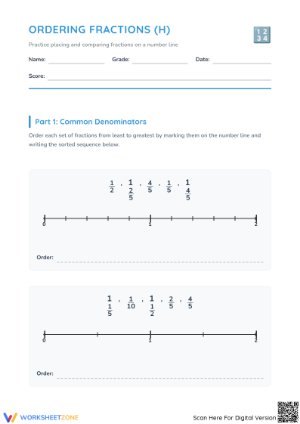
Fractions on a number line pdf worksheets for 4th grade address one of the most conceptually demanding shifts in upper-elementary math — moving students away from parts-of-a-shape thinking and toward seeing fractions as values with fixed, ordered locations. This set covers equal partitions, unit fractions, equivalent fractions, and mixed numbers, which is the full arc of Grade 4 fraction placement work. Everything prints cleanly in black and white, keeping visual attention on the number line structure rather than color fills or decorative elements.
The Specific Skills Each Worksheet Targets
Each worksheet in the set focuses on one or two closely related skills, which makes it easier to match the right worksheet to the right moment in instruction. The progression moves deliberately from foundational to complex.
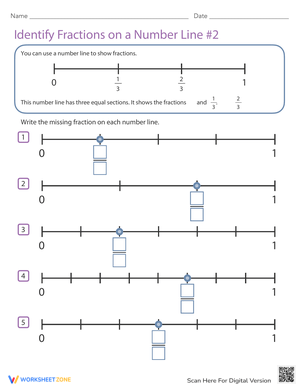
- Equal partitioning: Students count the spaces between tick marks — not the marks themselves — and identify how many equal parts make one whole. Every other skill in the set depends on getting this right first.
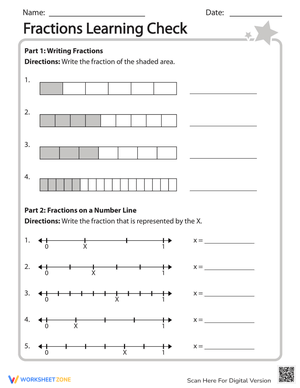
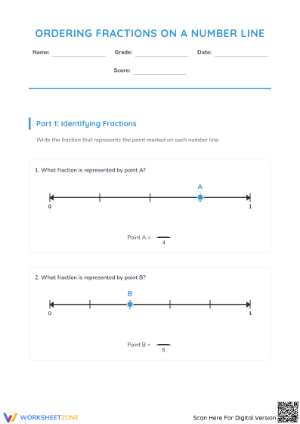
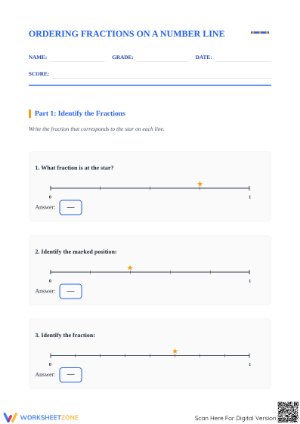
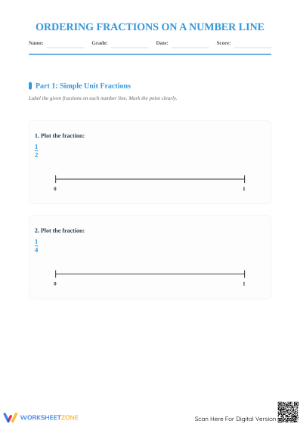
- Labeling unit fractions: Students write fractions at pre-marked points on lines divided into halves, thirds, fourths, sixths, and eighths.
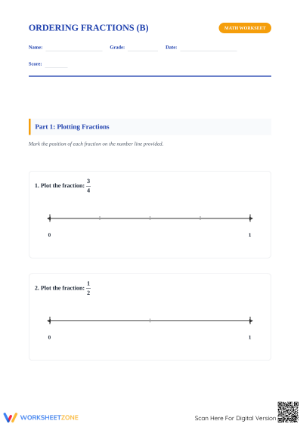
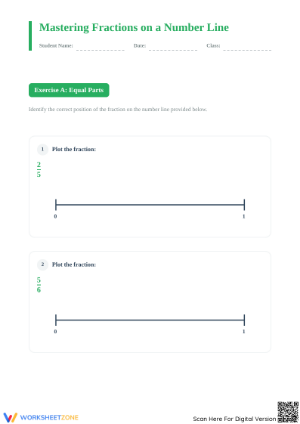
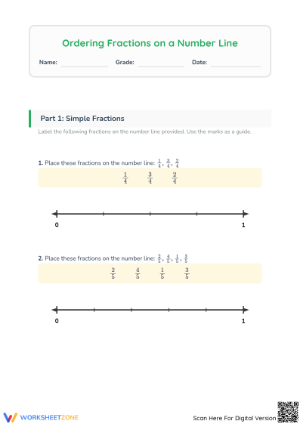
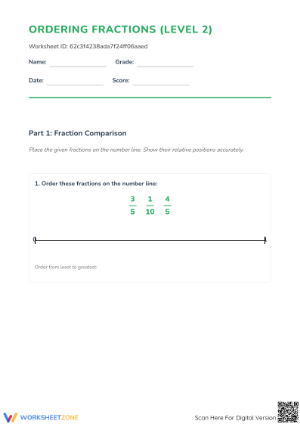
- Plotting given fractions: Students place a fraction — such as 3/4 or 5/6 — on a blank or partially labeled number line.
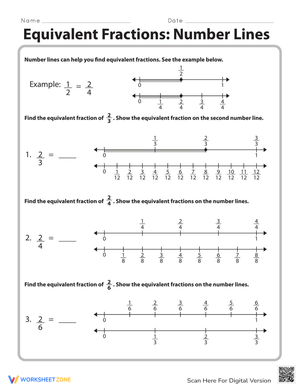
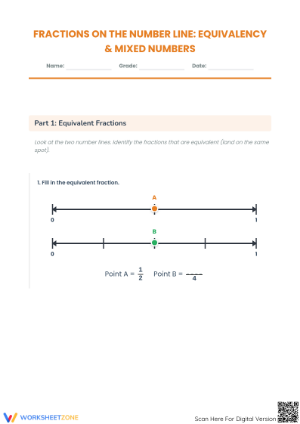
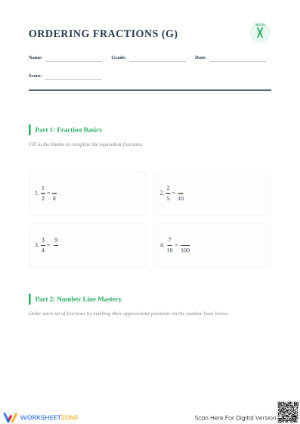
- Equivalent fractions on one line: Students identify that 1/2 and 2/4 mark the same point, then explain or verify the match using the structure of the line.
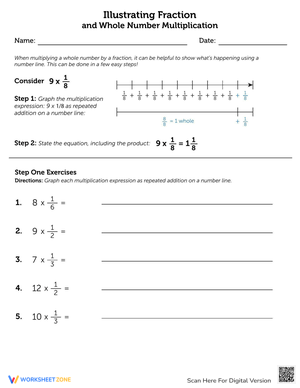
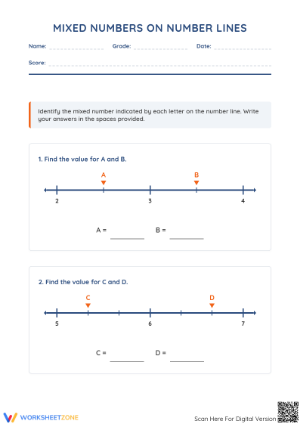
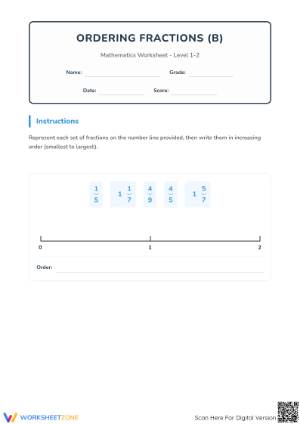
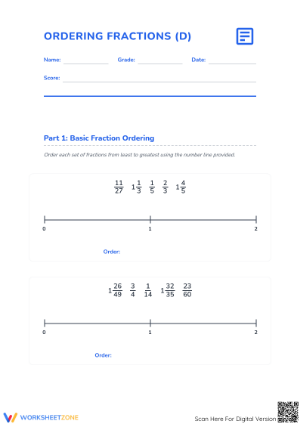
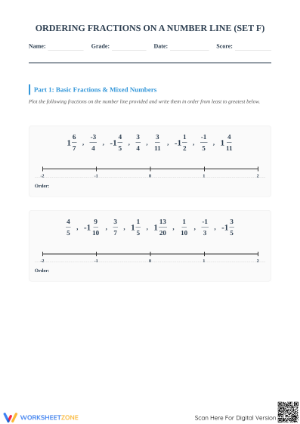
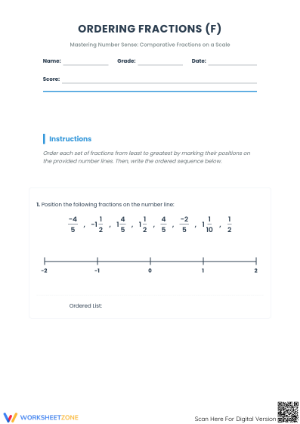
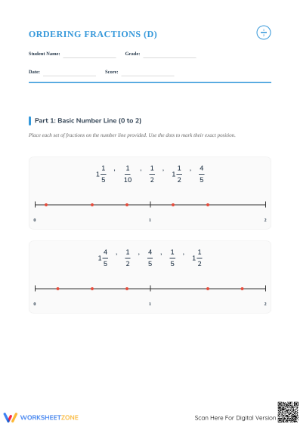
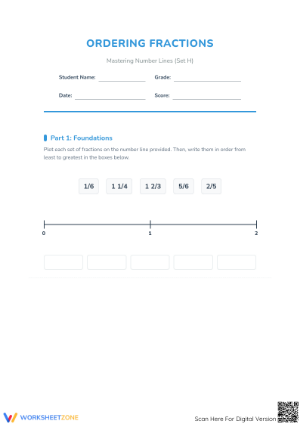
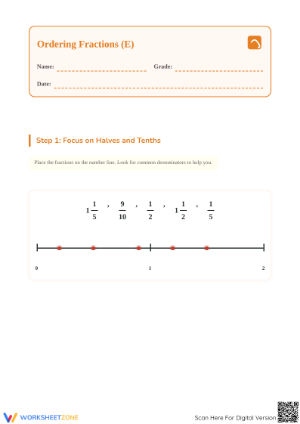
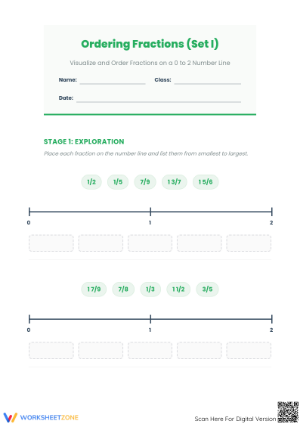
- Fractions greater than 1 and mixed numbers: Students extend the partition pattern past the whole-number mark to locate values like 5/4 or 1 3/4 without restarting the count from zero.
- Measurement word problems: Students connect fraction placement to real contexts — ribbon lengths, distances walked, water in a container — giving the abstract location a concrete referent.
That last type matters because it ties number line work directly to the measurement strand, which is how these standards play out on assessment items and in day-to-day classroom teaching.
Mistakes Students Make That Teachers Need to Catch Early
Number line work makes student reasoning visible in a way that a fill-in-the-blank exercise does not. When an answer is wrong here, the work on the worksheet usually shows you why.
The most persistent error is counting tick marks instead of intervals. A number line divided into fourths has five marks from 0 to 1, and students who count marks write 5 as the denominator instead of 4. This error almost always disappears once students trace or lightly shade each interval before labeling anything — slowing the hand slows the assumption. It is worth spending two minutes on that routine at the start of any number line lesson.
A second pattern appears with equivalent fractions. Many students can repeat that 1/2 and 2/4 are "equal," but on the same line they will plot the two fractions at different points because they process each one separately rather than treating the line as a shared reference frame. Worksheets that show two differently partitioned lines side by side — one divided into halves, one into fourths — make the shared location undeniable in a way that verbal explanation alone does not.
Mixed numbers create a third problem. Students frequently treat the whole number 1 as a stopping point and restart their count from zero after crossing it. The result is that 5/4 lands at the first mark past 0 instead of the first mark past 1. Having students draw the full partition from 0 to 2 before placing any value prevents that reset habit from forming in the first place.
Building These Worksheets Into Your Lesson Sequence
Fractions on a number line pdf worksheets for 4th grade fit most efficiently into a math block when each worksheet has a single, defined purpose. Ten to twelve focused minutes with one worksheet generates cleaner formative data than a longer set students race through without thinking carefully about placement.
- Mini-lesson follow-up: After whole-group modeling on the board or document camera, assign four to six number line problems for immediate practice. Students who need redirection show it quickly on a short task.
- Math center rotation: Slip a worksheet into a dry-erase sleeve. Partners label points, compare answers, and erase before the next group arrives — no extra materials needed.
- Monday warm-up: Use one partitioning or labeling problem as a retrieval opener at the start of the week. Spaced retrieval from the previous week's instruction transfers better than re-teaching from scratch, and students who were shaky on Friday will reveal it in the first two minutes.
- Exit check: Cut one problem from a worksheet and use it as a two-minute end-of-lesson check. Sorting those slips into three piles — confident, partial, not yet — takes about four minutes after students leave and drives the next day's small-group decisions.
- Intervention group: Pull the partitioning and labeling worksheets for students who are guessing at placement. Those two skill types reveal whether a student has the foundational interval-counting structure before you move them to equivalence work.
Standard Alignment
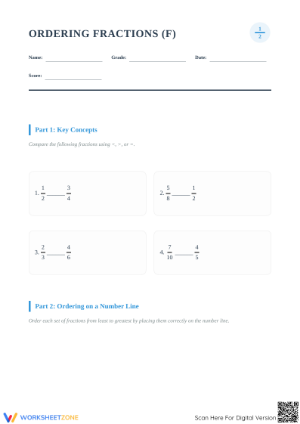
These worksheets connect directly to CCSS.MATH.CONTENT.4.NF.A.1 and CCSS.MATH.CONTENT.4.NF.A.2. The first standard asks students to explain equivalence using visual fraction models and to understand that the size of a fractional part depends on the size of the whole — exactly what a number line makes explicit. The second requires comparing fractions with different numerators and denominators using benchmarks, which is fraction number line reasoning applied to a relational context. In classroom terms, number line placement is not an introductory warm-up activity; it is a central reasoning tool for the comparison work both standards describe. Teachers using fractions on a number line pdf worksheets for 4th grade can sequence the set to mirror how these standards unfold in instruction: partitioning first, then labeling, then equivalence, and finally comparison and mixed number placement.
Adapting the Set for a Range of Learners
Students still building fraction vocabulary need worksheets that reduce the number of simultaneous decisions. For those students, choose worksheets where tick marks are already drawn and students only need to name or label points — not construct the partition themselves. Pre-labeled benchmark fractions (0, 1/2, 1) give a reference frame that lowers cognitive load without pulling the work below grade level. Fewer problems with more writing space also reduces the anxiety that crowded worksheets can create for students working on processing speed alongside math content.
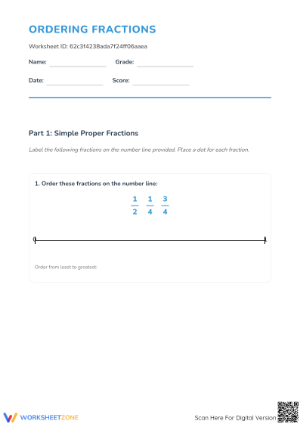
Students who have mastered unit fraction placement can move into worksheets that involve two superimposed number lines, equivalent fraction matching without visual support, or placing fractions greater than 1 on an unmarked line. A strong extension task: ask students to place three fractions on one line and write a comparison sentence for any two using the words less than or greater than. That task asks for both procedural accuracy and the language of relational thinking, which is exactly where Grade 4 fraction instruction is headed by end of unit. The range of difficulty across fractions on a number line pdf worksheets for 4th grade means teachers rarely need to pull a separate resource to serve both groups in the same classroom.
Frequently Asked Questions
What fraction skills should Grade 4 students demonstrate on a number line by end of unit?
By the end of a Grade 4 fraction unit, students should identify equal partitions, label unit and non-unit fractions, place fractions accurately on lines from 0 to 1 and from 0 to 2, recognize equivalent fractions at the same point, compare fraction sizes using benchmark reasoning, and locate mixed numbers using a partition consistent with the denominator.
How do I break the tick-mark counting habit before it becomes automatic?
Before students label anything, have them shade or trace each interval — not each tick mark. Some teachers call it "count the jumps" to distinguish it from counting the lines. After two or three sessions with that routine built in, the error rate drops noticeably and students stop needing the reminder. The key is catching it at the first lesson, not after students have practiced the wrong method several times.
Do the worksheets include answer keys?
Each worksheet comes with a corresponding answer key so teachers can check work efficiently during a center rotation, collect exit checks without marking each one individually, or allow students to self-correct at the end of a lesson.
Can these worksheets support standardized test preparation?
Number line fraction tasks appear on most state assessments aligned to the Common Core because they require students to show relational reasoning, not just recall. The variety of task types across the set — partitioning, labeling, placing, and comparing — mirrors the range of item formats students encounter on those tests. Spreading the worksheets across several weeks rather than using them in one concentrated block builds the retrieval strength that assessment performance depends on.