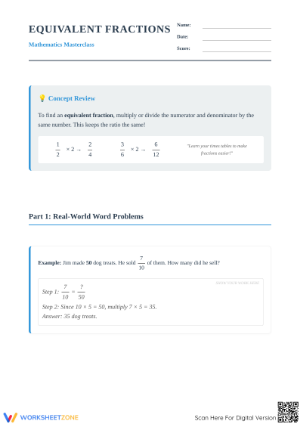
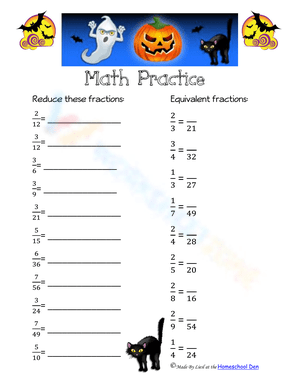
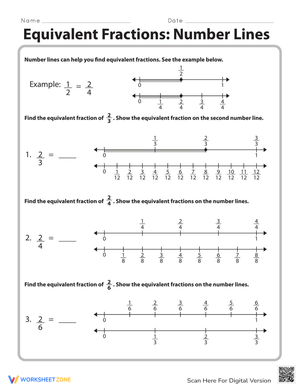
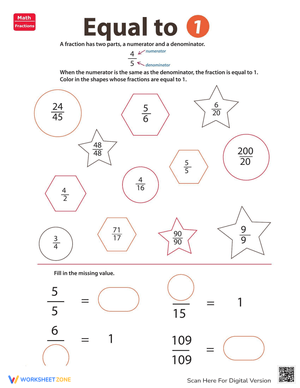
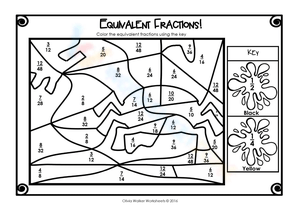
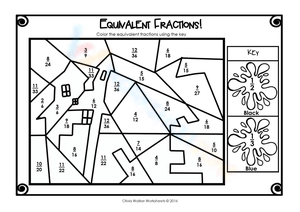
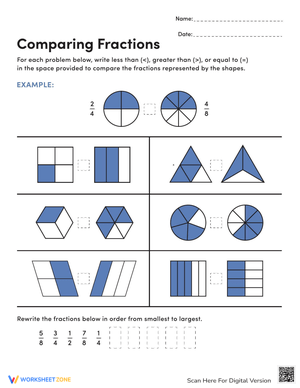
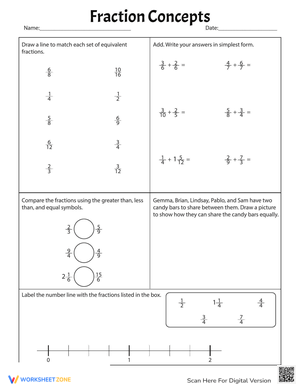
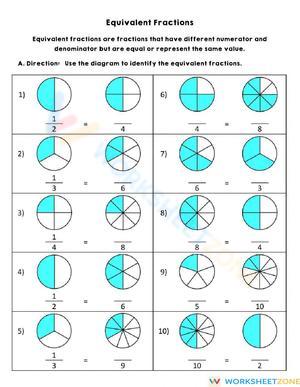
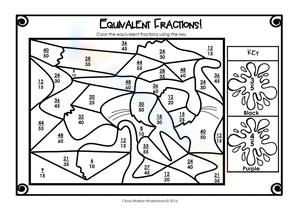
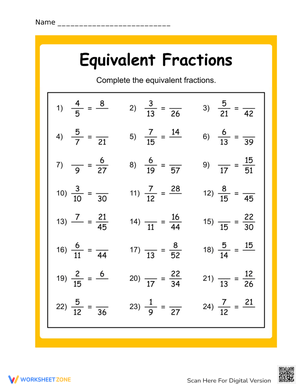
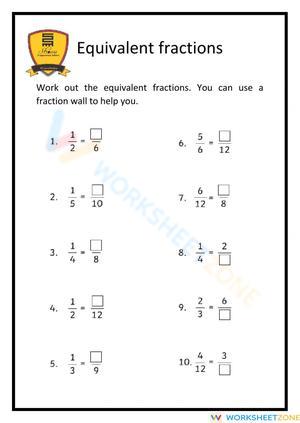
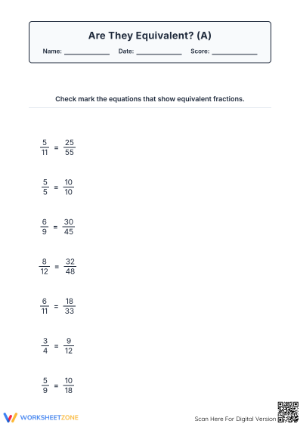
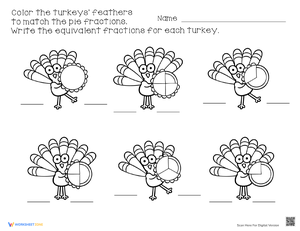
These equivalent fractions printable worksheets for 4th grade give teachers ready practice across the full arc of 4.NF.A.1 — from shaded area models through missing-numerator equations — without requiring any prep beyond printing. The set covers three distinct representations: area models, fraction bars, and number lines, so students encounter equivalence as a consistent mathematical relationship rather than a collection of disconnected procedures. That coverage matters because students who see only one model often apply it rigidly and stall when a problem arrives in a different form.
What's Inside the Set
Each worksheet targets a specific skill within the broader concept of fraction equivalence, which keeps cognitive load manageable during initial instruction. The types of practice across the set include:
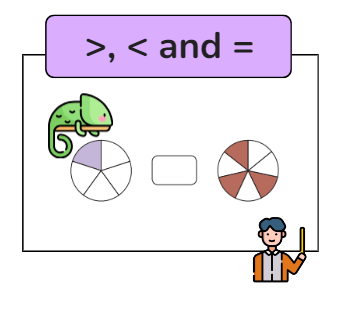
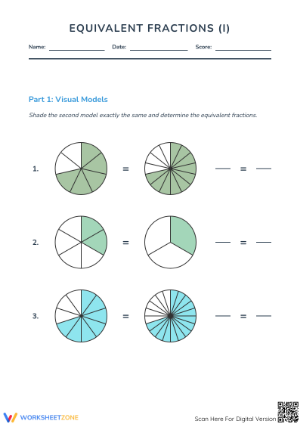
- Coloring and partitioning area models — circles and rectangles — to match a given fraction
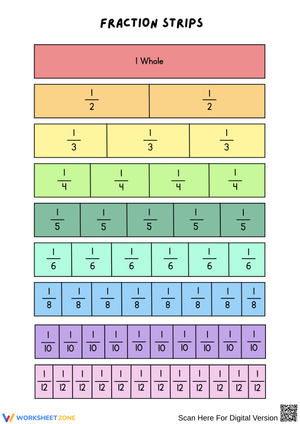
- Fraction bar diagrams where one bar is pre-shaded and students shade a second bar to match
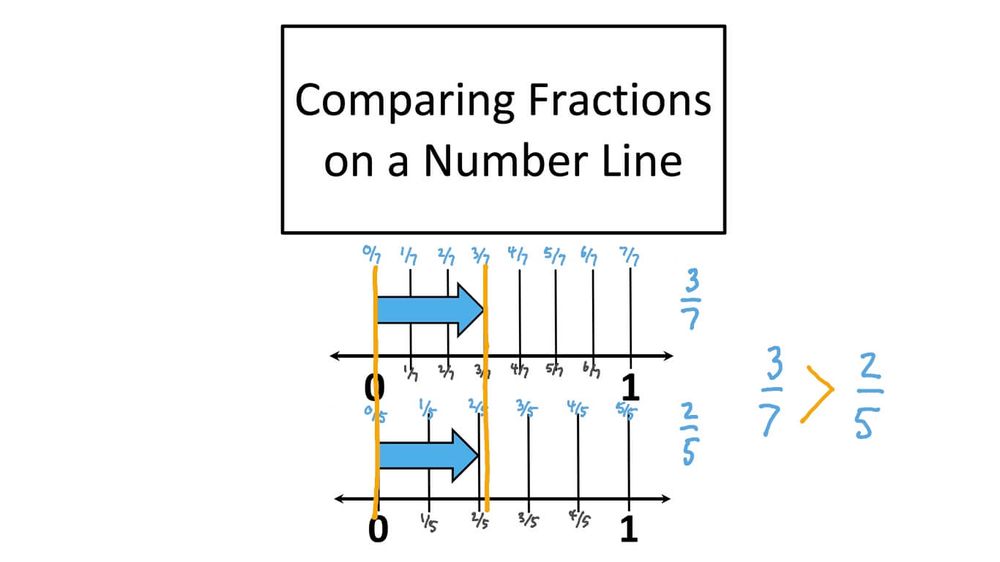
- Parallel number line tasks where students label two lines with different denominators and identify which points align
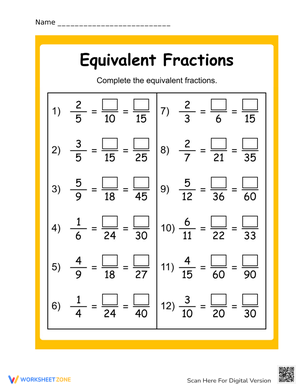
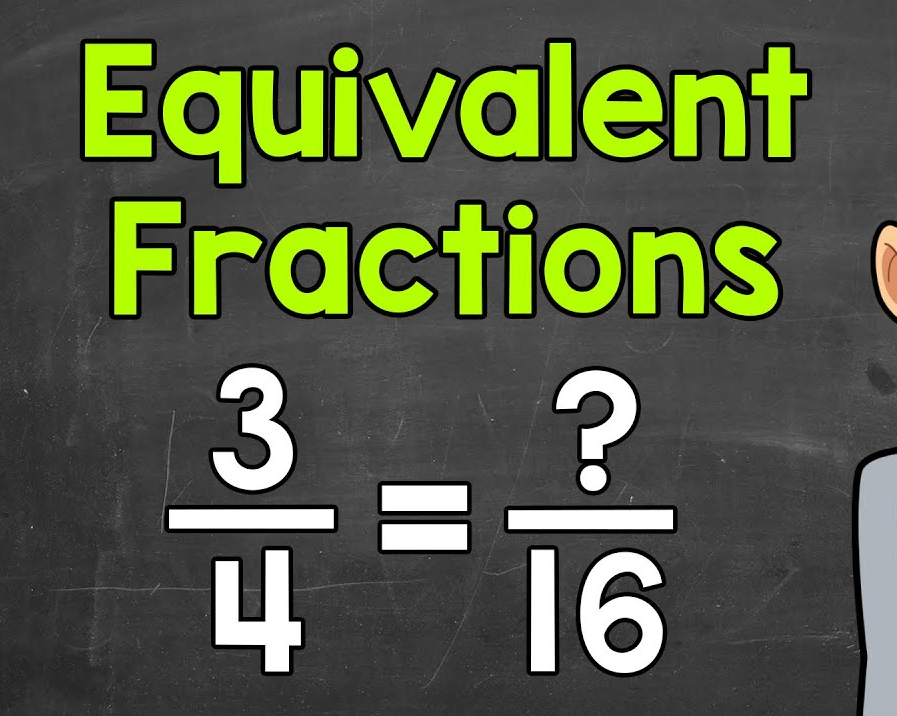
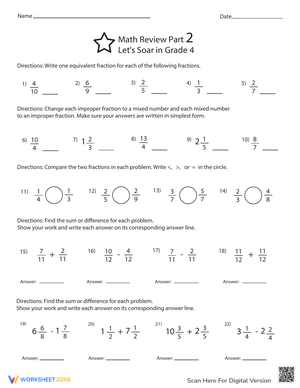
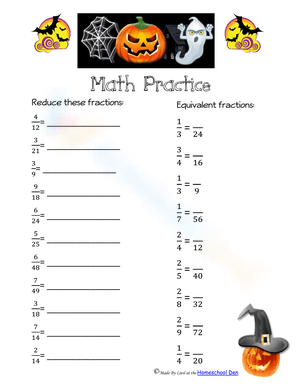
- Missing-numerator and missing-denominator equations such as 2/3 = ?/12
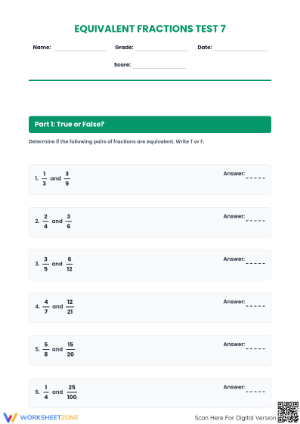
- Sorting tasks where students group equivalent fraction pairs from an unordered list
- Short constructed-response items asking students to explain in writing why two fractions are equal
The written-explanation items deserve a specific note. Getting a 4th grader to write "I multiplied both the top and bottom by 4" is a formative window that a circled answer never opens. Students who write those explanations reveal whether they understand the multiplicative relationship or are just pattern-matching from the worked example at the top of the worksheet.
Fraction Mistakes That Surface Quickly in Student Work
The most consistent error at this grade is applying the multiplication to only one part of the fraction. A student who correctly solves 1/2 = ?/8 by multiplying the denominator by 4 and then the numerator by 4 will often write 3/5 = 3/20 on the next problem — multiplying only the denominator because the numerator happened to stay the same in the previous example. The worksheets place problems with identical numerators back-to-back with problems where both parts change, which surfaces this error quickly rather than letting it harden over several days of independent practice.
A second error is size confusion with unlike denominators. Students who have just internalized that larger numbers mean larger quantities will argue that 2/6 is greater than 1/3 because "6 is bigger than 3." This is exactly the reasoning that equivalent fraction work is meant to disrupt. The number line worksheets — where 2/6 and 1/3 land on the exact same point — do more to correct this than any verbal explanation, because the correction is self-generated. When a student marks both fractions at the same location and sees it, the realization sticks in a way that being told the answer does not.
Watch also for students who produce correct answers on procedural items but go blank on the explanation questions. They have memorized "multiply top and bottom by the same number" without understanding why that operation preserves value. The constructed-response items sort these students out within the first session.
Standard Alignment
CCSS.MATH.CONTENT.4.NF.A.1 requires students to explain why a fraction a/b is equivalent to (n times a)/(n times b) using visual fraction models. Critically, the standard says explain — not just identify or produce. That language places the burden on conceptual understanding rather than procedure alone. These worksheets address that requirement by pairing every visual model task with a prompt asking students to state what changed and what stayed the same. The "what stayed the same" half of that question is where the real understanding lives: the value of the fraction didn't move; only the way the parts were counted changed.
4.NF.A.1 sits early in the 4th-grade fraction progression because it is load-bearing for everything that follows — comparing fractions with unlike denominators (4.NF.A.2), adding and subtracting fractions (4.NF.B.3), and multiplying fractions in 5th grade. Students who leave 4th grade with a procedural-only grasp of equivalence hit that gap immediately in 5th grade when unlike denominators become routine rather than novel.
Building These Worksheets Into the Week's Instruction
The area model and fraction bar worksheets work best at the opening of the unit, when students are still forming mental images of what equivalence means. The number line worksheets land better after two or three days of area model work — students arrive at the number line already expecting that different-looking fractions can be equal, so the visual confirmation clicks rather than confuses. Save the missing-numerator equation worksheets for once students have that visual foundation; introduced too early, the symbolic format sends students straight to guess-and-check rather than reasoning.
For small-group instruction, the sorting task worksheet runs well as a paired activity: print one worksheet per pair, cut the fraction cards apart, and have students physically arrange them into equivalent groups before recording. The physical sorting step slows students down enough that they justify each placement to their partner, which surfaces reasoning that silent independent practice never would. Exit tickets drawn from the constructed-response items give clear data on which students are ready for the comparison unit and which still need one more day on equivalence before moving forward.
These equivalent fractions printable worksheets for 4th grade also hold up as Monday warm-ups during the two weeks after the unit ends — a spaced-retrieval use that costs five minutes and pays dividends when fractions reappear in the comparing and adding units. The fraction bar format is especially efficient for this purpose because it re-establishes the visual quickly without requiring a full re-teach.
Adjusting the Work for a Range of Student Levels
Students still working on basic fraction identification need the area model worksheets with pre-drawn, pre-partitioned shapes — they shade and label without having to generate the partition themselves. That reduced demand lets them concentrate on the equivalence relationship rather than the drawing task. Once they can consistently match shaded regions, they move to the fraction bar worksheets where partial information is given and they complete the second bar independently.
Students ready to move beyond visual support should work the missing-numerator equations without models present. A useful extension: ask them to generate three equivalent fractions for a given fraction and then order the family from least to greatest denominator, noticing the pattern as the denominator grows. This anticipates 5th-grade work with larger denominators and keeps advanced students working at the edge of their current understanding rather than rehearsing what they already know.
For students who freeze when the visual is removed — a common profile at this age — the equivalent fractions printable worksheets for 4th grade that pair a small fraction bar alongside the equation offer a practical middle step. Students glance at the bar to confirm their equation work, then gradually rely on it less as their confidence builds. This is not avoidance of the abstract; it is a deliberate intermediate step between full visual support and purely symbolic work.
Frequently Asked Questions
Do these worksheets work for students who understand area models but struggle with the equation format?
Yes. The set includes worksheets that place a completed area model next to a blank equation, asking students to translate what they see into numbers. That bridge task is specifically useful for students who understand equivalence visually but haven't yet connected the image to the multiplicative procedure. The equation worksheets that follow have no model attached, so the progression is deliberate rather than abrupt.
Which worksheets travel home most successfully for homework?
The fraction bar worksheets. The visual makes the task self-explanatory — a parent doesn't need to know the 4.NF.A.1 standard to help a child shade a second bar to match the first. The missing-numerator equations are better reserved for classroom use, or sent home only after students have demonstrated they can explain the multiplication step aloud in class. Without that prior explanation, parents tend to show children cross-multiplication, which works but bypasses the conceptual understanding the unit is building.
When should I introduce the equivalent fractions printable worksheets for 4th grade that use number lines?
After students have worked with area models for at least two lessons and can correctly shade and label equivalent fractions in that format. Introducing number lines too early creates a second unfamiliar representation before the first one is solid. When the number line arrives after area model fluency, most students recognize the equivalence immediately — the parallel lines confirm what they already believe, and that confirmation is motivating rather than disorienting.













 Interactive Worksheet Maker
 Quiz Maker
 Word Search Maker
 Crossword Puzzle Maker
 Word Scramble Generator
 Sentence Scramble Generator
 Handwriting Worksheet Generator
 Name Tracing Generator
 Fill In The Blank Generator