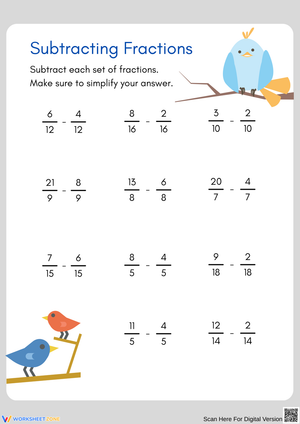
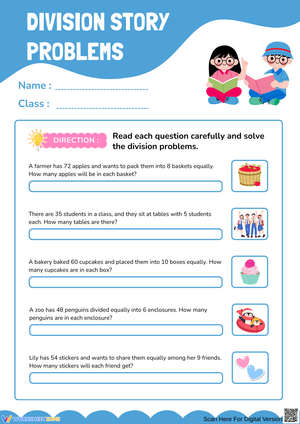
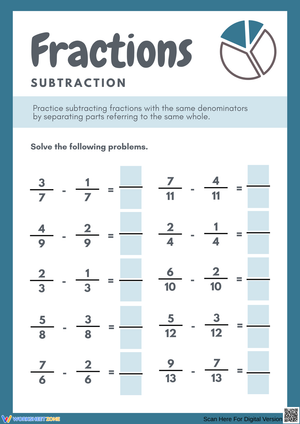
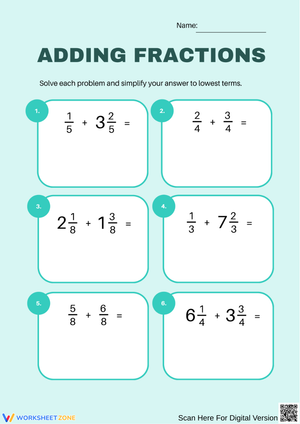
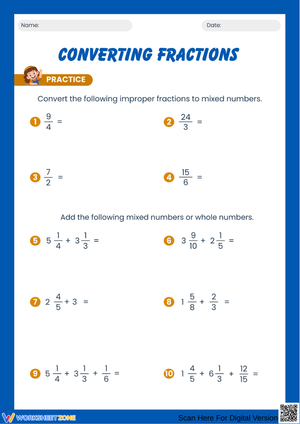
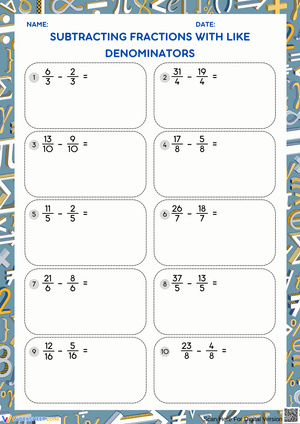
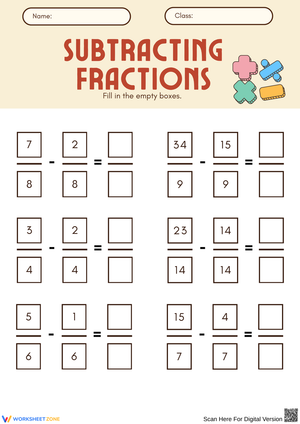
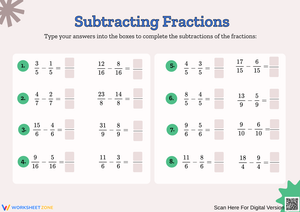
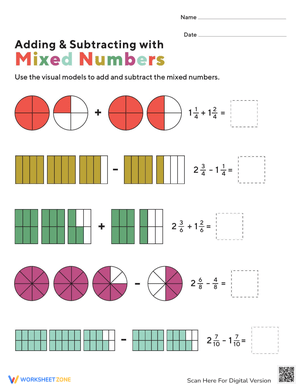
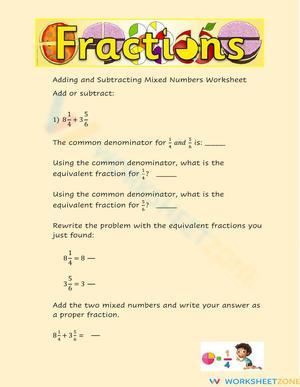
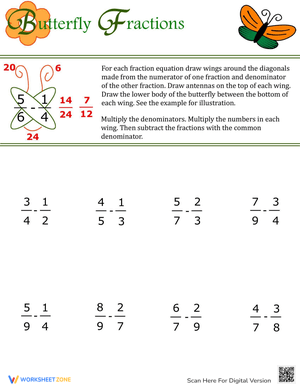
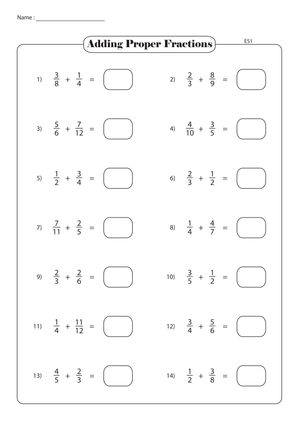
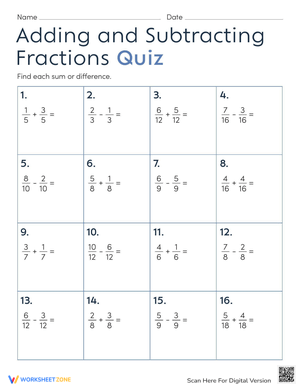
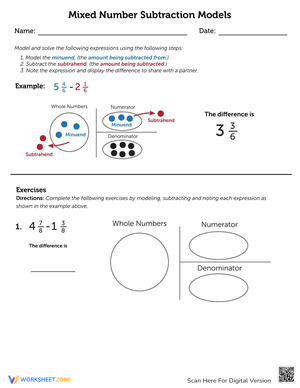
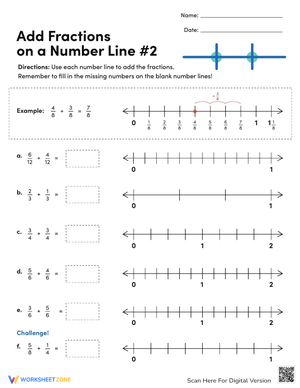
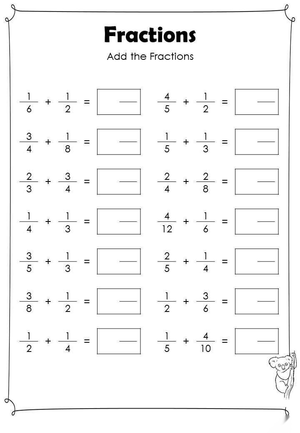
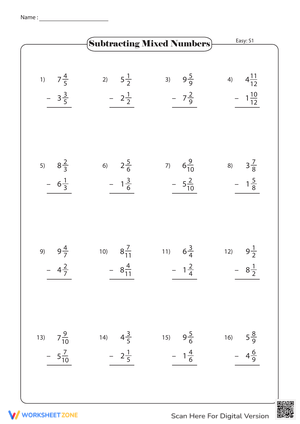
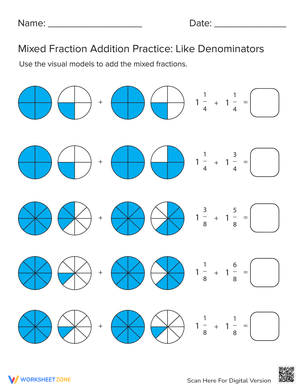
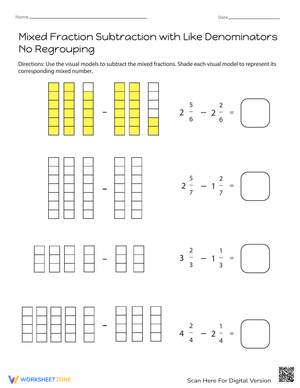
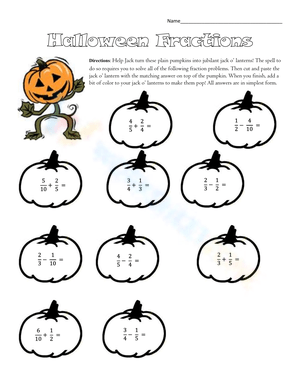
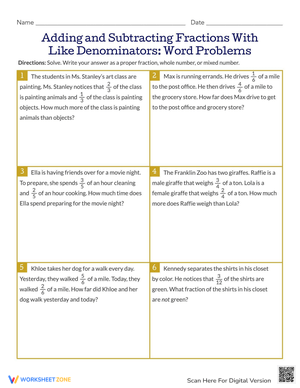
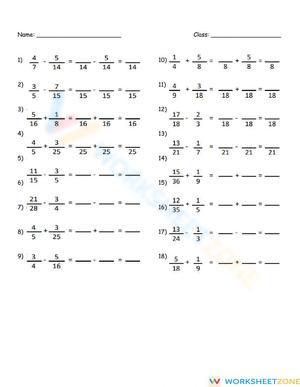
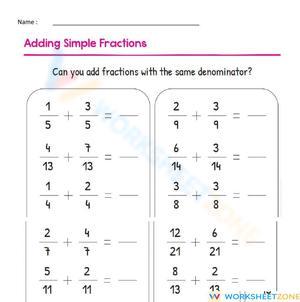
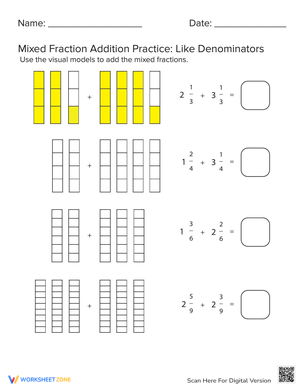
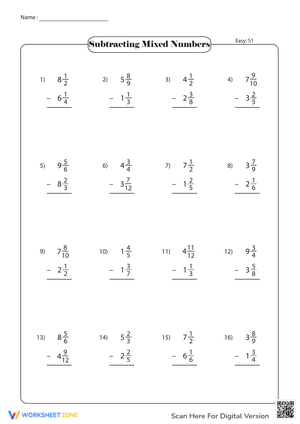
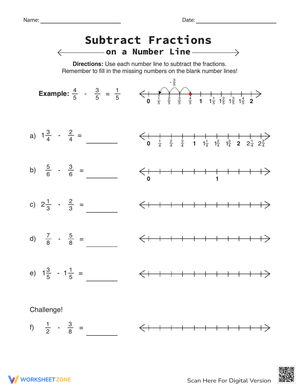
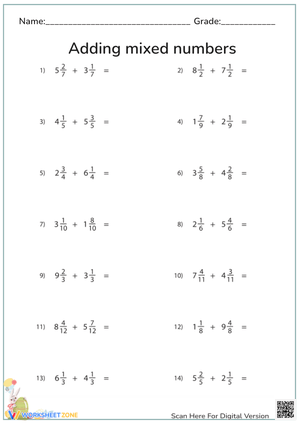
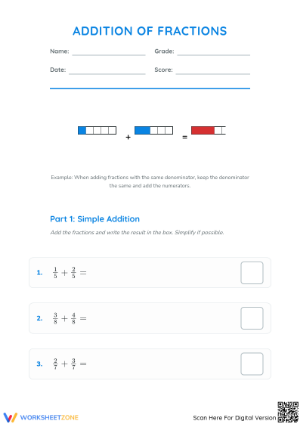
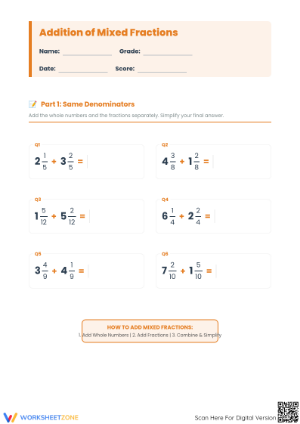
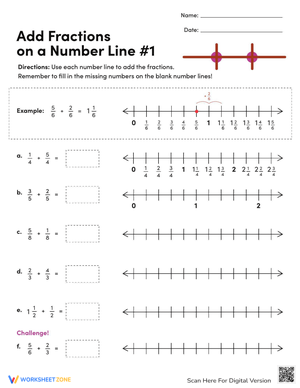
These 4th grade adding and subtracting fractions printable worksheets give teachers print-ready practice that targets three specific skills Grade 4 students need most: like-denominator computation, unit fraction decomposition, and matching an equation to a visual model. Each worksheet mixes problem types so a teacher can see evidence of both procedural fluency and conceptual understanding from a single sitting.
The Specific Skills These Worksheets Build
Grade 4 fraction addition and subtraction is narrower in scope than many teachers expect. Students add and subtract fractions with like denominators, decompose fractions into sums of unit fractions — writing 3/4 as 1/4 + 1/4 + 1/4, not 1/4 + 2/4 — and connect symbolic notation to fraction bars, number lines, and area models. This set stays inside that Grade 4 scope without drifting into unlike-denominator work, which belongs in Grade 5.
- Like-denominator addition and subtraction: Students combine or separate fractional parts and write the result as a single fraction over the same denominator.
- Unit fraction decomposition: Students break fractions into sums of unit fractions and write the corresponding equations.
- Fraction bar and area model tasks: Students shade diagrams, match pictures to equations, and complete partially drawn models.
- Number line tasks: Students mark fractions as points and distances, reinforcing that fractions are numbers — not just pieces of a shape.
- Short word problems: One or two context problems per worksheet check whether students can apply the operation in a meaningful setting.
Student Error Patterns Worth Knowing Before You Teach
The most common error in Grade 4 fraction addition is adding both the numerator and the denominator. A student writes 2/5 + 1/5 = 3/10 with complete confidence, because the only addition procedure they have ever used is: add top, add bottom. A worksheet that places a shaded fraction bar alongside that equation makes the error visible immediately — the student can see that 3/10 does not describe three out of five equal parts.
A second pattern is harder to catch: students who write the correct sum on computation items but cannot reproduce or explain a visual model. They have memorized "keep the denominator, add the numerators" without understanding why the denominator stays. On model-based worksheets, these students often draw fraction bars with unequal-sized parts or place tick marks on the number line in the wrong positions. That gap between rule-following and conceptual understanding is exactly what mixed-format worksheets surface.
Decomposition tasks reveal a third error. Students write 3/4 = 1/4 + 2/4 instead of 1/4 + 1/4 + 1/4 — they grasp decomposition partially but have not internalized unit fractions as the base building block. Catching this before it becomes habitual shifts instruction at the right moment.
Building These Worksheets Into Your Weekly Lesson Flow
The most efficient use of this set is to treat individual worksheets as components within a lesson, not as standalone assignments handed out after teaching is done. A visual-model worksheet works well during guided practice: project two problems, work through them together, then have students complete the rest with a partner. A computation worksheet fits cleanly into independent practice after direct instruction. A word-problem worksheet makes a strong exit check or the following morning's warm-up.
In a 60-minute math block, a practical rotation might look like this: five minutes of warm-up using one equation and one model from the previous lesson; twenty minutes of new instruction; fifteen minutes of partner work on a new visual worksheet; ten minutes of independent computation practice. Those final ten minutes produce fast formative data — a quick scan of the papers before dismissal tells you whether the lesson landed.
Teachers who build a full fraction unit around 4th grade adding and subtracting fractions printable worksheets find the print format more flexible than it first appears. These worksheets require no special materials and can be sorted into lesson sequences during a single planning period. For math centers, place the visual-model worksheet in one station and the computation worksheet in another. Students who finish early move to the word-problem worksheet. Setup takes less than two minutes.
Standard Alignment
This set addresses CCSS 4.NF.B.3, the standard cluster covering addition and subtraction of fractions with like denominators. In classroom terms, the sub-standards break down this way: 4.NF.B.3a asks students to understand the operation through models and equations; 4.NF.B.3b covers decomposing fractions into sums of unit fractions; 4.NF.B.3d applies both operations to word problems involving fractions and mixed numbers. In most Grade 4 pacing guides, this cluster arrives mid-year — after fraction equivalence work under 4.NF.A and before fraction multiplication, which appears in Grade 5 under 5.NF.B.
Adapting the Set for a Range of Learners
Students who enter this unit without a secure understanding of what a denominator represents need extra support at the model level before attempting computation. For these students, begin with fraction bar worksheets only, keep numerators at 1, 2, and 3, and have them read each equation aloud before writing anything. That verbal step consistently catches the denominator-addition error before it appears on paper.
On-level students work well with the standard rotation: a visual worksheet, a computation worksheet, and a word problem. Students who demonstrate fluency early can extend the word-problem worksheets by writing their own problem using a fraction from the set, then trading with a partner to solve.
For small-group instruction, print the complete worksheet for students who need space to draw and annotate their thinking. For a pull-out group where pacing matters, cut the same worksheet into individual problem strips and address one strip at a time. This lets the teacher sort errors by problem type during the session rather than collecting papers and analyzing them afterward.
When organizing differentiated stations, 4th grade adding and subtracting fractions printable worksheets sort naturally into three levels: visual-model only at the lowest entry point, mixed visual and computation at the grade-level target, and word-problem focused for extension. Teachers who file them this way cut planning time significantly over the course of a unit.
Frequently Asked Questions
Do these worksheets include unlike-denominator problems?
No. Grade 4 fraction work focuses entirely on like denominators. Unlike-denominator computation belongs in Grade 5 under 5.NF.A.1. Within this set, all addition and subtraction problems share a common denominator, though some worksheets include unit fraction decomposition and word problems that reference mixed numbers in context.
How do these worksheets work alongside fraction bar manipulatives?
They pair well. A common sequence is to begin a lesson with physical fraction bars, move to the printed models on the worksheets as a bridge between hands-on and abstract work, and then introduce bare equations. The fraction bar diagrams in this set are drawn to match standard fraction bar proportions, so students who worked with physical manipulatives first recognize the printed models immediately.
What fraction knowledge do students need before starting?
Students should be comfortable reading and writing fractions with denominators of 2, 3, 4, 6, and 8. They should understand that a fraction names equal parts of a whole and that fractions can be located on a number line. Students still uncertain about what a denominator represents will struggle with the computation worksheets and benefit most from starting with visual-model tasks alongside brief reteaching on fraction meaning.
Can these worksheets serve as formative assessment?
Yes, and the mixed-format worksheets serve that role most effectively. When a student solves the equation correctly but draws an inaccurate model, the paper captures evidence that an observation alone might miss. For a quick exit check, 4th grade adding and subtracting fractions printable worksheets that end with a word problem give teachers clear evidence of where each student stands — one problem, roughly two minutes, and a stack of papers that sort into three instructional groups before the next lesson.













 Interactive Worksheet Maker
 Quiz Maker
 Word Search Maker
 Crossword Puzzle Maker
 Word Scramble Generator
 Sentence Scramble Generator
 Handwriting Worksheet Generator
 Name Tracing Generator
 Fill In The Blank Generator