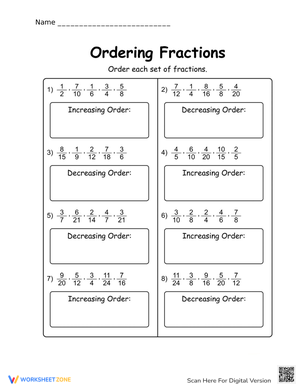
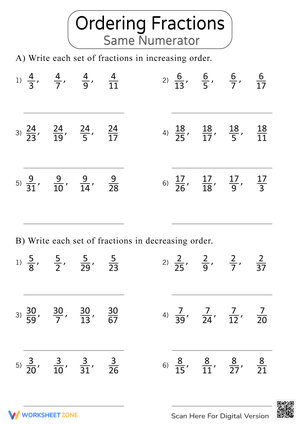
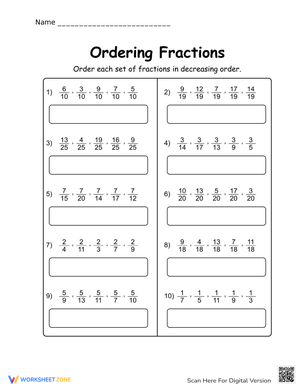
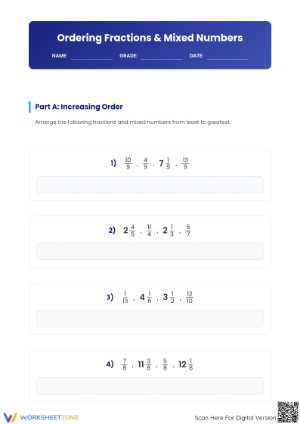
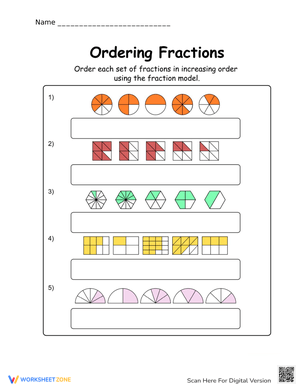
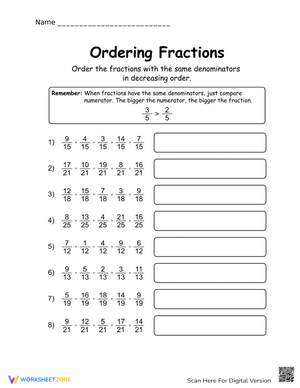
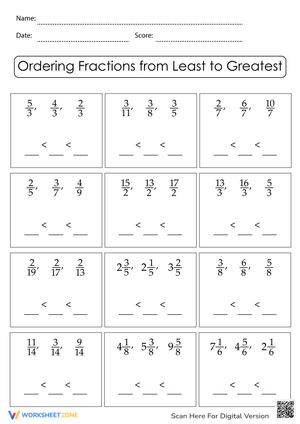
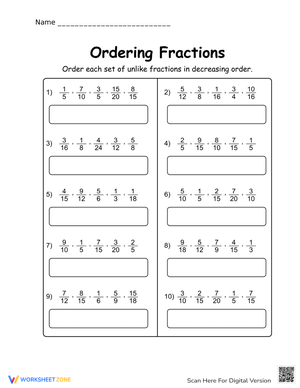
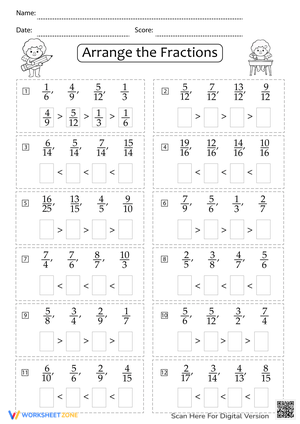
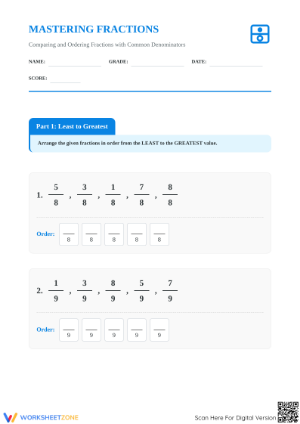
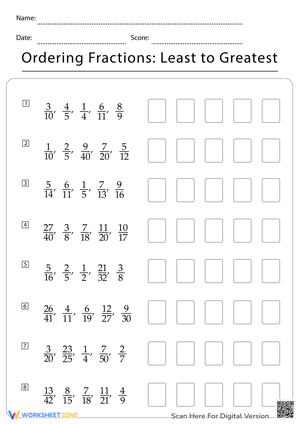
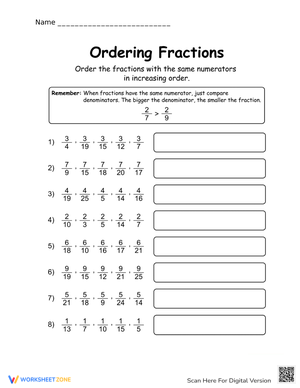
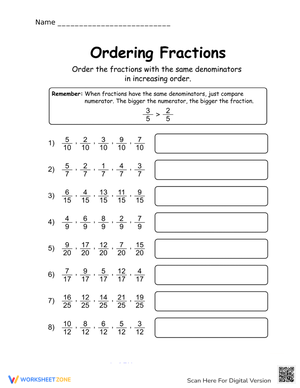
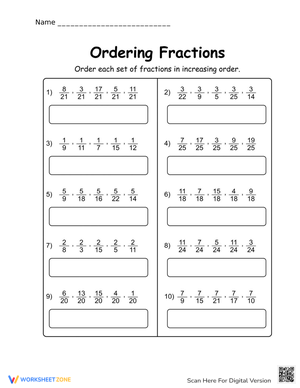
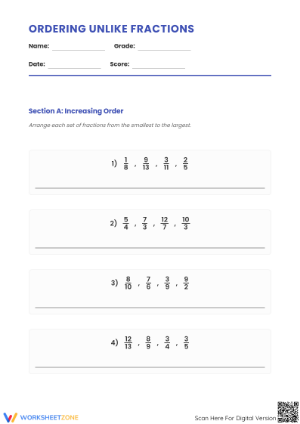
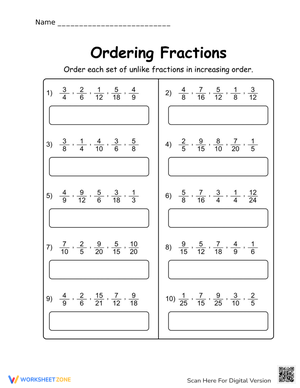
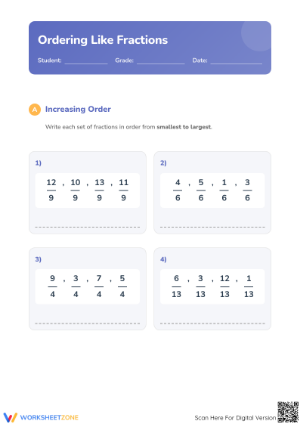
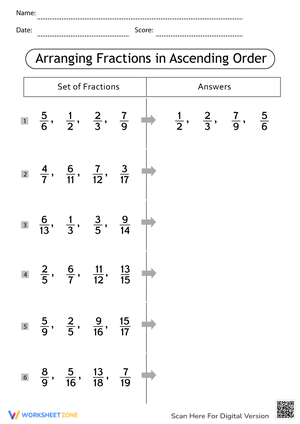
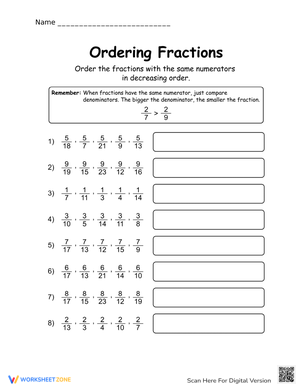
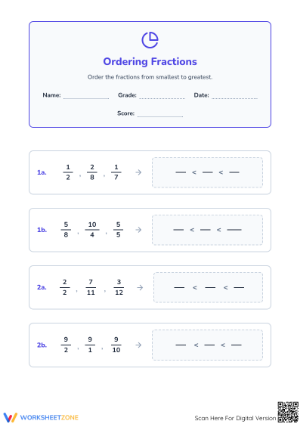
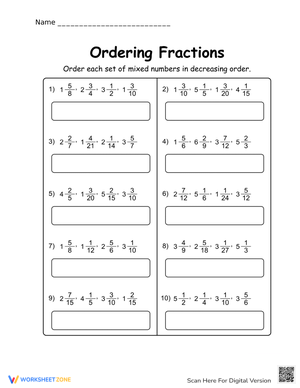
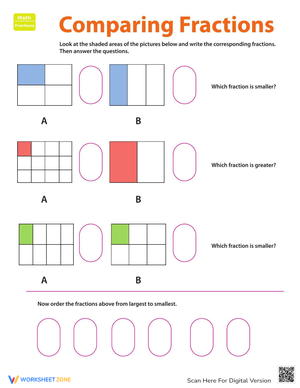
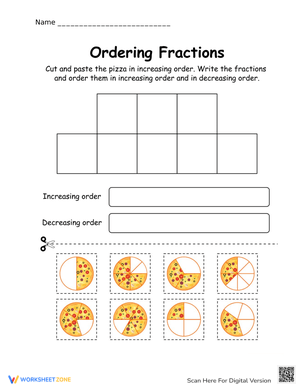
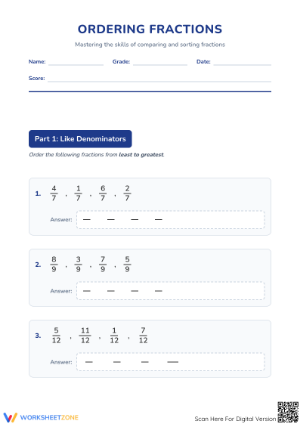
These 4th grade fractions ordering worksheets give teachers ready-to-print practice that moves students from visual models to symbolic reasoning without front-loading an entire unit before anything gets written down. The set zeroes in on the moment when Grade 4 students stop comparing same-denominator fractions and start handling sets with unlike denominators — a conceptual shift that reliably produces confusion even in students who felt confident a week earlier. Each worksheet holds cognitive load low by isolating one ordering strategy at a time, then combining strategies in the mixed-review worksheets that close out the set.
What Each Worksheet Asks Students to Do
The skills targeted here track closely with what the fourth-grade fraction progression actually demands: not reading fractions or computing with them, but making size judgments and placing several fractions in sequence. That task asks students to hold multiple values in mind simultaneously and apply a consistent strategy across each item — which is harder than it looks in September.
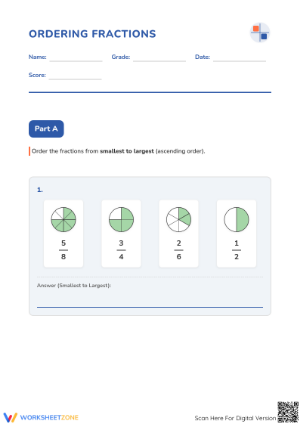
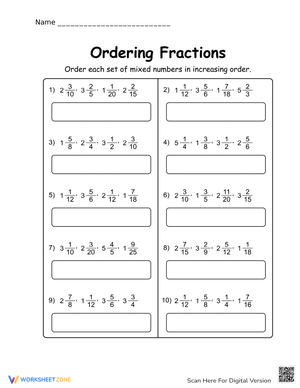
- Ordering three or more fractions from least to greatest and from greatest to least
- Comparing two fractions as a step toward arranging a full set in order
- Using benchmark fractions — particularly one-half and one whole — to anchor reasoning before calculating
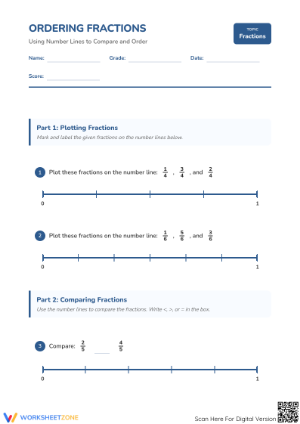
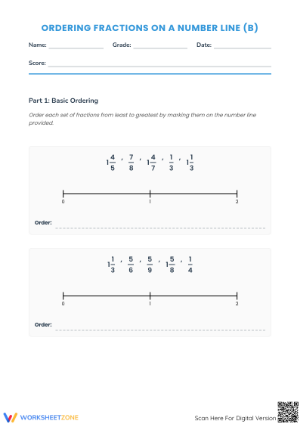
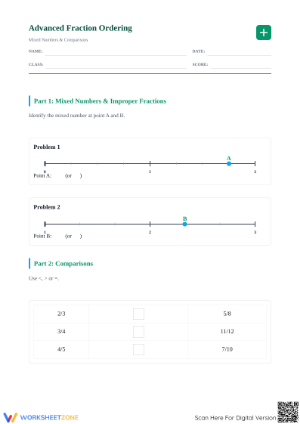
- Placing fractions on number lines and reading those positions to determine sequence
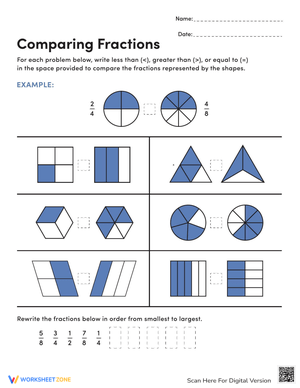
- Interpreting area models and fraction bars before transitioning to purely numeric notation
- Writing comparison statements using the words less than, greater than, and equal to
- Identifying a fraction that fits between two given values, a task that reveals genuine size understanding rather than procedural matching
The set progresses from worksheets where visual models accompany every problem to worksheets where students work numerically and select their own strategy. That arc gives teachers a natural sequence: introduce the visual, practice with support, then remove the support as understanding solidifies.
Student Errors Worth Knowing Before You Assign Practice
The most reliable error in fourth-grade fraction ordering is denominator confusion. Students who can read 3/8 correctly as "three-eighths" will still rank it above 3/4 because eight looks larger than four. They treat the denominator as a whole-number count rather than a description of slice size. On these worksheets that mistake shows up in writing immediately — if a student orders 1/8, 1/4, and 1/2 from greatest to least and puts 1/8 first, the error is visible and easy to address in a follow-up conversation before it hardens into habit.
A second pattern worth watching is procedural over-reliance. Once students learn to find common denominators, some apply that method to every item, including straightforward benchmark comparisons. A student who converts 1/2 and 7/8 to common denominators before ordering them is doing unnecessary work, and that signals rote application over genuine understanding. The explanation prompts built into several worksheets in this set help surface exactly that issue — students who write "I changed both fractions to eighths" on a problem that could have been solved with a number line are telling you something worth knowing before the unit assessment arrives.
Lesson-Planning Moves That Get the Most From This Set
These worksheets earn the most when they arrive on day two or three of a lesson sequence, not day one. The first session belongs to physical fraction strips and a projected number line — the concrete anchors students need before written practice makes conceptual sense. By the second session, a worksheet that mirrors those same strategies gives students a bridge between hands-on work and the symbolic notation they will encounter on assessments.
For sub days and morning warm-ups, having 4th grade fractions ordering worksheets already sorted and filed by strategy — benchmarks, common denominators, number-line placement — means fraction practice continues without any technology dependency or explanation of new material. A substitute can hand out the right worksheet because each one stands alone with clear directions and an answer key.
The last four or five items on any ordering worksheet in this set work well as a stand-alone exit ticket. Cover the upper portion, hand out just that section in the final eight minutes of class, and you have same-day data on which students still depend on visual models and which ones are ready to work with unlike denominators without them. That data shapes the next day's small-group decisions without adding planning time.
Standard Alignment
This set addresses CCSS 4.NF.A.2, which requires students to compare two fractions with different numerators and different denominators by reasoning about their size, and to record those comparisons using symbols and visual fraction models. The standard sits within the Grade 4 Number and Operations — Fractions domain and follows directly from 4.NF.A.1 (equivalent fractions), which is precisely why ordering with unlike denominators is a Grade 4 expectation rather than a Grade 3 one. Students need to understand that multiplying numerator and denominator by the same value preserves size — and that understanding is what makes the common-denominator strategy meaningful rather than mechanical.
Assessment items aligned to 4.NF.A.2 typically ask students to order three or four fractions, write a comparison using symbols, or explain why one fraction must come before another. The worksheets in this set reflect that format directly, so students practice the skill in the same form they will encounter it on grade-level assessments.
Adjusting the Set for a Range of Learners
Fraction understanding in fourth grade spans a wide range, and using 4th grade fractions ordering worksheets across that range works best when teachers sort the tasks deliberately rather than assigning the same worksheet to every student and hoping they self-differentiate.
Students who need additional support do best with worksheets that pair every fraction with an area model or number line. Keeping the denominator consistent within a single worksheet — all eighths, for example — helps students see the relationship between numerator size and position before both numbers begin to change simultaneously. Moving these students to unlike denominators before that grounding is solid tends to produce the denominator-confusion error described above, now compounded by a second layer of difficulty.
On-level students benefit from worksheets that mix strategies across items. Some problems in the set reward benchmark thinking, others call for common denominators, and a few push students toward number-line reasoning. That variation prevents the kind of procedural lock-in where students apply one method regardless of whether it fits the problem at hand.
For students who move quickly through the standard tasks, the missing-value worksheets offer a genuine extension. Asking a student to name two fractions that fit between 1/3 and 2/3, then order all four, requires understanding that fractions are dense — that infinitely many values exist between any two points on a number line. That is a real conceptual stretch within the Grade 4 domain, not simply harder arithmetic.
Frequently Asked Questions
What do students need to know before working on fraction ordering?
Students should be able to read and write basic fractions, recognize that a fraction describes part of a whole, and use visual models — fraction bars or number lines — with some confidence. Familiarity with equivalent fractions (4.NF.A.1) makes the ordering work more meaningful, because students understand why finding a common denominator preserves value rather than changing what the fraction represents.
Do these worksheets include visual models or only numeric problems?
A well-structured set of 4th grade fractions ordering worksheets includes both. Early worksheets pair each problem with a fraction bar or number line so students can connect symbolic notation to actual size. Later worksheets present fractions numerically, which is the format students encounter on most grade-level assessments. That progression gives teachers control over when to pull the visual support and when to hold it in place a bit longer.
How long does a typical ordering worksheet take during class?
Most students finish a focused ordering worksheet in ten to fifteen minutes during independent practice. Worksheets with written explanation prompts or missing-value tasks tend to run closer to twenty minutes, because students who engage carefully spend real time writing their reasoning — which is exactly the point of including those prompts in the first place.
How is ordering fractions different from comparing fractions?
Comparing asks students to decide which of two fractions is greater than, less than, or equal to the other. Ordering means placing three or more fractions in sequence, from least to greatest or greatest to least. In practice, ordering requires repeated comparison — students compare pairs to establish relative position, then arrange the full set. Both skills fall under 4.NF.A.2, and most ordering worksheets build comparison items directly into the sequencing tasks rather than treating them as separate exercises.