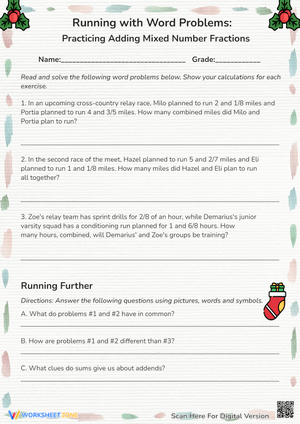
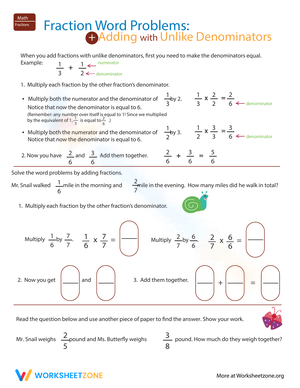
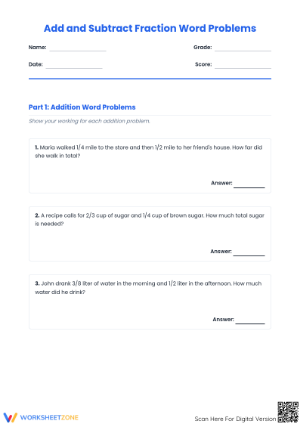
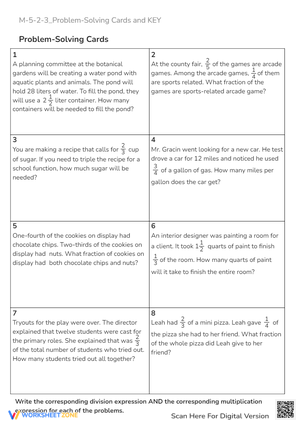
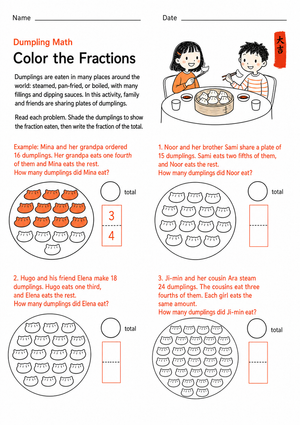
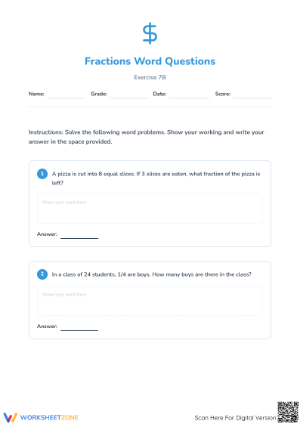
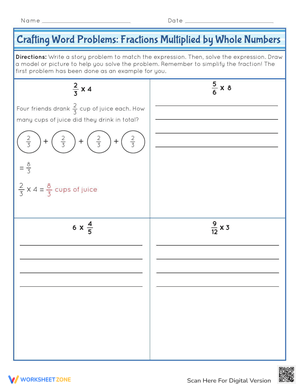
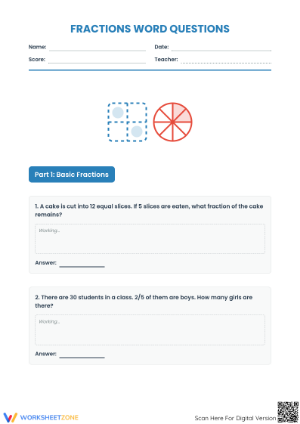
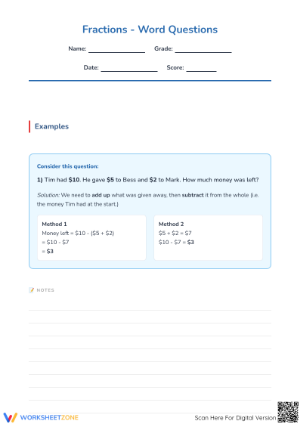
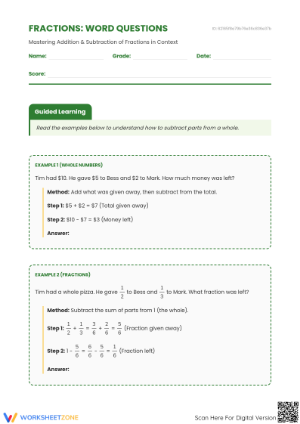
4th grade fraction word problems printable worksheets give students the contextual practice that makes fraction operations stick beyond the computation drill — students have to read a situation, decide what math it calls for, and execute it. Each worksheet in the set targets either addition and subtraction of fractions with like denominators or multiplication of a fraction by a whole number, the two operational clusters that define Grade 4 fraction instruction. Teachers get ready-to-use practice that fits as a warm-up, a focused small-group block, or a homework send-home without any assembly required.
The Specific Skills Targeted
Most of the breakdown in student work happens not at the arithmetic step but at the translation step — converting a sentence about runners, recipes, or measuring tape into a correct equation. Every problem in the set asks students to underline what is being asked, identify the action the problem describes, and sketch a visual model before writing any numbers. That sequence is the instructional point, not just a procedural suggestion.
Specific practice across the worksheets includes:
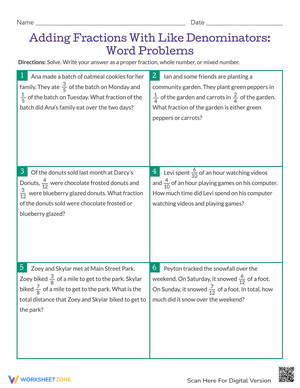
- Adding fractions with like denominators in measurement and food contexts — combined distances, total liquid volumes, shared portions
- Subtracting a fraction from a whole or from another fraction to find a remaining amount
- Multiplying a fraction by a whole number, interpreted first as repeated addition before writing the multiplication sentence
- Drawing a number line, tape diagram, or area model as a required step before solving
- Writing the final answer with the correct unit — a step students skip more consistently than teachers expect
Standard Alignment
Two CCSS Grade 4 standards drive the problem selection. CCSS.MATH.CONTENT.4.NF.B.3.D covers word problems involving addition and subtraction of fractions that refer to the same whole and have like denominators — the standard behind problems about combined distances, remaining liquid, and shared portions. CCSS.MATH.CONTENT.4.NF.B.4.C covers multiplication of a fraction by a whole number through word problems, which is where repeated-addition contexts like multi-batch recipes and equal-group scenarios appear. Both standards are assessed on most state tests aligned to the Common Core framework, making consistent word-problem practice here carry direct pre-assessment value.
Frequent Errors Worth Watching For
The most reliable error is adding the denominators. A student who answers 2/5 + 1/5 = 3/5 correctly on a computation worksheet will write 3/10 when those same numbers appear inside a paragraph. The extra reading creates enough cognitive load that students revert to the half-remembered rule: add the tops, add the bottoms. What makes word problem contexts useful is that the wrong answer becomes obviously unreasonable — a student who calculates that two runners combined covered 3/10 of a mile when each individual ran more than that can, with some prompting, recognize something went wrong.
The second consistent pattern is operation confusion. "Each of the four friends brought 2/3 of a pound of grapes" and "one friend brought 1/3 and another brought 2/3" look nearly identical on the page, but the first calls for multiplication and the second for addition. Fourth graders frequently apply the same operation to both because the surface features — fractions, friends, food — read the same. Students also drop units from final answers so reliably that treating unit omission as an actual error, rather than a minor clerical oversight, is worth enforcing early; it saves significant reteaching in fifth grade.
How to Work These Worksheets Into Your Lesson Block
The most effective placement is right after direct instruction, as students move from guided practice toward working independently. Model the think-aloud process for one problem — read twice, underline what is being asked, draw the model, then write the equation — before students work on their own. That release moment is where students most need a clear procedure, and the visual model requirement built into each worksheet enforces that step without the teacher needing to repeat the instruction.
For small-group intervention, taking a problem from the 4th grade fraction word problems printable worksheets and working through it as a group discussion — pausing after the drawing step before anyone writes an equation — is more productive in a 10-minute rotation than assigning the full worksheet independently. Completed work functions as formative data: a student who draws the correct tape diagram but writes the wrong equation has a notation problem, not a conceptual one, and the follow-up looks different for each case.
Adjusting the Set for a Range of Learners
Students who have not yet consolidated like-denominator addition should work with 4th grade fraction word problems printable worksheets that restrict problems to straightforward combining and separating with identical denominators — no simplification required in the final answer. Providing printed fraction strips alongside those worksheets gives students a concrete reference without slowing down peers who are ready to work abstractly.
For students who move quickly through the standard problems, the natural extension is introducing problems where the answer is an improper fraction that needs to be expressed as a mixed number. This does not require a separate worksheet — it means adding the conversion step to the work-shown requirement for those students. Students in the middle of the readiness range benefit most from the visual model requirement being enforced strictly: drawing before computing is the support structure, and the teacher does not need to modify the worksheet itself to make it work.
Frequently Asked Questions
How do I help students decide whether a word problem calls for addition or multiplication?
Have students ask one question before choosing an operation: is the same fractional amount appearing multiple times, or are different fractional amounts being combined? If the same fraction appears repeatedly — each box holds 3/4 of a pound and there are five boxes — the problem calls for multiplication. If different fractions are being combined — one container holds 1/4 and another holds 3/4 — that is addition. Keyword charts help some students get started, but teaching the underlying question is more transferable. Students who understand the conceptual distinction apply it to unfamiliar problems; students who rely only on keywords often get caught when the trigger words do not appear.
What visual models work best when students get stuck?
Number lines are strongest for problems involving distance, elapsed time, or sequential amounts — students can see the jumps and count them. Tape diagrams handle multiplication contexts better, making it clear how many equal fractional groups make up the total. When students approach the 4th grade fraction word problems printable worksheets without the habit of drawing first, requiring the model before they write the equation works better than suggesting it as an optional step. Students who draw consistently make fewer operation-selection errors than those who go straight to computation, and the difference shows up quickly in completed work.
My students are still shaky on equivalent fractions. Should they use these worksheets?
Yes — select problems that use like denominators throughout and do not require simplifying the final answer. Combining two unresolved skills in one problem, such as adding fractions and then renaming the result as a simpler fraction, tends to produce confusion more than learning. Once a student reliably adds and subtracts with like denominators in context, problems that involve basic equivalence can be introduced one at a time, with fraction tiles available for reference. The word-problem format stays valuable at this stage because it keeps practice grounded in meaning rather than pure symbol manipulation.