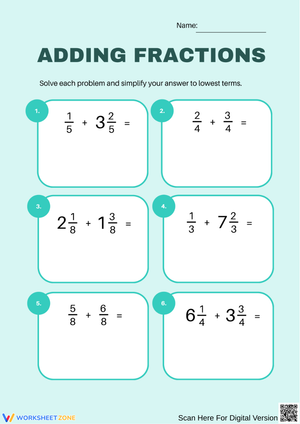
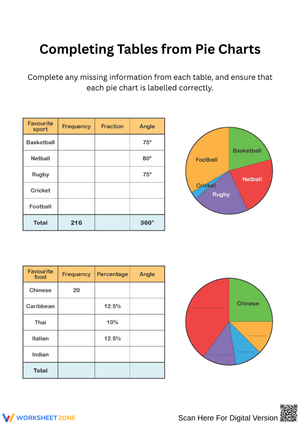
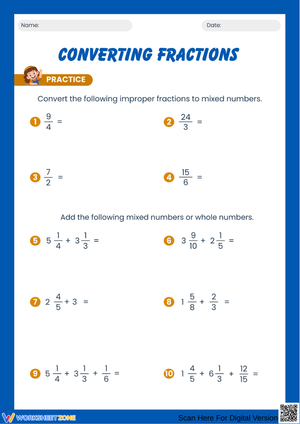
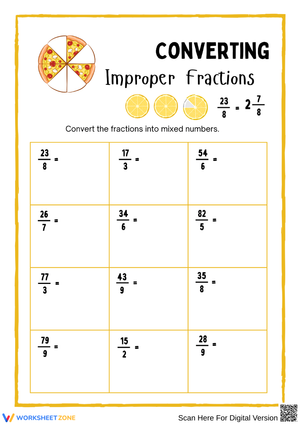
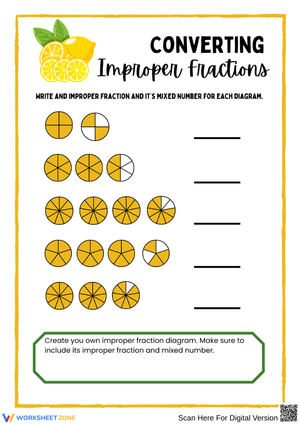
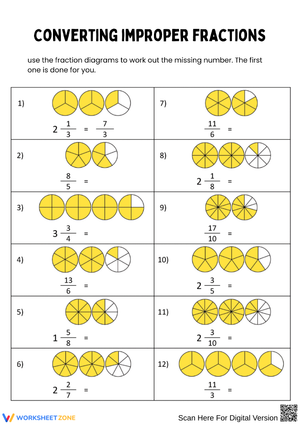
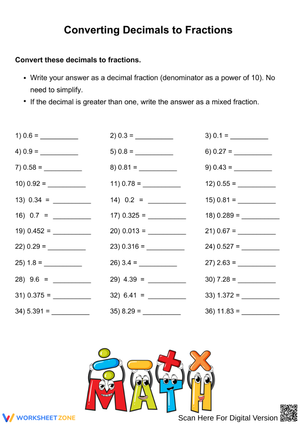
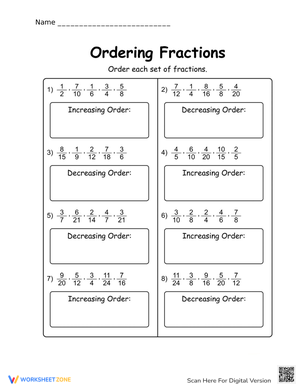
4th grade fraction printable worksheets give teachers targeted practice materials for the stretch of the curriculum where fractions stop being about recognition and start demanding real reasoning about size, equivalence, and operation. In fourth grade, students are expected to generate equivalent fractions, compare fractions with unlike denominators, add and subtract fractions with like denominators, and multiply a fraction by a whole number — a cluster of skills where gaps compound quickly if the conceptual foundation isn't secure. This set addresses all four areas using visual models, number lines, and word problems.
Skills Across the Set
The four skill areas map roughly onto the sequence most teachers follow across a fractions unit:
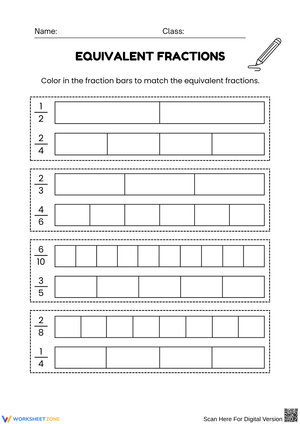
- Equivalent fractions: Students multiply numerator and denominator by the same factor, then use shaded area models and number lines to confirm the value hasn't changed — pairing the procedure with the visual on every worksheet so the concept and the algorithm build together.
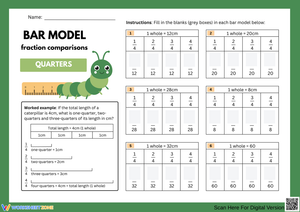
- Fraction comparison: Exercises move from visual comparison to benchmark reasoning (anchoring to one-half and one whole) to fully numerical comparison with unlike denominators. Word problems ask students to compare ingredient amounts, distances, and time intervals.
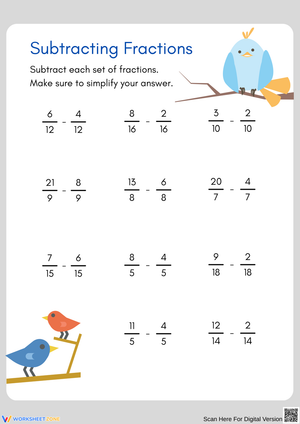
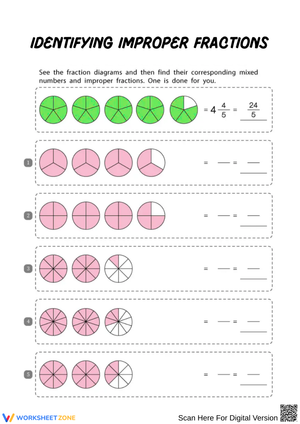
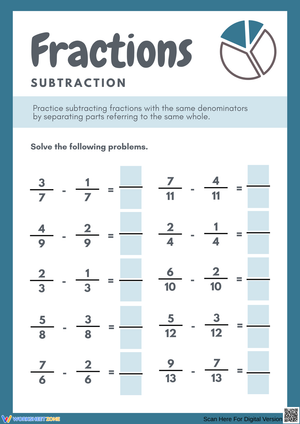
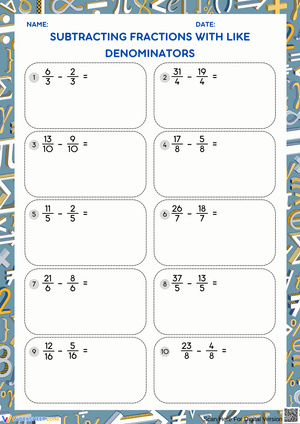
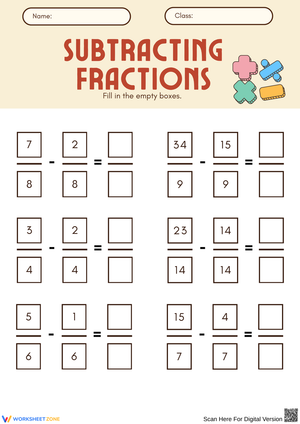
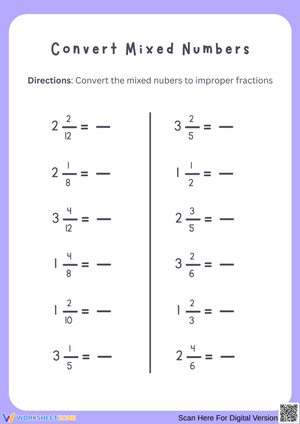
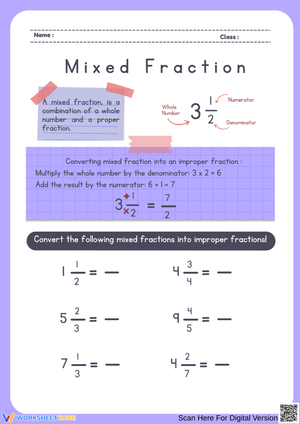
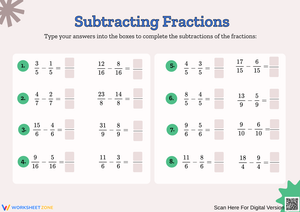
- Addition and subtraction with like denominators: Begins with decomposition — breaking five-sixths into five separate one-sixths — before moving to standard equations and mixed-number problems. Decomposition prevents the most common addition error and makes the transition to mixed numbers considerably smoother.
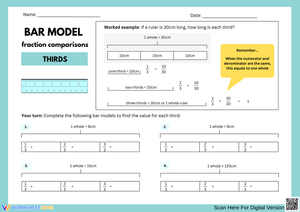
- Multiplying a fraction by a whole number: Tape diagrams and number lines connect the operation to repeated addition before students work with purely numerical equations. Students see why four times two-thirds produces eight-thirds, not eight-sixths.
Common Misconceptions to Watch For and Correct
Equivalence generates one error that extra procedural practice doesn't fix on its own. Students who can correctly generate equivalent fractions numerically still place one-half and two-fourths at different points on a number line because they're counting tick marks rather than reading position. That's not a computation mistake — it's a conceptual one, and it surfaces most clearly when students work on a number line they've drawn themselves rather than one printed for them.
In comparison, the most durable misconception is that a larger denominator signals a larger fraction. Students who have practiced correctly for weeks will still write that one-eighth is greater than one-half when the problem is worded differently from the practice set. Benchmark reasoning corrects this more reliably than more algorithm practice: once a student habitually asks "is this fraction above or below one-half?" before comparing, the denominator-size confusion mostly disappears.
For addition, the error nearly every fourth-grade teacher has circled on a worksheet is adding the denominators — one-third plus one-third becoming two-sixths. Decomposition practice addresses this at the root: students who have built three-fourths out of three individual one-fourths don't arrive at three-eighths when they add them back together. In the multiplication section, a parallel error emerges when students multiply both the numerator and denominator by the whole number. Tape diagrams showing five groups of two-thirds make the correct operation — ten-thirds, not ten-fifteenths — visually obvious.
Fitting These Worksheets Into the Week
These work best as the "you do" phase of a lesson, deployed after whole-group instruction and a few guided problems. For fraction equivalence specifically, opening with two or three problems as a warm-up before instruction gives a quick read on where students are before the teaching begins — a more efficient formative snapshot than waiting until the end of the lesson to find out who was lost from the start.
Small-group use is where 4th grade fraction printable worksheets do some of their most targeted work. When a group stalls on benchmark comparison — able to apply the procedure but unable to articulate why one-half is a useful reference point — a worksheet with a dedicated number-line model brings the visual back without requiring the teacher to redraw it. The printable format makes it easy to hand three students the area-model worksheet while the rest of the class works on the number-line version: same concept, different entry point, no extra prep time.
Friday retrieval practice is another natural fit. Running a single worksheet on a concept introduced earlier in the week — not as a grade, just as spaced retrieval — produces measurably better retention than reteaching the following Monday. Five to eight minutes at the end of a Friday block earns those results without cutting into new instruction time.
Standard Alignment
The set addresses four standards within the Number and Operations — Fractions domain of the Common Core State Standards for Mathematics. CCSS 4.NF.A.1 targets recognizing and generating equivalent fractions using visual models. CCSS 4.NF.A.2 addresses comparing fractions with unlike numerators and denominators by reasoning about their size. CCSS 4.NF.B.3 covers addition and subtraction of fractions as joining and separating parts of the same whole, including decomposition into unit fractions and work with mixed numbers. CCSS 4.NF.B.4 covers multiplication of a fraction by a whole number with both visual and numerical representations expected. In terms of instructional timing, 4.NF.A.1 and 4.NF.A.2 generally land in the first half of the year, with 4.NF.B.3 and 4.NF.B.4 following once equivalence is secure. Teachers in states with adapted standards will find direct parallels in most state frameworks under equivalent domain headings.
Differentiating Across Ability Levels
Students who enter fourth grade with shaky fraction foundations — who can name a fraction but aren't reliably placing one-half on a number line — need the visual-model content before any procedural work. Within the 4th grade fraction printable worksheets, the area-model and number-line exercises in the equivalence section serve as a re-entry point for these students. Working through the first two problems together before releasing to independent practice makes the difference between students who complete the worksheet correctly and students who complete it incorrectly with full confidence.
For students who move through equivalence and comparison quickly, the word problems in the addition and multiplication sections provide the real challenge. These problems ask students to translate a context into an equation, decide whether the operation involves like or unlike denominators, and interpret the answer — three steps that are easy to rush through without real understanding. Requiring these students to write a sentence explaining their reasoning before moving on slows the work down productively. That expectation doesn't need to appear on the worksheet itself; it's a verbal instruction the teacher gives to a specific group.
Frequently Asked Questions
Do these worksheets cover fractions and decimals together?
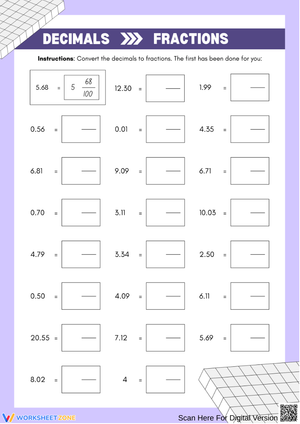
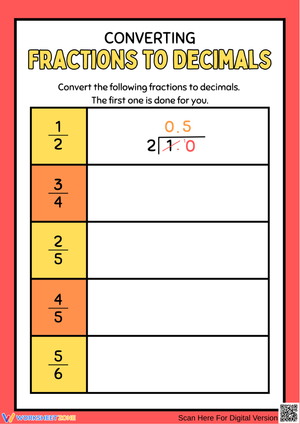
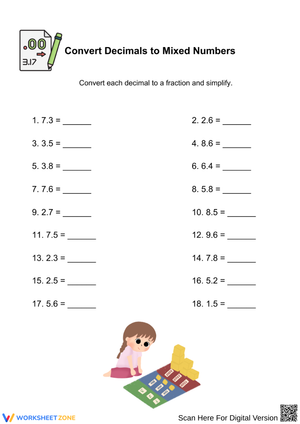
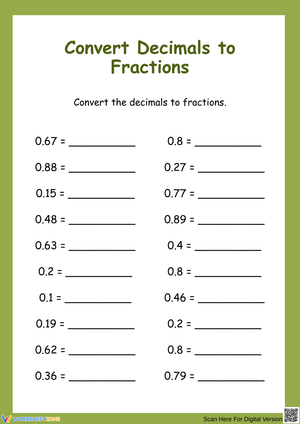
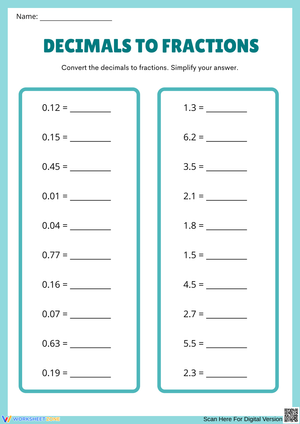
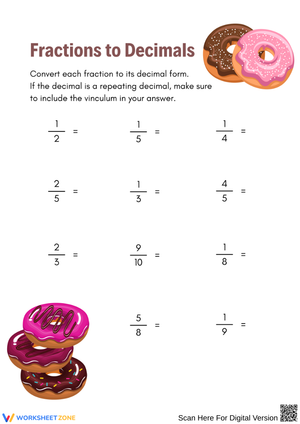
The set focuses on the four fraction skill areas above. The decimal connection — expressing tenths and hundredths in decimal notation, using hundredths grids to show equivalence — is addressed in a separate resource aligned to CCSS 4.NF.C.5 through 4.NF.C.7. Some teachers introduce the relationship informally while using these worksheets, noting that one-fourth can also be written as 0.25, but that connection is not built into the worksheet tasks themselves.
How much prior knowledge do students need before starting?
Students should be able to identify a fraction as a part of a whole, name the numerator and denominator, and represent unit fractions on a number line — all Grade 3 expectations. The equivalence worksheets pick up directly from that foundation. If students can't yet reliably place one-half on a number line, spending one or two lessons on that before introducing the comparison or addition materials will save time overall.
Are answer keys included?
Yes. Every worksheet in the set includes a corresponding answer key. The keys for the comparison and benchmark-reasoning exercises include brief explanations alongside the correct answers, because the reasoning matters as much as the result at this level. Teachers who use 4th grade fraction printable worksheets as formative checks can use those explanations as a starting point for a short class discussion when the same error surfaces across several students' work.