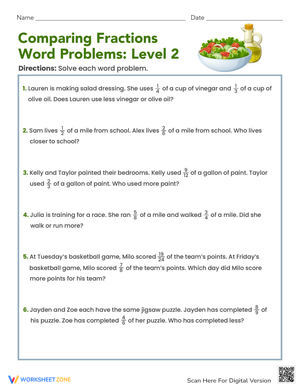
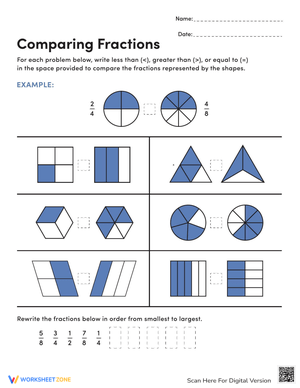
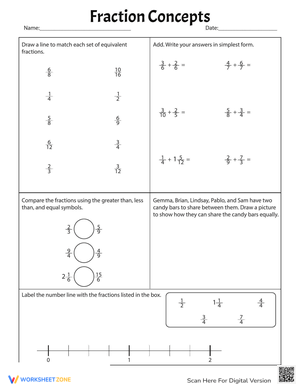
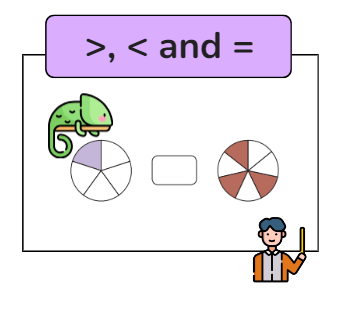
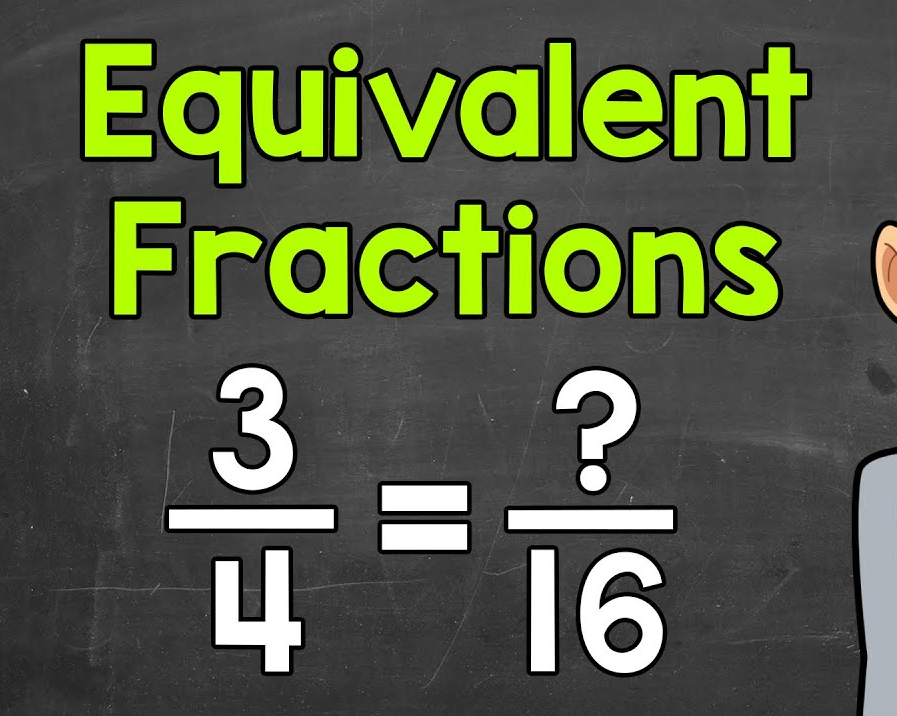
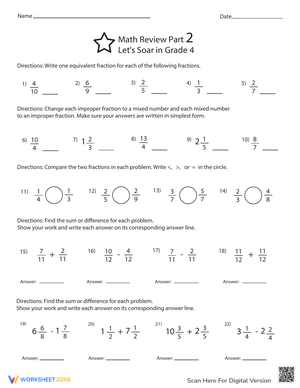
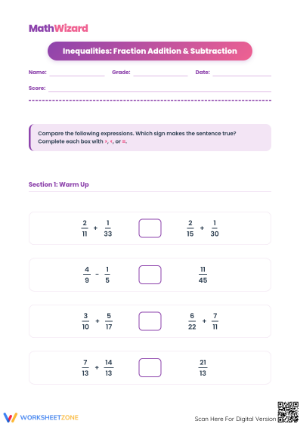
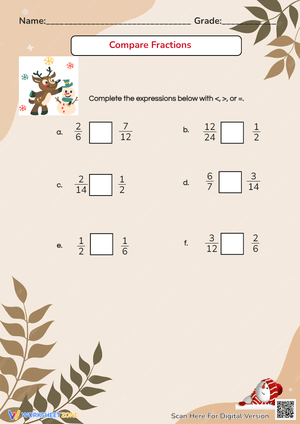
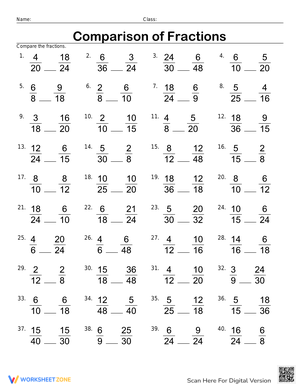
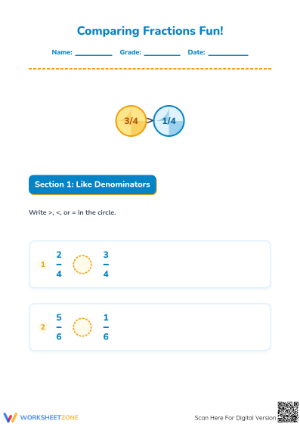
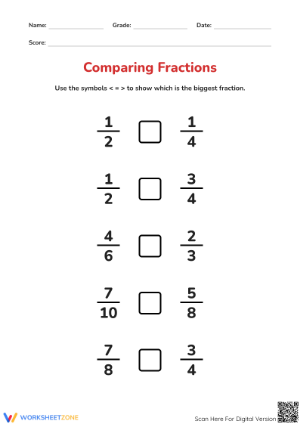
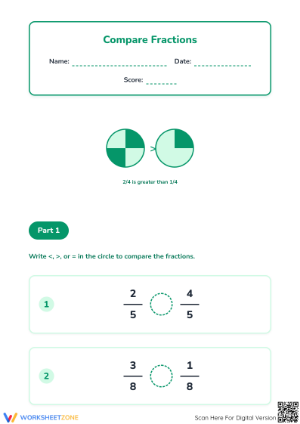
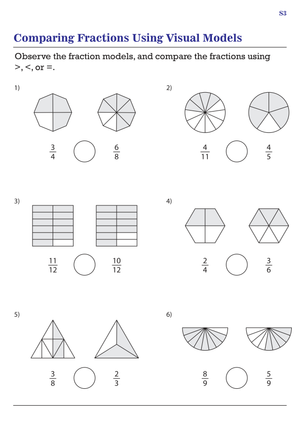
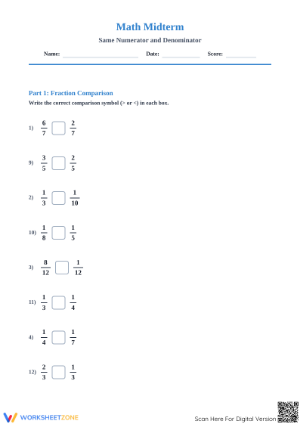
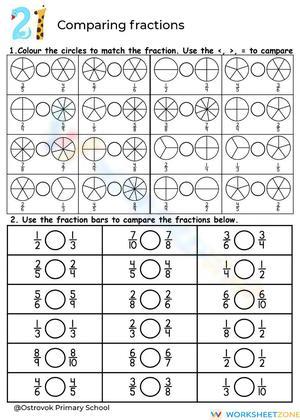
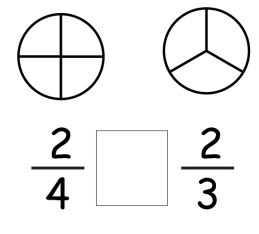
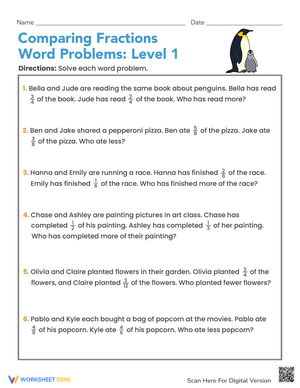
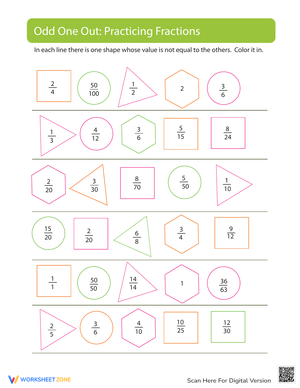
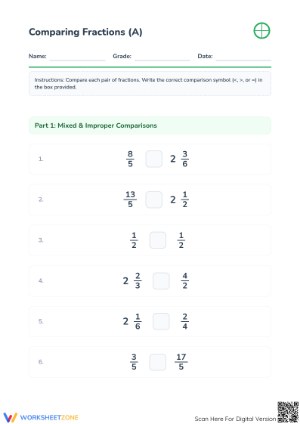
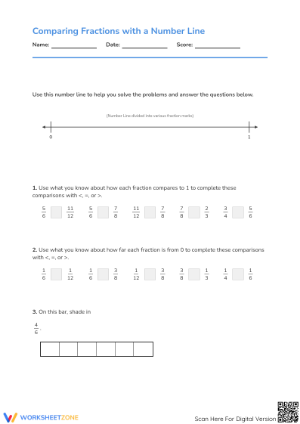
These comparing fractions worksheets for 4th grade address the exact moment in the curriculum where procedural shortcuts start to override conceptual understanding — the point where teachers discover that a student who could shade a fraction model in third grade has no idea what to do when two fractions have neither the same numerator nor the same denominator. The set works through three distinct comparison strategies and includes both visual and symbolic formats, so teachers can assign by readiness as the unit progresses.
The Specific Skills Covered Across the Set
Each worksheet targets a defined skill rather than mixing approaches randomly. The skills across the full set include:
- Comparing fractions using benchmark fractions — primarily 1/2 and 1 whole — as mental reference points
- Comparing fractions that share the same numerator by reasoning about what the denominator tells you about piece size
- Generating equivalent fractions to reach a common denominator before comparing
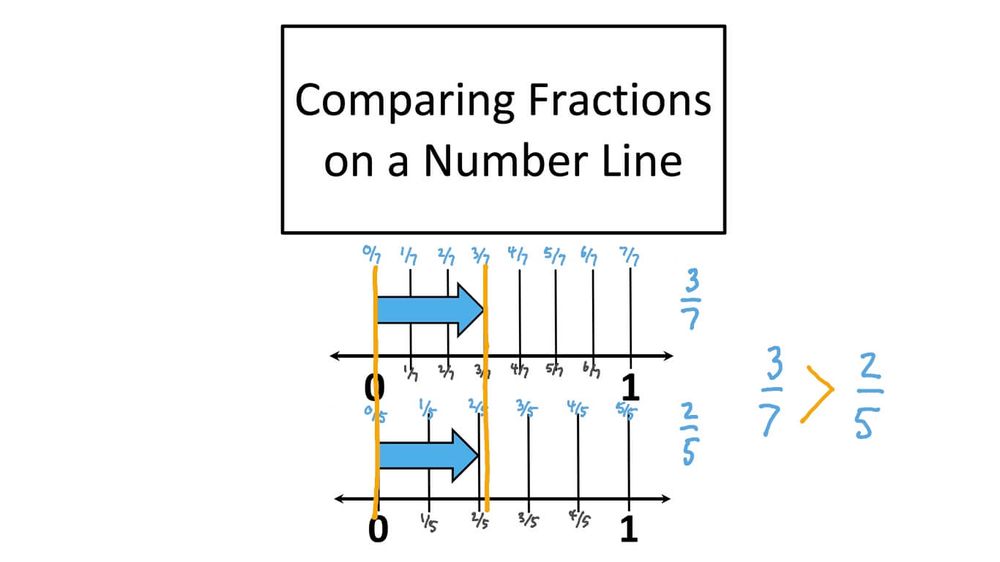
- Plotting fractions on a number line and identifying which fraction is farther from zero
- Applying comparison reasoning inside word problems involving measurement and recipe contexts
The word problem worksheets deserve a separate note. Students who correctly compare 3/4 and 5/8 in symbolic form often stumble when the same comparison is buried inside a sentence about measuring liquid or cutting rope. The language demands shift the cognitive task, and several worksheets in the set deal specifically with that translation from abstract symbols to real-world context.
The Three Comparison Strategies Students Work Through
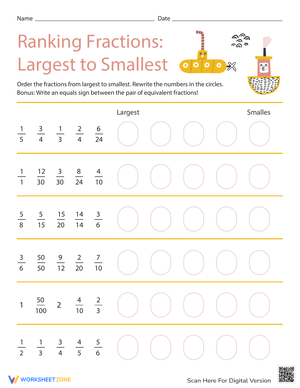
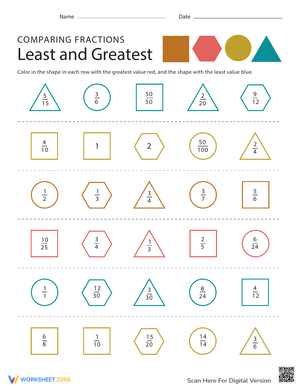
Benchmark reasoning tends to be the fastest strategy and the one that builds the most transferable number sense. When comparing 3/8 and 5/6, a student who knows that 4/8 equals 1/2 can immediately see that 3/8 falls below that midpoint while 5/6 sits well above it — so 5/6 is greater than 3/8 without any calculation. The worksheets build this habit with repeated exposure to fractions that land clearly on one side of 1/2 before introducing pairs where the benchmark comparison is less obvious.
The same-numerator strategy receives less instructional time in most fourth-grade classrooms than it deserves. When two fractions share a numerator, the one with the smaller denominator is larger — fewer, bigger pieces are being counted. Comparing 2/3 and 2/5 this way takes seconds once students internalize the logic, but most fourth graders need several focused exposures before that intuition becomes automatic. Several worksheets isolate this comparison type specifically so the pattern has room to register before students encounter mixed problem types.
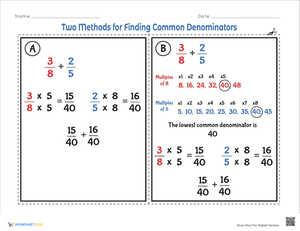
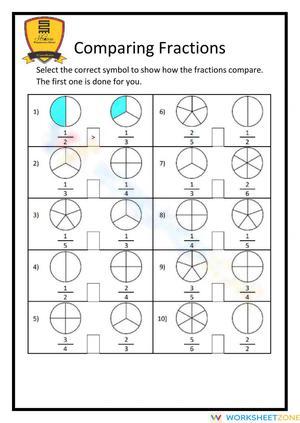
Finding a common denominator is the fallback when neither benchmark logic nor same-numerator reasoning applies cleanly. These comparing fractions worksheets for 4th grade walk students through the multiplication step explicitly — multiply both the numerator and denominator by the same factor — so the procedure stays anchored to its meaning rather than becoming a rule students execute without understanding why it works.
Frequent Student Errors Worth Watching For and Correcting
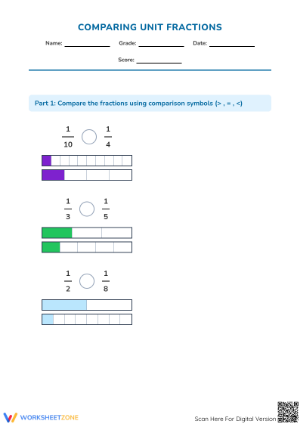
The most durable misconception in this unit is what researchers sometimes call the whole-number bias. Students who have correctly learned that larger numbers mean larger quantities in whole-number work apply that same logic to denominators. A student who writes "1/8 is greater than 1/4 because 8 is greater than 4" is not confused about fractions in isolation — they are over-applying a previously reliable rule. The fix is not more symbolic practice but more time with area models showing that dividing a rectangle into 8 equal parts produces thinner slices than dividing the same rectangle into 4.
A second pattern that appears consistently in actual student work: students treat numerator and denominator as two separate whole-number comparisons. Shown 3/5 versus 4/7, they note that 4 is greater than 3 and 7 is greater than 5, then conclude the fractions must be "equal" because both numbers in one fraction are smaller. This error surfaces most reliably with fractions that are genuinely close in value, and it is easy to miss unless teachers require students to estimate placement on a number line before computing.
There is also the same-size-whole requirement. Students learn it, nod along, and then forget it the moment fractions appear in a word problem context. A student will compare 1/2 and 3/4 correctly on a symbolic worksheet, then conclude in a story problem that a half-serving from a large container is definitely smaller than a three-quarter serving from a tiny one. Worksheets that embed fractions in context — rather than presenting bare comparison problems — force students to notice whether the whole has actually been held constant.
Standard Alignment
CCSS.MATH.CONTENT.4.NF.A.2 requires students to compare two fractions with different numerators and different denominators by reasoning about their size, and it explicitly states that comparisons are valid only when both fractions refer to the same-size whole. This standard sits at the conceptual core of the 4th-grade Number and Operations — Fractions domain. It extends 3.NF.A.3, where students compare fractions sharing either a numerator or a denominator, and it lays the groundwork for 4.NF.B.3, where adding and subtracting fractions requires fluency with equivalent fractions developed here. In classroom terms, these worksheets belong after students can generate equivalent fractions but before fraction addition instruction begins — that sequencing matches the standard's instructional intent and avoids asking students to use equivalent fractions as a tool before they understand what the tool does.
How to Work These Worksheets Into Your Lesson Plans
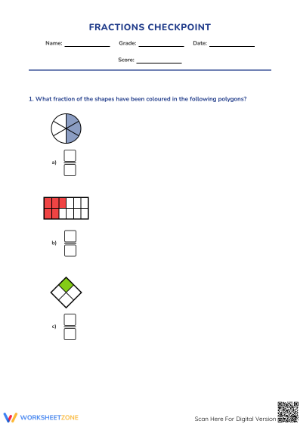
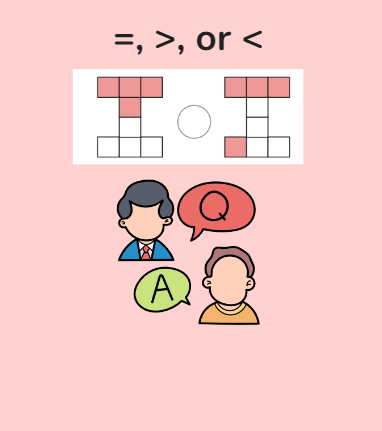
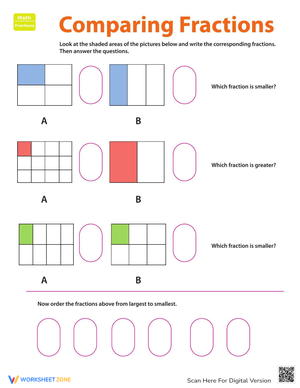
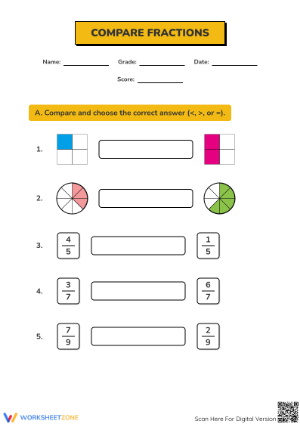
The area-model worksheets function well as whole-group introduction material early in the unit. Projected under a document camera, they let the class shade together and talk through disagreements in real time. That discussion — particularly when two students shade the same fractions differently and reach different conclusions — does more to build the concept than silent independent practice would. The shared reference experience also gives teachers language to return to later: "Remember when we saw that 3/4 covered more of the rectangle than 5/8?"
Once most students have the visual logic, the strategy-based worksheets fit naturally into a small-group rotation. Running three groups at once — one on benchmark comparisons, one on common denominators with fraction strips available, one on number line plotting — lets a teacher sit with the group that needs direct support while the others work independently. The word problem worksheets land best at the end of the unit as a transfer check, not as introductory material. Students who attempt them before they have a solid comparison strategy in place tend to guess rather than reason.
One activity that transfers well from these comparing fractions worksheets for 4th grade into a brief end-of-period game: pull six comparison problems onto index cards, have partners each draw a card, solve their problem, then determine whose resulting fraction is larger. Running this during the last eight minutes of class keeps students engaged with the skill past the point when most would mentally disengage from a standard written exercise.
Adjusting These Worksheets for a Range of Fourth-Grade Learners
Students who are still uncertain about what a fraction represents — not just what the symbols mean, but what three-fourths of a rectangle actually looks like physically — need the area-model worksheets before anything procedural. Sending these students to common-denominator exercises first produces answer-getting behavior: they follow steps without any sense of whether the result is reasonable.
For students who have the concept but are slow or inconsistent, the benchmark and same-numerator worksheets give them faster strategies that require no multi-step computation. These comparing fractions worksheets for 4th grade include enough of both comparison types that students can build fluency with the quicker approaches before returning to common denominators for cases that genuinely require them. The goal is that students select a strategy rather than defaulting to the most laborious one every time.
At the top of the class, the word problem worksheets can be extended by requiring a written justification — not just a comparison symbol, but a sentence explaining why one fraction is greater than another. That writing requirement is optional for the rest of the class but meaningful for students who need challenge that computational work alone won't provide. It also surfaces exactly the kind of reasoning 4.NF.A.2 is after.
Frequently Asked Questions
Do students need to find a common denominator for every comparison problem in the set?
No, and that is deliberate. Many problems are written so that benchmark reasoning or same-numerator logic is the cleaner, faster approach. Students who default to finding common denominators for every problem are not making errors — but they are missing the broader number sense the standard targets. Asking students to name the strategy they used, rather than just record a symbol, reveals whether they are thinking flexibly or executing a single memorized procedure.
Which visual model works best for students who are still concrete thinkers?
Area models using divided rectangles of equal size tend to work better than circles for side-by-side comparisons because rectangular partitions are easier to draw accurately and to read proportionally. Fraction strips provide similar information and have the advantage of being physical objects students can align and move. Number lines are the most abstract of the three and are more productive once students have already built the foundational concept through area work rather than as a starting point.
Does the same-size-whole requirement actually appear on assessments, or is it only a conceptual note?
It appears on state assessments and PARCC-style items as a context-embedded problem — typically a word problem in which two fractions reference different wholes, and students must identify whether the comparison is valid. Teachers who address it briefly during instruction and then move on consistently see students miss those items. It is worth treating as a testable concept rather than a disclaimer.













 Interactive Worksheet Maker
 Quiz Maker
 Word Search Maker
 Crossword Puzzle Maker
 Word Scramble Generator
 Sentence Scramble Generator
 Handwriting Worksheet Generator
 Name Tracing Generator
 Fill In The Blank Generator