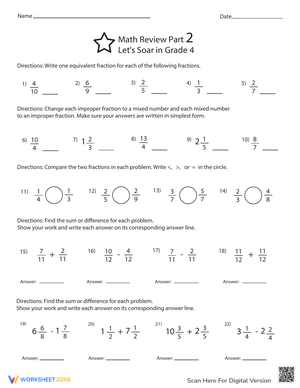
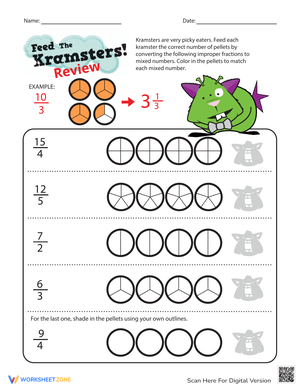
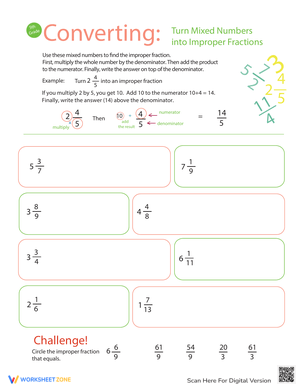
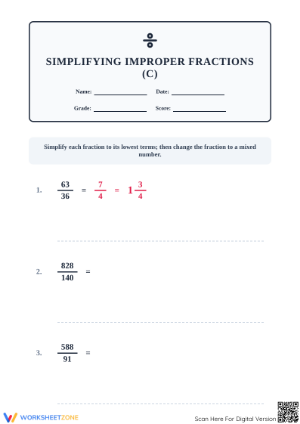
These 4th grade mixed numbers and improper fractions printable worksheets give teachers a targeted collection covering three distinct skill areas: visual fraction models, procedural conversion in both directions, and word problems set in measurement and cooking contexts. The set moves from counting shaded pieces across partitioned rectangles through to applied problems that require students to decide which form of a number fits the situation.
What's Inside the Set
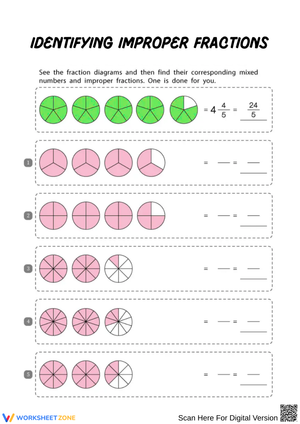
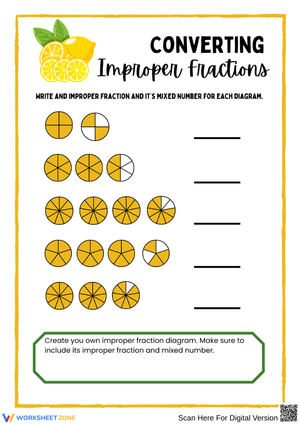
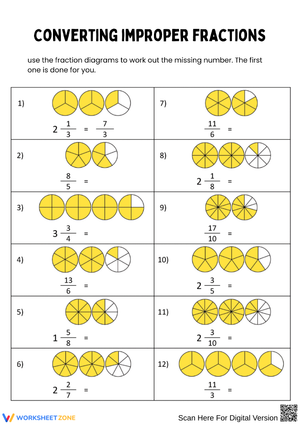
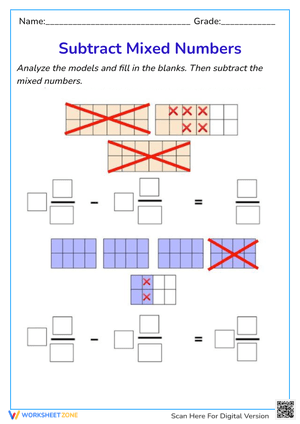
Visual model worksheets come first in the instructional sequence. Each presents shaded circles, area models, or number line diagrams and asks students to write both the improper fraction and the equivalent mixed number for the same picture. A worksheet might show three rectangles each divided into fifths — all five parts of the first two fully shaded, two parts of the third shaded — and students count 12 total fifths while also naming the picture as 2 and 2/5. That counting work is the conceptual core of conversion, and completing it visually first makes the later algorithm feel like a shortcut rather than an arbitrary rule to memorize.
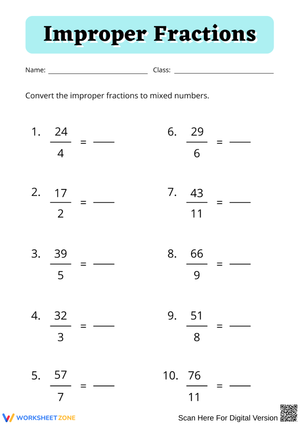
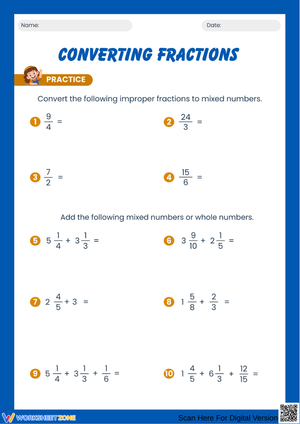
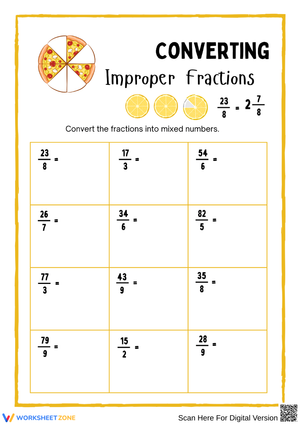
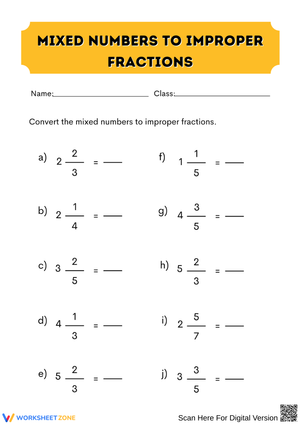
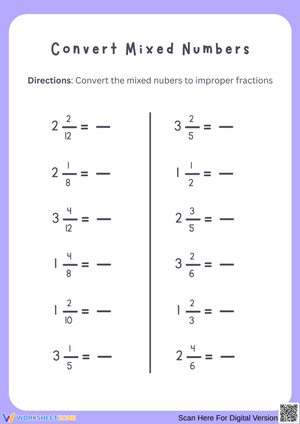
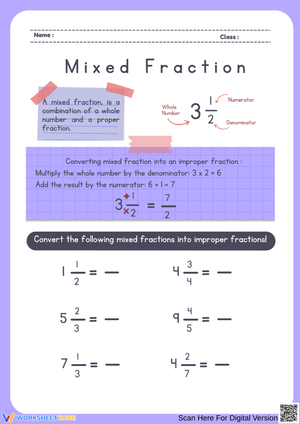
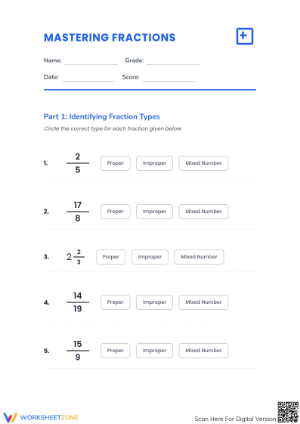
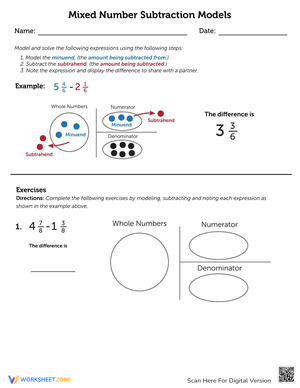
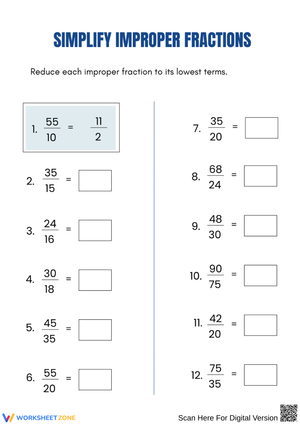
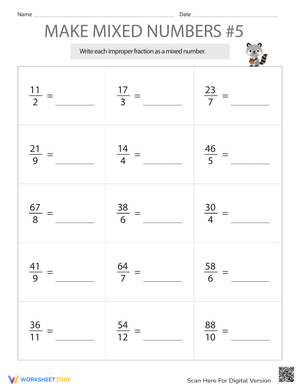
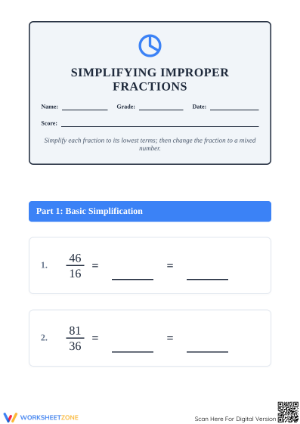
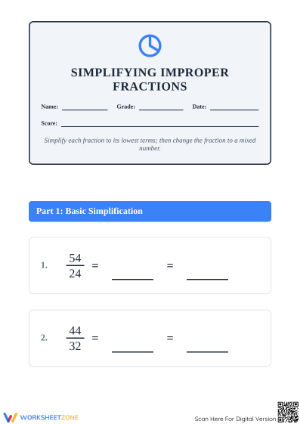
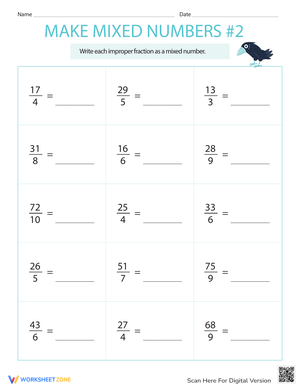
Procedural worksheets move students through both conversion directions with structured prompts that make each arithmetic step visible. For mixed-to-improper, the format separates the multiplication and addition into distinct labeled boxes — students write the product of the whole number and denominator in one space, then add the numerator before writing the final fraction. For improper-to-mixed, a division prompt keeps the quotient and remainder in separate labeled spaces. Word problem worksheets close the set with realistic contexts — ribbon lengths, recipe amounts, fruit divided among groups — and phrase each final answer line as "__ whole ___ and __ extra ___" so students must interpret the number, not just convert it.
Errors Students Make That These Worksheets Help You Catch
The most persistent error in mixed-to-improper conversion is skipping the addition after multiplying. A student converting 3 2/5 multiplies 3 × 5, gets 15, and writes 15/5 — never adding the 2. The answer doesn't look wrong because it's still a fraction over 5, and nothing in the surface form flags the missing step. Worksheets that require students to write 15 + 2 = 17 in a separate labeled box before completing the fraction make the omission visible in a way that a single answer line does not.
The most consistent error in the other direction is placing the remainder over the quotient. Converting 13/4, a student divides 13 ÷ 4 = 3 remainder 1 and writes 1/3 as the fractional part — treating the 3 whole groups as the denominator. Visual model worksheets address this directly: a student who has shaded 13 fourths across rectangle strips can see that the denominator must describe the size of each piece, not the count of full rectangles. Running a visual worksheet alongside a procedural one on the same conversion problem gives students a built-in self-check they can actually use independently.
A third pattern appears in word problem work: students compute correctly but leave the answer as an improper fraction when the context requires a mixed number. A student asked how many whole cups are in 9/4 cups writes 9/4 and considers the problem finished. Phrasing the final prompt as "__ whole cups and __ extra fourths" requires interpretation, not just conversion, and changes what counts as a complete answer.
Fitting These Worksheets Into a Fraction Unit
Each worksheet type fits a specific moment in the unit, and the sequence matters. Visual models belong before the algorithm; procedural worksheets come after the class has a shared visual reference; word problems close the unit when you need to see whether students can transfer the skill to unfamiliar contexts.
- Opening warm-ups: A visual model worksheet at the start of a math block — 5 minutes before direct instruction — surfaces what students already know about wholes and parts and gives you a quick read on where the class is before you teach anything.
- Guided practice: Project a procedural worksheet and solve the first two problems aloud, thinking through why the remainder goes over the original denominator, before releasing students to work independently.
- Exit tickets: Three conversion problems at the door tell you which students divided correctly but mishandled the remainder versus which are still mixing up the multiplication and addition steps — in about two minutes of checking.
- End-of-unit review: A word problem worksheet at the close of a unit reveals gaps that procedural practice misses, since students who have memorized steps without understanding often cannot apply them when a problem is embedded in a real context.
Standard Alignment
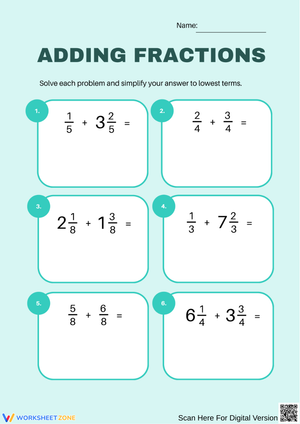
The worksheets target CCSS.MATH.CONTENT.4.NF.B.3, with the tightest fit to 4.NF.B.3c — the expectation that Grade 4 students add and subtract mixed numbers with like denominators by replacing each with an equivalent fraction. Fluent conversion between forms is the prerequisite for that operation: a student who cannot reliably convert 2 3/4 to 11/4 will stall whenever mixed number addition requires regrouping. The decomposition worksheets address 4.NF.B.3b directly — asking students to express 2 1/3 as 3/3 + 3/3 + 1/3 = 7/3 matches the standard's language about fractions as sums of unit fractions and requires an equation, not just a numerical answer. These 4th grade mixed numbers and improper fractions printable worksheets address both the conceptual understanding and the procedural fluency dimensions of 4.NF.B.3, not only the computation that appears on assessments.
Adjusting the Set Across Student Levels
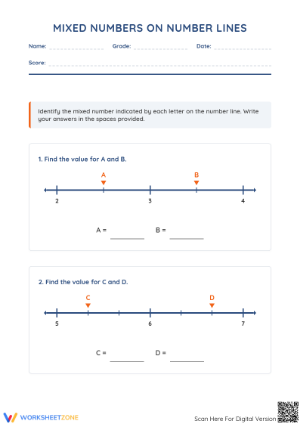
Students who struggle with the conversion procedure often need the visual model worksheets as a reset mid-unit, not just as an opening activity. Returning to shading rectangles and counting pieces after a procedural lesson gives the algorithm a referent it lacked. For students who freeze when facing a blank number line, start with pre-marked lines where they only need to place a single point — asking them to construct the scale and plot the value simultaneously is too much to hold at once, and the frustration that follows doesn't reflect what they actually understand about fractions.
Students who move quickly through procedural conversion are well served by the word problems and by prompts that require justification. Asking a fast student to verify their answer using both a drawing and the algorithm — "show two different ways to prove your answer is correct" — extends thinking without requiring separate material. The 4th grade mixed numbers and improper fractions printable worksheets that pair word problems with a "show your reasoning" line serve this purpose well: a student who writes 9/4 = 2 1/4 in three seconds still has to draw the area model and explain why the denominator stays the same across both forms.
For students with language-based supports in place, the visual model worksheets reduce reading demand while keeping the mathematical thinking intact. A student who cannot yet decode a measurement word problem can still demonstrate genuine understanding of the conversion by shading a model correctly and labeling it in both forms.
Frequently Asked Questions
When in the school year should this unit appear?
Most Grade 4 teachers introduce conversion between mixed numbers and improper fractions after students have practiced equivalent fractions and can identify unit fractions reliably. In a standard CCSS-aligned pacing calendar, that placement falls in the second quarter — roughly late fall through early winter. The skill connects fraction work from Grade 3 with the unlike-denominator addition students will encounter in Grade 5.
Do the worksheets come with answer keys?
Yes. Each worksheet includes a complete answer key. For visual model worksheets, the key shows one correct shading arrangement; on open number line activities, where alternate placements are mathematically valid, the key notes that acceptable variation exists rather than marking a single answer correct.
How long does each worksheet take most students to complete?
Visual model worksheets run 8 to 12 minutes for on-grade students. Procedural conversion worksheets with 12 to 16 problems average 10 to 15 minutes. Word problem worksheets take longer — 15 to 20 minutes — because students must read and interpret before computing. These are classroom estimates; actual timing varies considerably by class and by how much discussion the teacher builds around student responses.
Can these be used alongside a basal math program?
The 4th grade mixed numbers and improper fractions printable worksheets work alongside any curriculum that follows CCSS sequencing. The visual model worksheets pair naturally with hands-on fraction tools — fraction circles, pattern blocks, fraction tiles — and the word problem worksheets extend textbook lessons that stop at procedural conversion without asking students to apply the skill in context.













 Interactive Worksheet Maker
 Quiz Maker
 Word Search Maker
 Crossword Puzzle Maker
 Word Scramble Generator
 Sentence Scramble Generator
 Handwriting Worksheet Generator
 Name Tracing Generator
 Fill In The Blank Generator