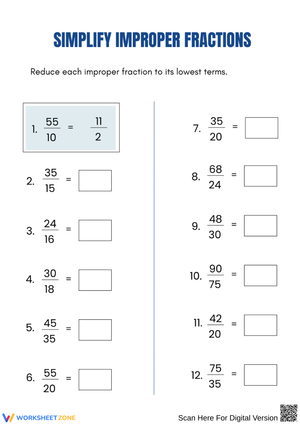
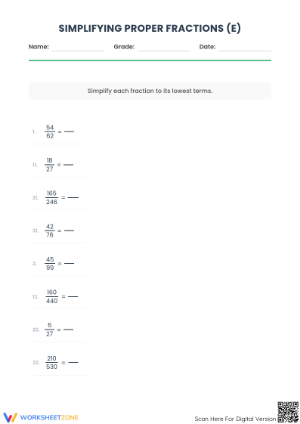
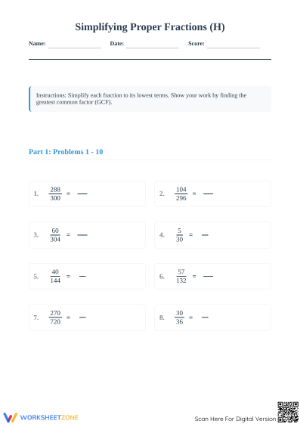
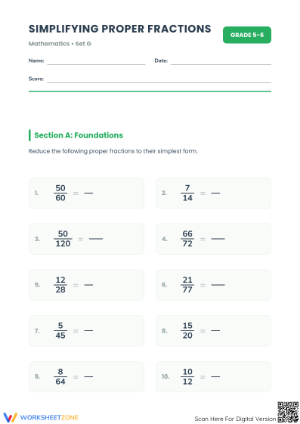
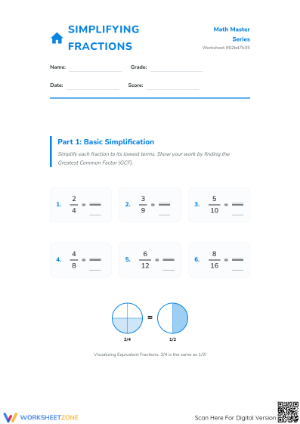
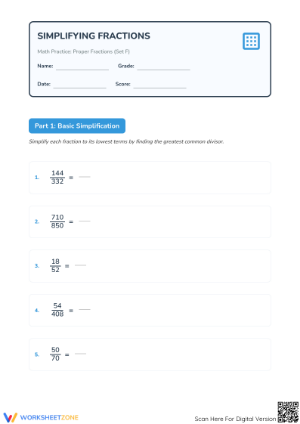
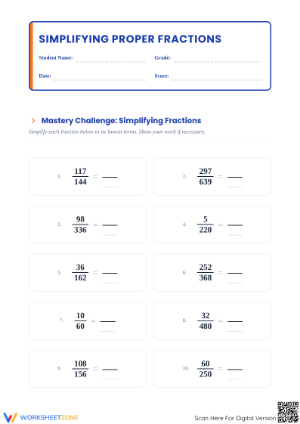
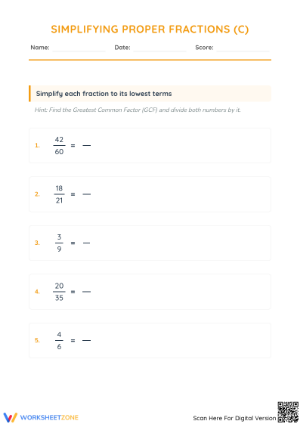
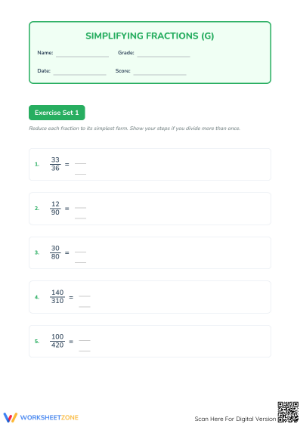
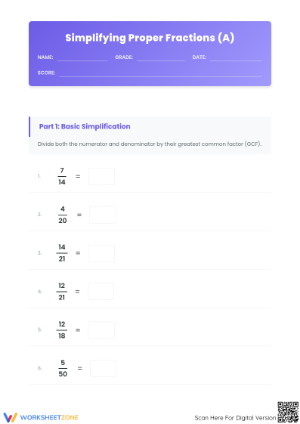
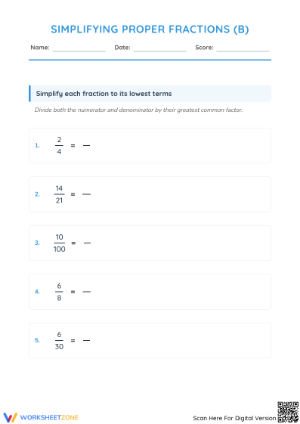
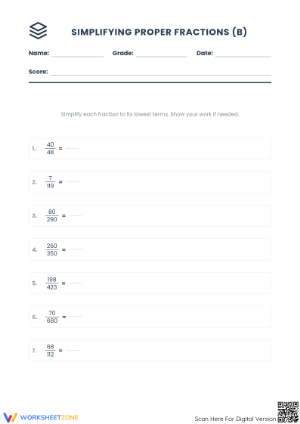
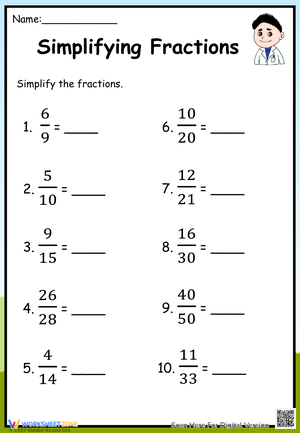
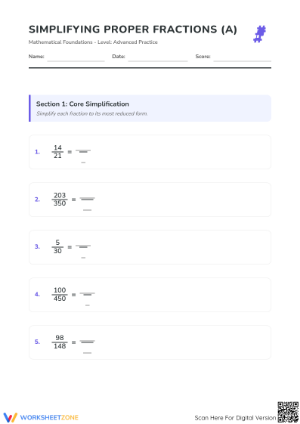
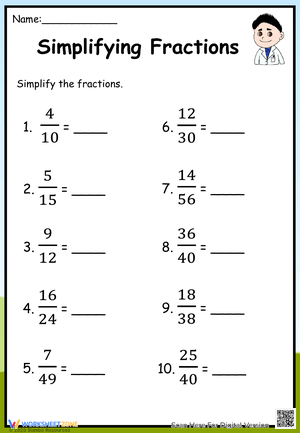
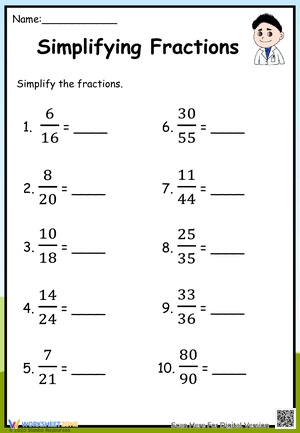
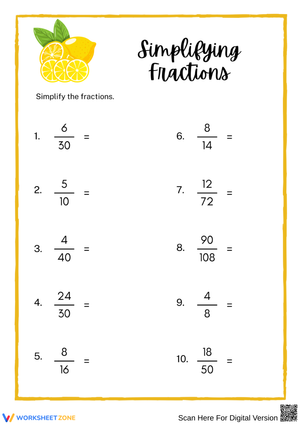
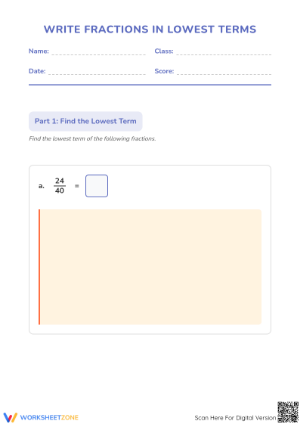
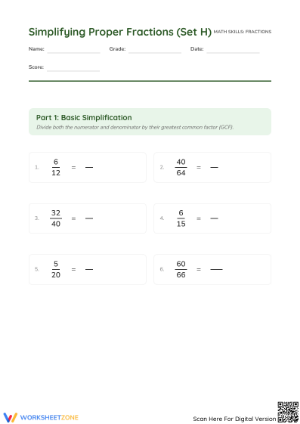
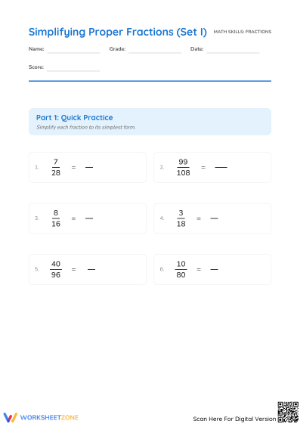
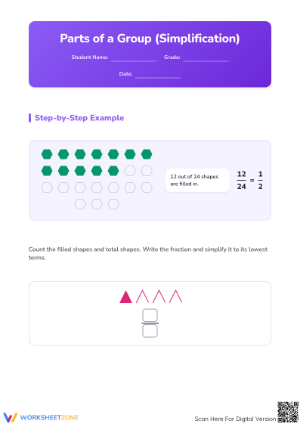
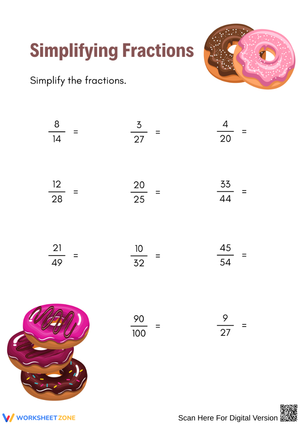
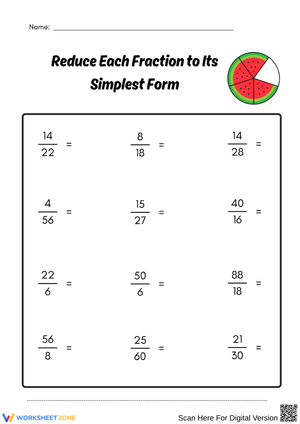
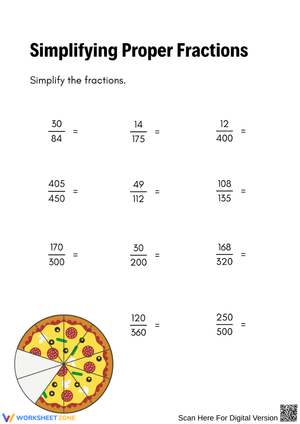
These 4th grade simplifying fractions worksheets give students structured practice with a concept that trips up more learners than teachers expect: that a fraction's appearance can change without changing its value. The set mixes visual equivalence tasks, factor-based reduction, and short error-analysis items — the combination that moves students from guessing to reasoning. Teachers get resources that work as mini-lesson follow-ups, center tasks, and quick formative checks, all within the Grade 4 fraction progression.
Skills These Worksheets Build
Each worksheet targets a specific part of the simplifying process rather than combining all fraction work into one undifferentiated task. Students move through distinct skill areas: identifying a common factor shared by numerator and denominator, dividing both parts by that factor, confirming the result names the same amount as the original, and deciding whether the fraction is already in simplest form. Visual tasks ask students to shade or match equivalent representations before any numbers get divided. Factor tasks ask students to circle shared factors in a number pair — 6 and 9 share a factor of 3; 4 and 10 share a factor of 2 — before applying that reasoning to a fraction. Explanation prompts ask students to write one sentence justifying why two fractions are equal. Error-analysis items present a worked simplification with a deliberate mistake and ask students to locate and correct it.
That range of item types matters because simplifying fractions sits at the intersection of fraction understanding and number theory. Grade 4 is the developmental moment when students are expected to move beyond picture-based fraction thinking and begin working with numerical relationships between parts. The worksheets honor both sides of that transition instead of jumping straight to symbolic reduction.
Student Errors Worth Catching Before They Become Habits
The most reliable mistake: students divide only the numerator, leaving the denominator untouched. A student asked to simplify 4/8 will write 2/8 because they found the factor 2 and applied it once. The worksheet catches this when the explanation prompt asks them to shade a model — 2/8 clearly does not match the shaded representation of 1/2, and the visual contradiction forces a rethink. A second common error is stopping at the first available factor rather than reaching simplest form. Given 12/18, a student might divide by 2 and write 6/9, decide that looks simpler, and move on. That answer is not wrong as a step, but it is not simplest form. Items that ask "Is this fraction in simplest form? How do you know?" build the checking habit that prevents early stopping. A subtler misconception — one that shows up frequently in actual student work — is the belief that a simplified fraction is smaller in value than the original. Students who hold this idea will say that 1/2 is worth less than 2/4, which signals they have not yet connected simplification to equivalence. Error-analysis items that ask "Did this student change the value of the fraction? Explain your answer" address that confusion directly.
How to Build These Worksheets Into Your Lesson Plans
The worksheets fit in several places without disrupting lesson flow. After a direct-instruction mini-lesson, one worksheet with six to eight mixed items gives students enough repetition to consolidate the skill without turning the practice period into a slog. For math centers, pair one worksheet with a set of fraction strips so students can verify each simplification against a physical model rather than just comparing numbers. Morning work — three to five review problems on the day after initial instruction, then again three or four days later — applies spaced retrieval at a small scale and takes under ten minutes. Exit tickets built from two or three items near the end of the block reveal whether students can simplify independently before you plan the next day's instruction.
One sequencing pattern that works well: assign the visual equivalence worksheet first, then the factor-identification worksheet, then the mixed practice that brings both together. This ordering reflects how most fourth graders actually build the concept — picture first, number reasoning second, integration third. Skipping the first step and going straight to factor work produces students who can follow a procedure without being able to explain it, which makes review cycles harder when fractions return later in the year.
Standard Alignment
Simplifying fractions in Grade 4 connects directly to CCSS 4.NF.A.1, which asks students to explain why a fraction a/b is equivalent to a fraction (n×a)/(n×b) — recognizing that both numerator and denominator are multiplied or divided by the same nonzero number. This standard explicitly positions equivalence as the conceptual anchor, which is why the visual model tasks in this set of 4th grade simplifying fractions worksheets appear alongside reduction problems rather than as an optional warm-up. Students who can only reduce fractions numerically without explaining the equivalence relationship have met the procedural surface of 4.NF.A.1 but not its reasoning requirement. The explanation prompts built into these worksheets give teachers evidence of conceptual understanding, not just correct answers.
Adjusting the Set for Different Points in the Learning Curve
Students who are still shaky on factor identification need worksheets where the common factor is given or circled, with the task being to complete the division rather than find the factor independently. Including a small multiplication table on the same worksheet lets those students verify arithmetic without stopping to ask for help, which keeps the focus on the fraction concept rather than the calculation. Students at grade level work best with the standard mixed format: a model, four to six reduction problems, and one explanation item per worksheet.
Students who are ready for extension benefit from a different kind of challenge than simply larger numbers. Give them a worksheet that starts with a fraction like 18/24 and asks for every equivalent fraction between that and simplest form, then asks which form is simplest and why. That task requires generating equivalents in both directions — multiplying and dividing — and applies the idea that simplest form is a specific destination, not just a smaller-looking fraction. It also surfaces whether students understand that any given fraction has exactly one simplest form, a conceptual point worth establishing early.
Frequently Asked Questions
Do students need to know greatest common factor before using these worksheets?
Not necessarily. Several worksheets ask students to find any common factor, not necessarily the greatest one, and then check whether the result is in simplest form. Students who divide 6/12 by 2 to get 3/6 and then divide again by 3 to reach 1/2 are doing valid work — they just take an extra step. The checking habit that develops from that process is worth more at this grade level than knowing the GCF shortcut.
How many worksheets should students complete before moving to mixed review?
Most fourth graders need two to three focused worksheets before mixed review is productive. One worksheet on visual equivalence, one on factor-based reduction, and one short mixed set gives enough repetition for students to recognize the procedure while keeping each session under fifteen minutes. Beyond that, the returns diminish quickly — students start rushing rather than reasoning.
Can these be used with students working below grade level on fractions?
Yes, with targeted selection. Choose worksheets that include fraction strip models printed directly on them and limit problem sets to fractions with denominators of 4, 6, 8, and 12 — the denominators most students at this level recognize from earlier fraction work. Avoid worksheets that require factor pairs beyond the basic multiplication facts. The 4th grade simplifying fractions worksheets in this set include those lower-denominator options because below-grade intervention in fourth grade often needs the same conceptual sequence, just with narrower numbers.
Are these useful for test preparation?
State assessments at Grade 4 regularly include fraction equivalence items in both selected-response and constructed-response formats. The explanation prompts in these worksheets build the written reasoning habit that constructed-response items require. Students who have only practiced circling answers from a list are often unprepared when a prompt asks them to explain why two fractions are equal — that specific skill takes separate, intentional practice, and the set includes it.
When sequencing 4th grade simplifying fractions worksheets, the order matters more than the total number assigned. Visual equivalence first, factor-based reduction second, mixed practice and error analysis last. Students who work through that sequence — rather than jumping straight to reduction — show stronger retention when fractions return in review, because the conceptual anchor of equivalence is already in place before the procedure is practiced at speed.