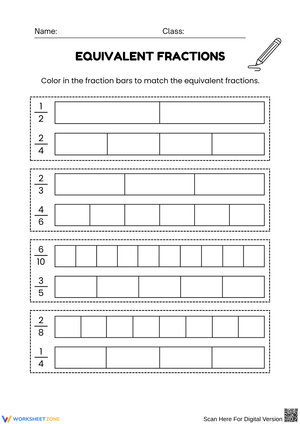
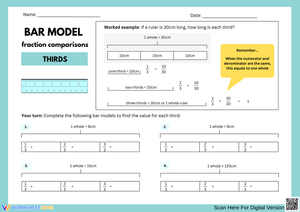
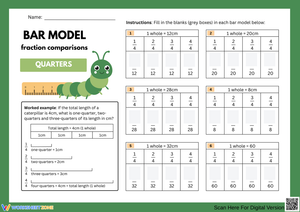
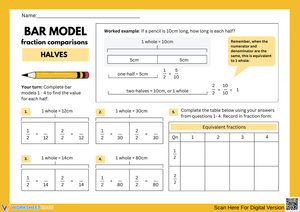
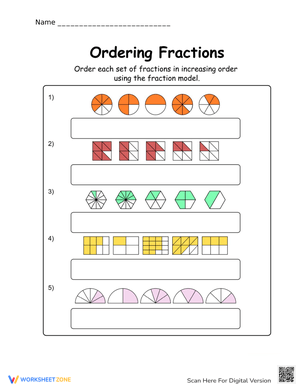
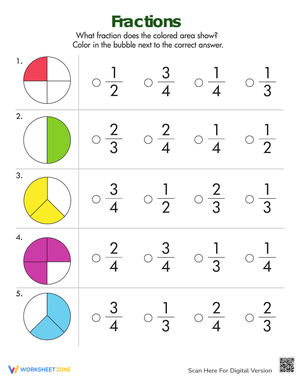
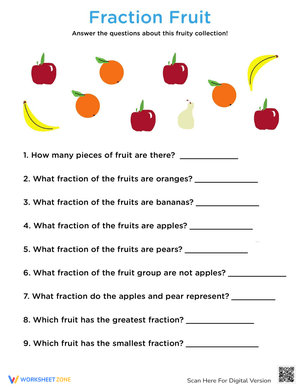
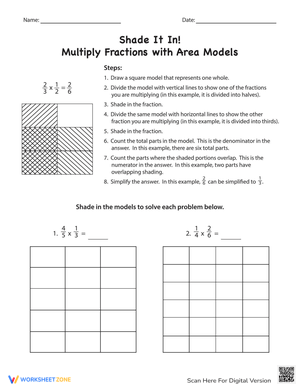
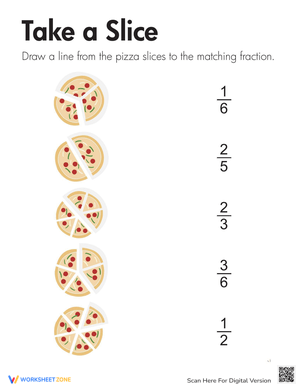
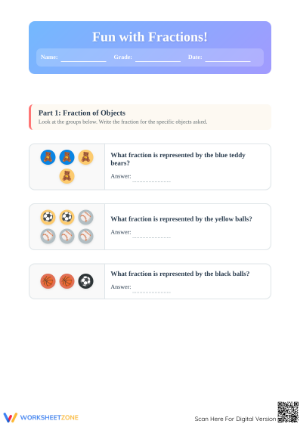
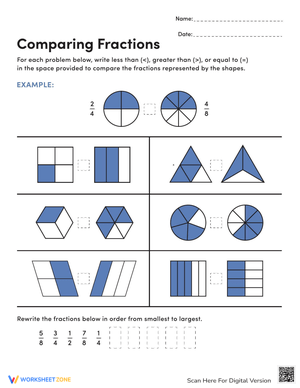
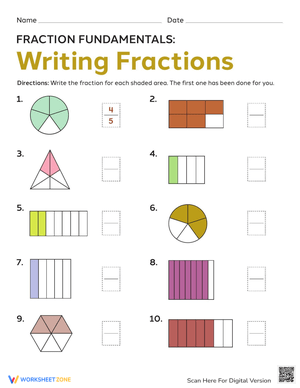
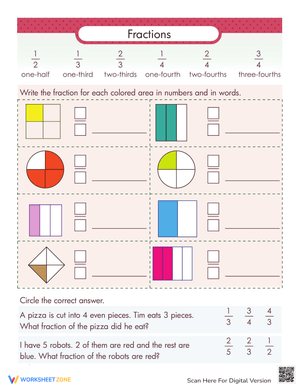
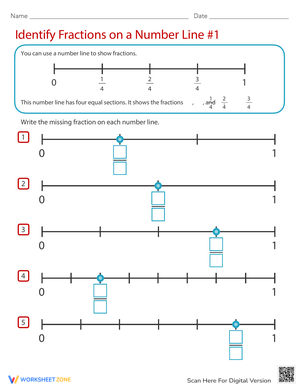
These fraction models worksheets for 4th grade put three visual representations—area models, number lines, and tape diagrams—into a print-ready set that slots into guided practice, station rotations, or exit-ticket review without additional prep. Grade 4 is when fraction instruction makes its biggest conceptual jump: students stop naming parts of a shape and start treating fractions as numbers that can be compared, ordered, and decomposed. The visual anchor each worksheet provides makes that transition less fragile.
The Specific Skills Targeted
Each worksheet zeroes in on one of four interconnected competencies that fourth graders need to own before fraction operations become accessible.
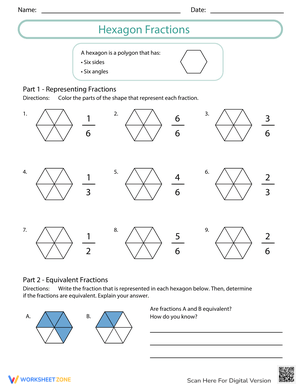
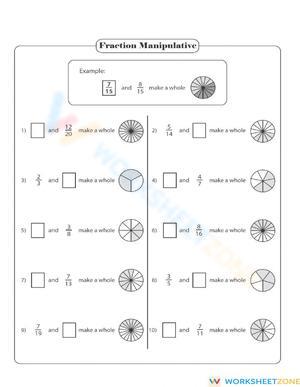
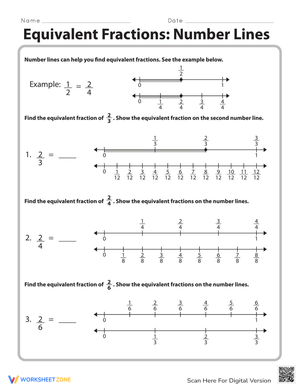
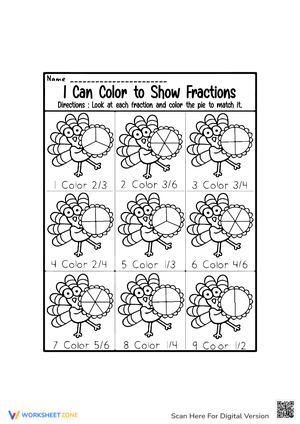
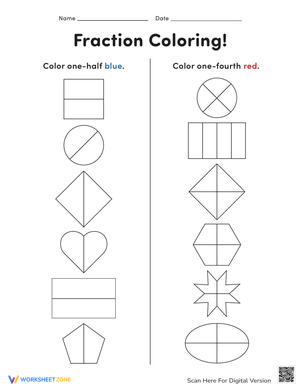
- Generating equivalent fractions: Students shade a rectangle to show 1/3, then redraw the same shape partitioned into sixths and count how many sixths match. The visual proof makes the multiplicative relationship feel discovered rather than handed down.
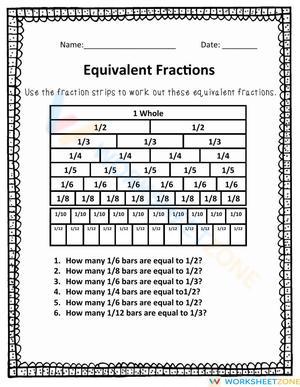
- Comparing fractions with unlike denominators: Using tape diagrams of equal total length, students partition each bar differently and mark the given fraction. The comparison is visual before it is numerical—which fraction strip extends farther to the right?
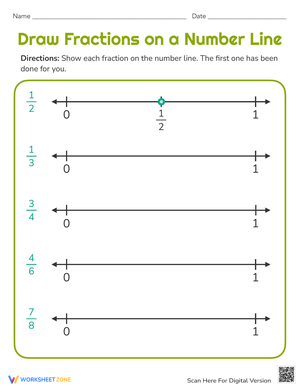
- Decomposing fractions: Number line worksheets ask students to break 5/4 into 4/4 and 1/4, locate both pieces, and identify their sum. This connects directly to mixed-number understanding before students need to learn a new procedure for it.
- Adding and subtracting fractions with like denominators: Students shade consecutive sections of an area model to represent a sum, then count total shaded parts. The act of shading slows them down usefully—they can't skip straight to an answer without building the picture.
Frequent Mistakes Teachers Should Expect and Correct
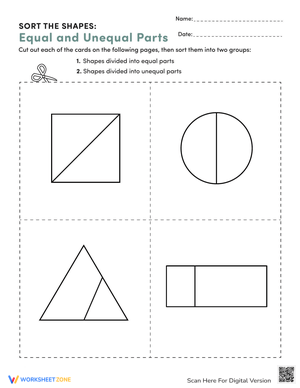
The most persistent error with area models is unequal partitioning. A student who draws a rectangle, puts the first dividing line near the middle, then crowds the remaining lines to the right will shade two sections and call it 2/4—but the model doesn't actually demonstrate equivalence with 1/2. This error is easy to miss during independent work. Circulating and asking "are your parts equal?" before students write the fraction catches it before it solidifies into habit.
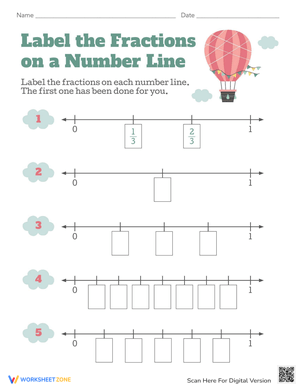
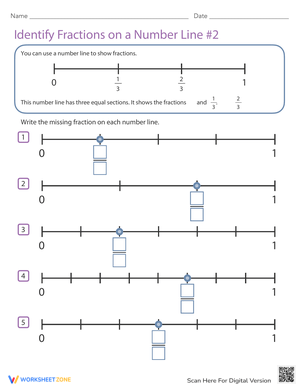
Number line work surfaces a different problem. Many fourth graders treat tick marks as a list rather than as boundaries of equal intervals. They place 1/3 and 2/3 at the first and second marks regardless of how many total marks appear on the line. The fix is deliberate: before placing any fraction, students label the whole-number endpoints and count intervals, not marks. That distinction needs more than one lesson to stick, and returning to the same number line worksheet format across multiple sessions reinforces it more effectively than moving to a new format each time.
There's also the comparator error that surfaces even after students correctly shade a visual model. A student who agrees, looking at two tape diagrams, that 3/8 is less than 1/2 will still write 3/8 greater than 1/2 on a separate symbolic task because "8 is bigger than 2." The model and the written inequality haven't connected yet. Having students write the comparison symbol directly underneath the completed tape diagram—on the same worksheet—makes that link explicit.
Smart Ways to Work These Worksheets Into Your Lesson Plans
The most efficient use of the set is a three-day sequence during the 4.NF unit. Day one: use the area model worksheet whole-group, projecting a copy at the front while students work on their own printed copies. Day two: run the number line and tape diagram worksheets as paired stations with ten-minute rotations. Day three: have students pull out both previous worksheets as a reference while completing a mixed-model comparison task. Spreading the model types across three separate sessions, rather than front-loading all three on one day, produces the kind of retention that holds up on assessments three weeks later.
These fraction models worksheets for 4th grade also work well as a structured warm-up in the first five minutes of math class. Project a single problem—an unshaded area model alongside a written fraction—and give students 90 seconds to shade before walking through it together. That short routine, repeated across several mornings, builds fluency without eating into the main lesson block.
For exit-ticket use, choose a worksheet that includes more than one model type so you can see not just whether students got the right answer but which representation gave them trouble. Sort responses into three groups—accurate model and correct fraction, correct setup but partitioning error, and didn't know how to begin—and use those groups to plan the next day's small-group instruction.
Standard Alignment
The worksheets in this set address the 4.NF (Number and Operations—Fractions) domain of the Common Core State Standards for Mathematics.
- 4.NF.A.1 — Explain why a fraction a/b is equivalent to (n×a)/(n×b) using visual fraction models. The area model and tape diagram worksheets ground this standard in concrete shading tasks before students are asked to write the numerical relationship.
- 4.NF.A.2 — Compare two fractions with different numerators and denominators using benchmarks, models, or number lines, then record the comparison with a symbol. The number line and tape diagram worksheets address this standard directly, and the error-correction step of writing the inequality below the model matches how the standard describes recording results.
- 4.NF.B.3a — Understand addition and subtraction of fractions as joining and separating parts of the same whole. The area model worksheets for addition reinforce this part-to-whole meaning before any algorithm appears.
Teachers using Illustrative Mathematics Grade 4 tasks alongside these resources will find the language consistent—both treat fractions as numbers on a number line rather than only as parts of a shaded region.
Adjusting the Set for Different Readiness Levels
Students still solidifying third-grade fraction concepts—identifying and naming unit fractions from a pre-drawn model—need the area model worksheets first, with denominators held to halves, thirds, and fourths. Introducing the number line worksheets before those students can consistently partition equal parts on their own tends to produce more confusion than clarity. For this group, it also helps to let them hold a physical fraction strip and align it against the printed tape diagram before drawing any lines of their own. That physical-to-printed transfer reduces the cognitive load of the drawing task so they can focus on the fraction relationship itself.
Students who move through equivalence and comparison quickly can extend the same worksheets by producing two different visual models for the same fraction—one area model, one number line—and writing a sentence explaining why both are correct. That task calls on flexible thinking that maps to the higher-order expectations in 4.NF and transitions naturally toward fifth-grade fraction operations. Students ready to work with tenths and hundredths will find the set's open-ended blank-model worksheets accommodate those denominators without any modification.
Frequently Asked Questions
Why does the set include three model types instead of focusing on one?
Each model reveals something different about fractions. Area models show part-to-whole relationships within a bounded region, making them strong for introducing equivalence. Number lines show fractions as measurements on a continuous scale, which builds the conceptual groundwork for comparing magnitudes and, later, for adding and subtracting. Tape diagrams make comparison concrete by placing two fractions side by side at equal total length, so the visual answer is immediate. Students who have worked with all three are better positioned to choose the right tool for a given problem rather than forcing every fraction task into one familiar format that may not fit.
Where in the 4.NF unit do these worksheets fit best?
Area model worksheets belong early in the unit, when students are first building the idea of equivalence with concrete shading. Fraction models worksheets for 4th grade that use number lines and tape diagrams fit better in the middle of the unit—after students understand that a fraction is a number, but before they're expected to compare fractions with inequality symbols and without any visual support. Mixed-model worksheets work well in the final week of the unit as review, or in the days immediately before a cumulative assessment.
Can these worksheets be used with students who are working below grade level?
Yes, with deliberate selection. A fourth grader still working on 3.NF concepts benefits most from the area model worksheets with unit fractions—1/2, 1/3, 1/4—where the partitioning is straightforward and the denominator stays small. Fraction models worksheets for 4th grade that involve comparing fractions with unlike denominators or decomposing improper fractions are appropriate only after that foundation is in place. Assigning one worksheet at a time based on a specific skill gap, rather than the full set at once, gives teachers cleaner information about exactly where a student's understanding breaks down.













 Interactive Worksheet Maker
 Quiz Maker
 Word Search Maker
 Crossword Puzzle Maker
 Word Scramble Generator
 Sentence Scramble Generator
 Handwriting Worksheet Generator
 Name Tracing Generator
 Fill In The Blank Generator