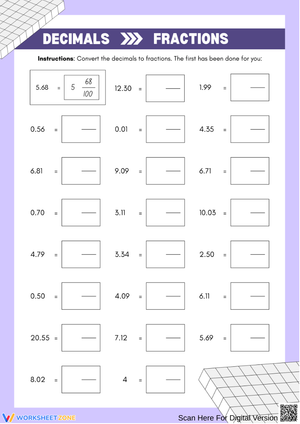
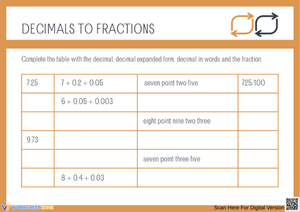
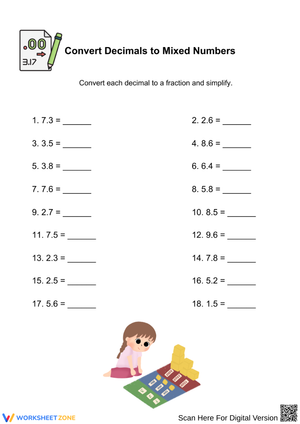
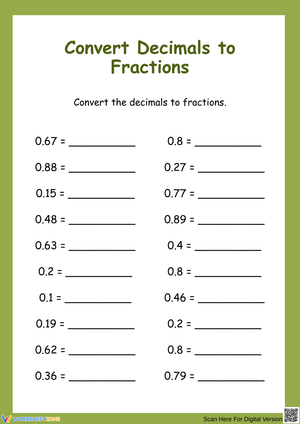
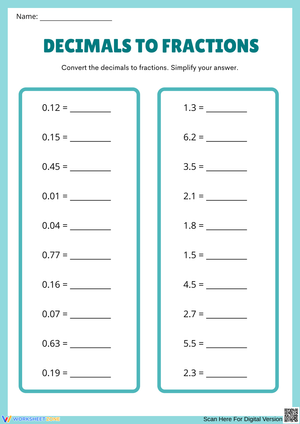
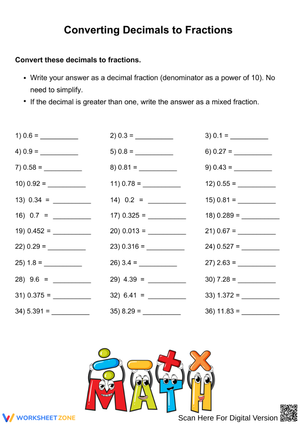
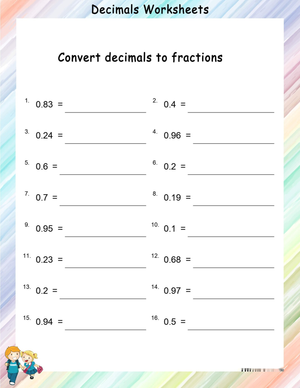
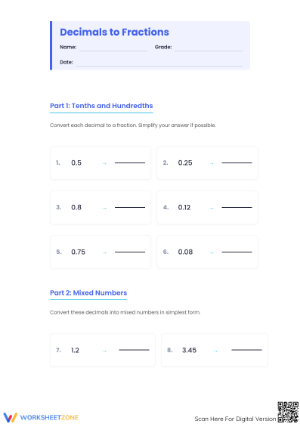
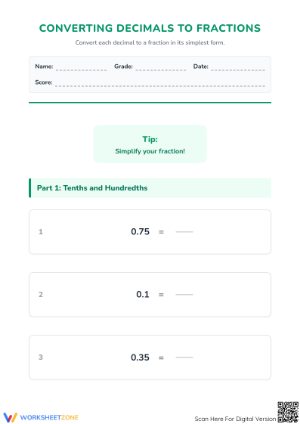
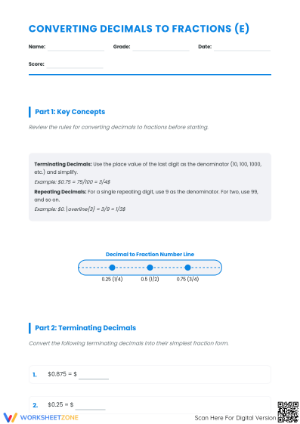
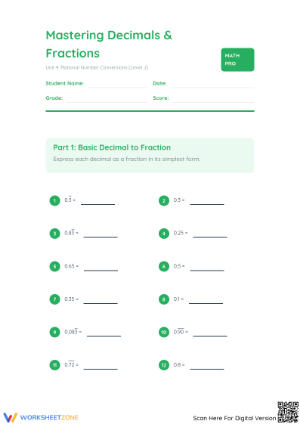
These converting decimals to fractions printable worksheets for 4th grade give teachers a focused, classroom-tested set of resources for one of the trickiest conceptual pivots in elementary math — the moment students must recognize that 0.7 and 7/10 are not two different numbers but the same value written in two different systems. Each worksheet targets denominators of 10 and 100, which is exactly where fourth-grade standards place this work, and none of the problems drift into fraction simplification or unlike denominators. Teachers get direct, printable practice with nothing extraneous.
What Each Worksheet Targets
The set covers four interlocking skills:
- Read a decimal and write its fractional equivalent with a denominator of 10 or 100
- Read a fraction with a denominator of 10 or 100 and write the matching decimal
- Use a 10x10 grid to shade a given decimal and label both representations
- Plot decimal-fraction pairs on a number line and identify the equivalence
The progression moves from visual to abstract. By the time students reach bare-conversion problems — no grid, no number line, just a decimal and a blank — they have already confirmed the equivalence through something they could count and see. One worksheet in the set pairs a decimal with a written number name, so a student writing "seven tenths" as both 0.7 and 7/10 at the same time is demonstrating genuine place value understanding rather than pattern-matching.
Standard Alignment
4.NF.C.6: Use decimal notation for fractions with denominators 10 or 100. This standard sits inside the Number and Operations — Fractions domain and connects directly to 4.NF.C.5, which requires students to express a fraction with a denominator of 10 as an equivalent fraction with a denominator of 100. In classroom terms, students need to see that 3/10 and 30/100 describe the same location on a number line before they can reliably write 0.30 and 0.3 as equivalent. The worksheets address both standards together, which reflects how most teachers actually sequence the unit rather than treating the two conversion directions as separate, unrelated lessons.
Mistakes Students Make That These Worksheets Help You Catch
The most consistent error is denominator confusion with single-digit tenths decimals. A student who correctly writes 0.47 as 47/100 will often turn around and write 0.7 as 7/100 — because they have built a shortcut: count the digits after the decimal point and use that number as the denominator. The error is not careless; it works on two-digit decimals and breaks down on one-digit ones. When you see this in student work, the most effective correction is to have the student read the decimal aloud as "seven tenths" before touching the fraction. Once they say it correctly, the denominator is obvious.
A second pattern worth noting: students writing 0.30 as 3/100 rather than 30/100, dropping the trailing zero because it feels redundant. These worksheets include enough 0.30-style problems that the error surfaces early in practice, where it belongs — not on the unit assessment.
How to Build These Worksheets Into Your Lesson Plans
Converting decimals to fractions printable worksheets for 4th grade work best when they follow a concrete introduction — students should have manipulated base-ten blocks or shaded a physical 10x10 grid before any pencil-to-paper work. Once that concrete phase is done, the visual-model worksheets serve as a natural bridge. A reasonable sequence is two class days on grid and number-line worksheets, one day on notation practice without visuals, and then a short mixed-format check to confirm students retained the equivalence rather than only recognizing it when prompted by a picture.
The grid-shading worksheets take more time and work best as a guided-practice activity during the math block, when you can circulate and catch the denominator errors described above before they calcify. The number-line and notation worksheets fit well into the morning warm-up slot — five problems at the start of class keeps the concept active across a multi-week unit without cutting into direct instruction time.
Differentiating the Set Across Ability Levels
For students still shaky on place value to the tenths, start with the grid-model worksheets and cover the decimal notation column until they have written the fraction. Let them verify their answer by counting shaded squares before they see the decimal symbol. This removes one layer of symbolic demand while place value understanding develops — it is a temporary measure, not a permanent workaround.
Students who move through tenths and hundredths quickly can extend the skill into comparison: determining that 0.6 is greater than 0.06 by writing both as fractions (6/10 versus 6/100) and reasoning from the denominators. This stays inside the 4.NF.C domain without pulling in fifth-grade content.
In a small-group setting, read every decimal aloud together before written work begins. Consistently saying "four tenths" instead of "zero point four" removes a layer of symbol-reading demand and lets students concentrate on the conversion itself. It is a small adjustment that genuinely changes what the task is asking them to do.
Frequently Asked Questions
Do these worksheets expect students to simplify fractions?
No — and that is deliberate. At this grade level, the standard asks students to express decimals as fractions with denominators of 10 or 100, not to reduce those fractions further. A student who writes 0.5 as 5/10 has answered correctly. Expecting 1/2 introduces equivalent fraction work that belongs in a separate instructional focus. These worksheets stay inside base-ten denominators so students practice exactly what 4.NF.C.6 requires.
What visual models appear across the set?
The worksheets use 10x10 grids and number lines. Grid worksheets ask students to shade a given decimal, then label both the fraction and the decimal below the model. Number-line worksheets ask students to plot a value and write its fractional name at that point. Both model types appear in forward and reverse formats — students work from decimal to fraction and from fraction to shaded model.
Can I use these with students who need more time on tenths before moving to hundredths?
The converting decimals to fractions printable worksheets for 4th grade set sequences simpler denominators first, so teachers can assign the tenths worksheets alone during early instruction and hold the hundredths materials until that foundation is solid. There is no need to introduce both denominators simultaneously if a student's assessment data suggests tenths are not yet secure.
How do these fit into test preparation?
State assessments aligned to Common Core regularly embed decimal-to-fraction translation inside multi-step word problems, which means students who have practiced converting decimals to fractions printable worksheets for 4th grade in isolation carry the automatic recall those multi-step problems depend on. Students who only encountered this skill inside longer problem sets often stall when the translation step appears mid-problem, because they never had to execute it quickly on its own.