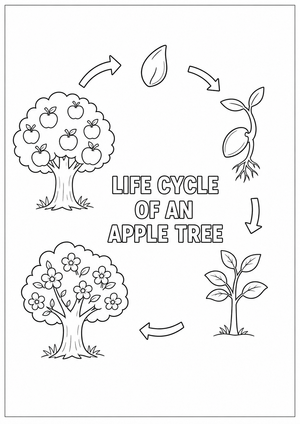
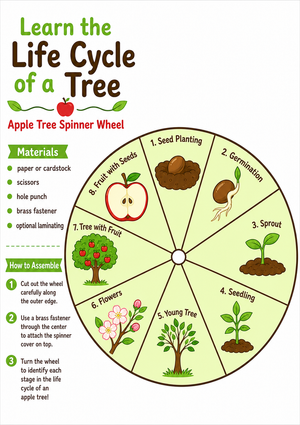
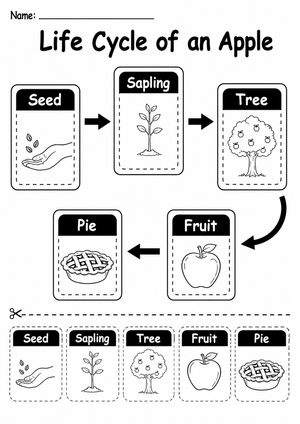
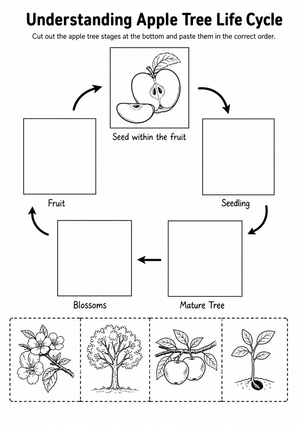
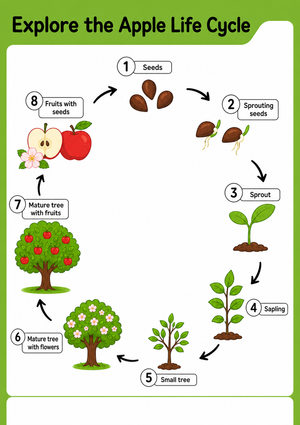
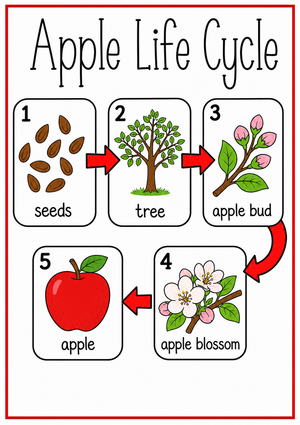
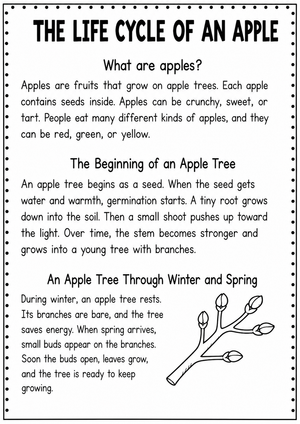
These apple life cycle printable worksheets for 2nd grade give teachers a ready set of sequencing, labeling, and written-response activities organized around the six stages an apple tree moves through — from seed through germination, seedling, sapling, blossom, and ripe fruit. The resources anchor well to fall, when students arrive already primed: apples in the lunch box, seeds visible in the snack. That real-world hook shortens the distance between the diagram on each worksheet and the biological process students can actually see and touch.
What Each Worksheet Targets
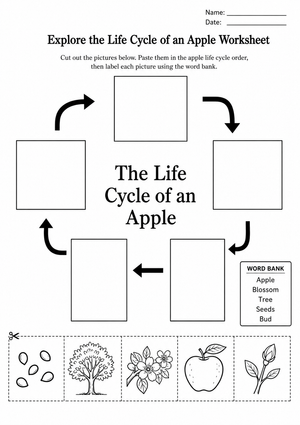
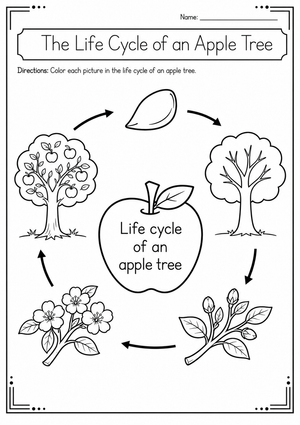
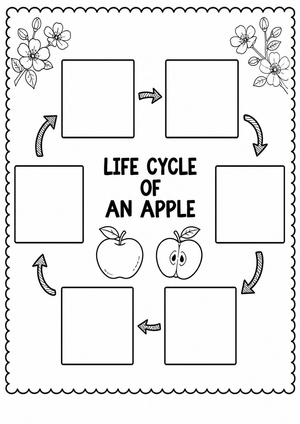
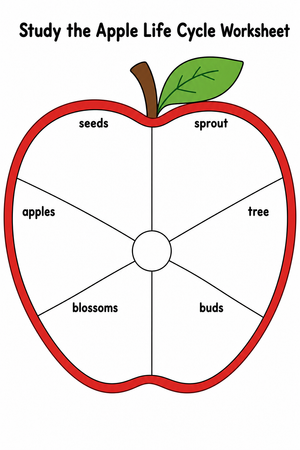
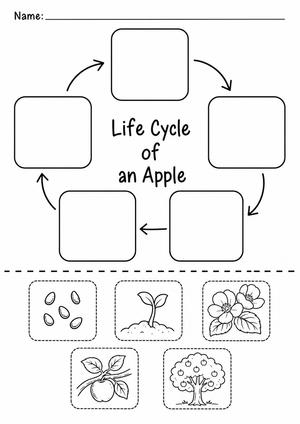
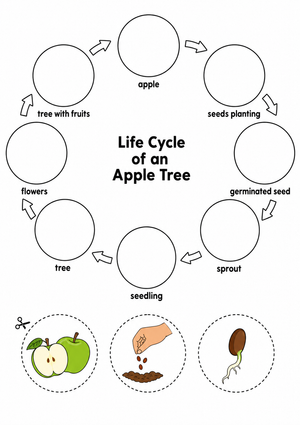
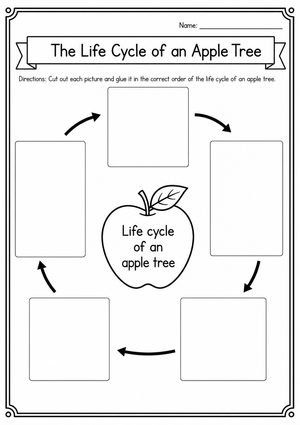
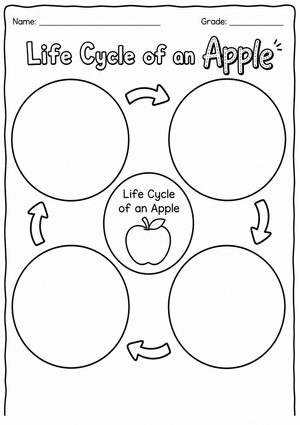
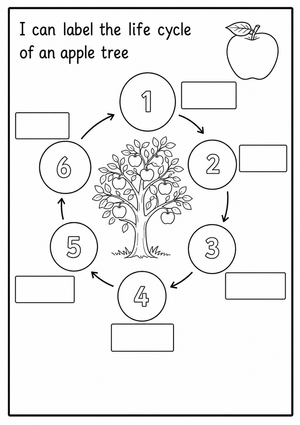
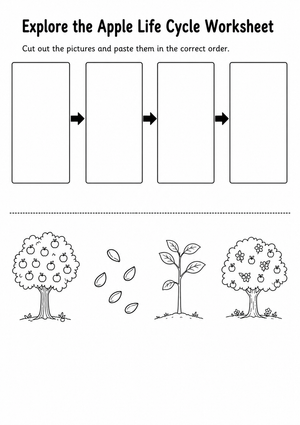
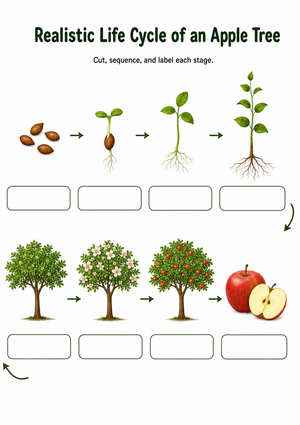
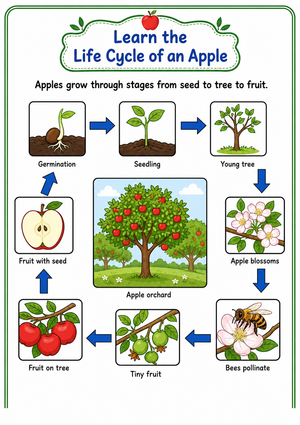
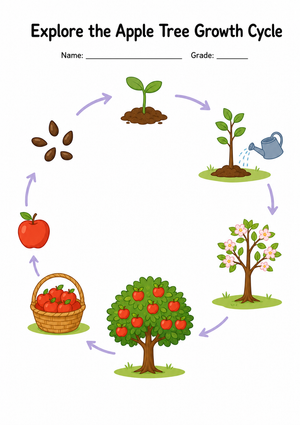
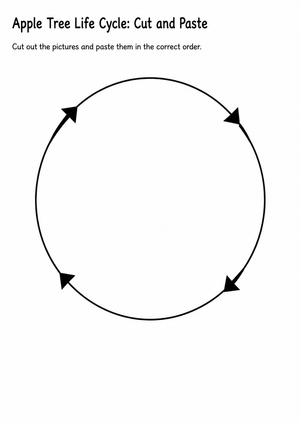
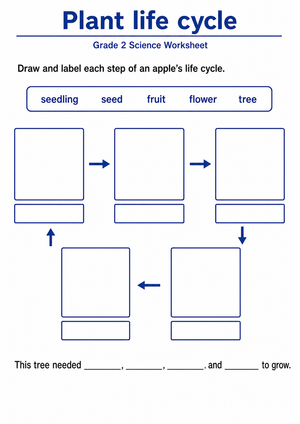
The set covers the full arc of the apple's development. Cut-and-paste sequencing worksheets ask students to order six illustrated stages and arrange them on a numbered cycle diagram — a format that immediately surfaces whether a student understands the circular logic of a life cycle or has only internalized a linear list. Labeling worksheets supply a word bank (seed, seedling, sapling, blossom, fruit, pollination) and a clean diagram; students write each term into the correct position. A separate written-response worksheet asks students to explain in two or three sentences why the blossom stage must come before the fruit stage — a small but revealing task that shows whether students understand causation or have simply memorized the order. One worksheet in the set focuses specifically on pollination: students draw the path a bee takes between two blossoms and circle the stage that would be skipped if bees were removed from the orchard entirely.
Mistakes Students Make That These Worksheets Help You Catch
The most persistent error at this grade is conflating seedling and sapling. Students who can recite both words will still draw a full-grown tree next to "seedling" because the image they carry of a plant is usually a mature one. The labeling worksheet makes this visible immediately — a student who places "sapling" at the germination stage has not absorbed the distinction between early and established growth. A brief class comparison using a photograph of a three-inch apple seedling next to a photograph of a ten-year-old apple tree clears this up faster than re-reading the definition ever will.
A second recurring confusion involves where pollination belongs in the sequence. Second graders frequently position it after fruit appears, treating it as part of the harvest rather than the cause of it. On the sequencing worksheet, this shows up as a misplaced blossom card — placed between "fruit" and "seed" rather than between "mature tree" and "fruit." When you see that error in a student's finished sequence, it signals that the function of pollination hasn't landed, only the word.
How to Build These Worksheets Into Your Lesson Plans
The sequencing worksheet works best as a formative check two or three days into a plant life cycle unit — not on day one. Students who attempt the cut-and-paste activity before any direct instruction spend the bulk of their time guessing rather than reasoning, and the resulting work tells you almost nothing useful. Lead with a read-aloud and a whole-class discussion, then bring in a real apple. Cut it open, pull out the seeds, and spend eight or ten minutes talking through what those seeds would need to become a tree. After that grounding, the sequencing worksheet becomes a knowledge-consolidation task rather than a cold introduction.
The apple life cycle printable worksheets for 2nd grade also fit naturally into station rotations. Set up three groups: one where student pairs complete the labeling worksheet and check each other's answers using a reference card, one where students examine a real apple and record observations in a science journal, and one where students work independently on the written-response worksheet. This structure lets you pull a small group to the carpet for targeted reteaching while the rest of the class stays productively on task — which matters when your science block runs only thirty minutes.
Standard Alignment
These worksheets align to NGSS 2-LS2-2, which asks second graders to develop a simple model that mimics how animals disperse seeds or pollinate plants. The sequencing and pollination-focused worksheets address this standard directly: students model the relationship between bees and apple blossoms and trace how seeds return from fruit to soil. The set also supports the crosscutting concept of Patterns (Grades K–2), since identifying the predictable, repeating sequence of a plant's development is exactly what the standard expects students to demonstrate at this level.
Differentiating the Set Across Ability Levels
For students still building reading fluency, the word bank on the labeling worksheets reduces decoding load without removing the science thinking. If a student still struggles with the six-word bank, pairing the worksheet with a picture reference card — each term accompanied by a small image — keeps the focus on biological understanding rather than on reading difficulty.
Students who finish quickly benefit from an extension the written-response worksheet opens up naturally: ask them to add a seventh stage — seed dispersal — and write a sentence explaining how a seed travels from inside a fallen apple to the soil. This requires synthesis across the entire cycle rather than recall of a single stage, and it tends to surface genuinely interesting student thinking about birds, gravity, and decay.
Frequently Asked Questions
Do these worksheets cover pollination, or just the visual stages of the apple tree?
Pollination is covered directly. One worksheet asks students to draw a bee's path between blossoms on a diagram and to label the stages that fall on either side of the pollination event. This makes the cause-and-effect relationship visible rather than just stated — useful for students who have absorbed "bees help apples grow" as a fact without understanding the mechanism behind it.
At what point in a unit do these worksheets fit best?
The labeling worksheet works well on days one or two as a vocabulary primer. The sequencing and written-response worksheets belong mid-unit, once students have enough background to reason through their answers. The pollination worksheet fits naturally near the end of the unit, when students are ready to connect individual stages into a cause-and-effect explanation of how blossoms become fruit.
Are these appropriate for students with limited science background?
Second graders typically arrive with informal apple knowledge but little formal plant biology, so apple life cycle printable worksheets for 2nd grade are written with that starting point in mind. The vocabulary introduced — seed, seedling, sapling, blossom, pollination, fruit — is established through the diagram tasks rather than assumed. Students do not need prior plant science instruction to access the worksheets, though pairing them with a brief teacher introduction produces stronger results than assigning them cold.
Will students recognize these from a prior grade?
Plant life cycles appear in kindergarten and first grade at a simpler level — typically seed, plant, and fruit — so second graders will have some exposure. The apple life cycle printable worksheets for 2nd grade in this set extend that earlier work by introducing sapling as its own distinct stage and adding explicit pollination content with a causal framing. A student who completed a basic seed-to-plant activity in first grade will find this set pushes further rather than covering the same ground.












 Interactive Worksheet Maker
 Quiz Maker
 Word Search Maker
 Crossword Puzzle Maker
 Word Scramble Generator
 Sentence Scramble Generator
 Handwriting Worksheet Generator
 Name Tracing Generator
 Fill In The Blank Generator