


























Views
Downloads

Printable Apple Life Cycle Worksheet | Grade 3 Science
Paste this activity's link or code into your existing LMS (Google Classroom, Canvas, Teams, Schoology, Moodle, etc.).
Students can open and work on the activity right away, with no student login required.
You'll still be able to track student progress and results from your teacher account.
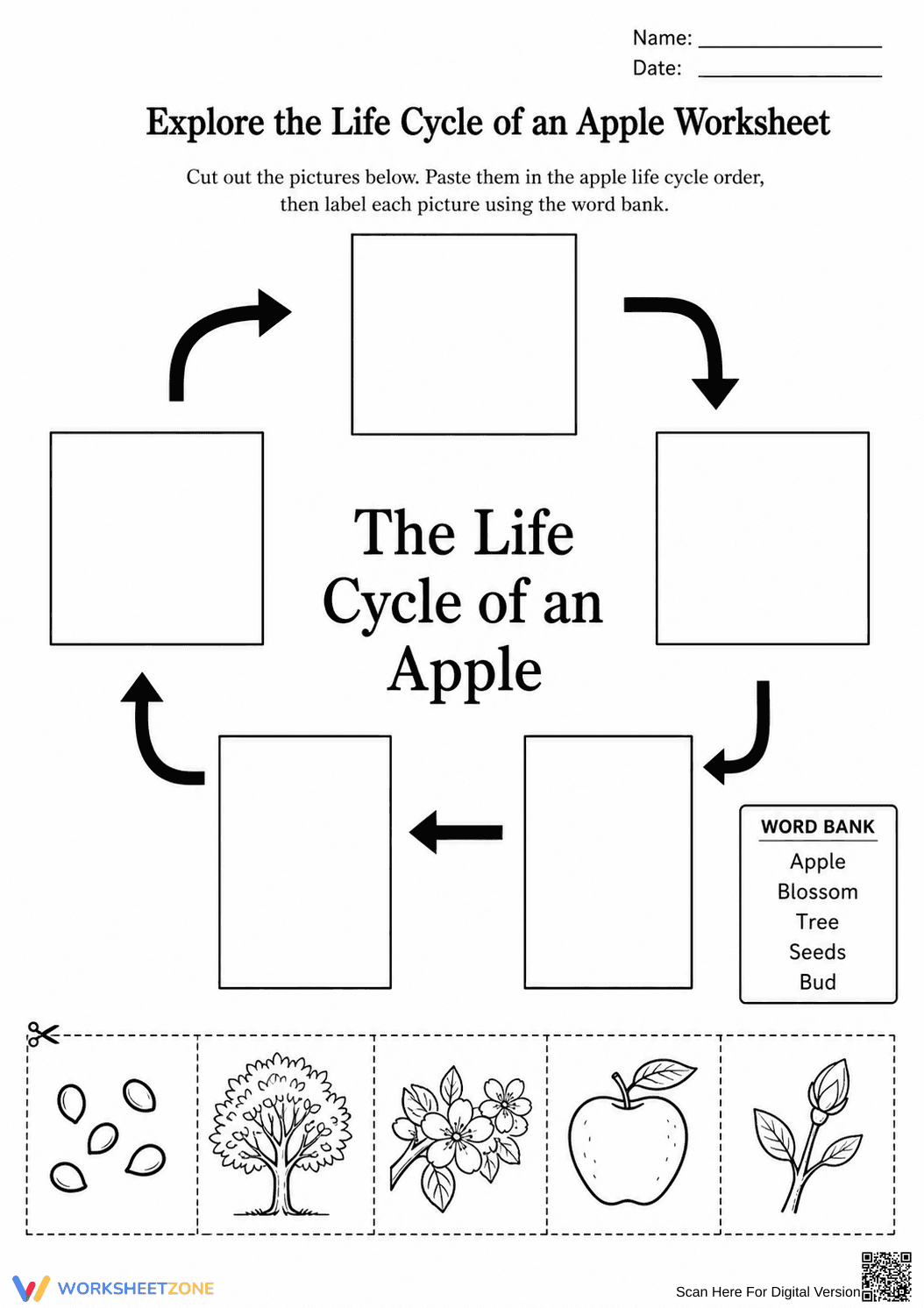
This hands-on science worksheet helps students sequence the life cycle of an apple from seed to fruit. By cutting, pasting, and labeling five growth stages, learners actively build their understanding of plant biology. The interactive format reinforces fine motor skills while solidifying foundational science concepts regarding how living things grow.
At a Glance
- Grade: 3 · Subject: Science
- Standard:
3-LS1-1— Sequence the stages of a plant's life cycle- Skill Focus: Sequencing life cycles
- Format: 1 page · 5 problems · No answer key · PDF
- Best For: Independent practice and science centers
- Time: 15–20 minutes
This single-page resource features a circular diagram with five blank boxes representing the growth cycle of an apple tree. Students will find five illustrations to cut out: seeds, a tree, a blossom, a bud, and an apple. A word bank provides the exact vocabulary needed to label each stage once pasted into sequential order.
This worksheet is designed for immediate classroom implementation:
- Print (1 minute): The black-and-white design ensures quick, ink-friendly printing.
- Distribute (1 minute): Hand out the sheets with scissors and glue. No extra modeling required.
- Review (3 minutes): Quickly check diagrams for accurate sequencing.
With under two minutes of prep time, this activity is an excellent addition to any sub plan.
This activity aligns with Next Generation Science Standards, specifically 3-LS1-1: "Develop models to describe that organisms have unique and diverse life cycles but all have in common birth, growth, reproduction, and death." By constructing this visual model, students demonstrate comprehension of biological stages. Both standard codes can be copied directly into lesson plans, IEP goals, or district curriculum mapping tools.
Use this resource as independent practice immediately following direct instruction on plant biology. Alternatively, it serves as an excellent interactive science center station. As a formative assessment observation tip, watch how students order the bud and blossom stages to check their grasp of flowering plant reproduction. Expected completion time is 15 to 20 minutes.
Designed for second and third-grade students learning basic botany, this worksheet includes built-in scaffolds like a word bank and visual cues. It is highly accessible for English Language Learners and pairs perfectly with a read-aloud book about seasonal changes or agriculture.
Understanding the sequential nature of biological growth is a fundamental component of early elementary science education. This activity directly supports standard 3-LS1-1 by requiring students to sequence the stages of a plant's life cycle through a hands-on, interactive modeling task. According to EdReports 2024, integrating tactile activities like cutting and pasting with targeted academic vocabulary significantly increases the long-term retention of scientific concepts in young learners. When students physically manipulate the distinct stages of the apple life cycle—moving from seed to mature fruit—they transition from passive listeners to active participants in their own learning process. This multimodal approach ensures that abstract biological concepts become concrete, observable, and highly memorable. By combining visual models with specific terminology, educators can effectively build the robust foundational knowledge necessary for more advanced biological studies in later grades.


