


























Views
Downloads

Apple Life Cycle Worksheet | Grade K-2 Essential
Paste this activity's link or code into your existing LMS (Google Classroom, Canvas, Teams, Schoology, Moodle, etc.).
Students can open and work on the activity right away, with no student login required.
You'll still be able to track student progress and results from your teacher account.
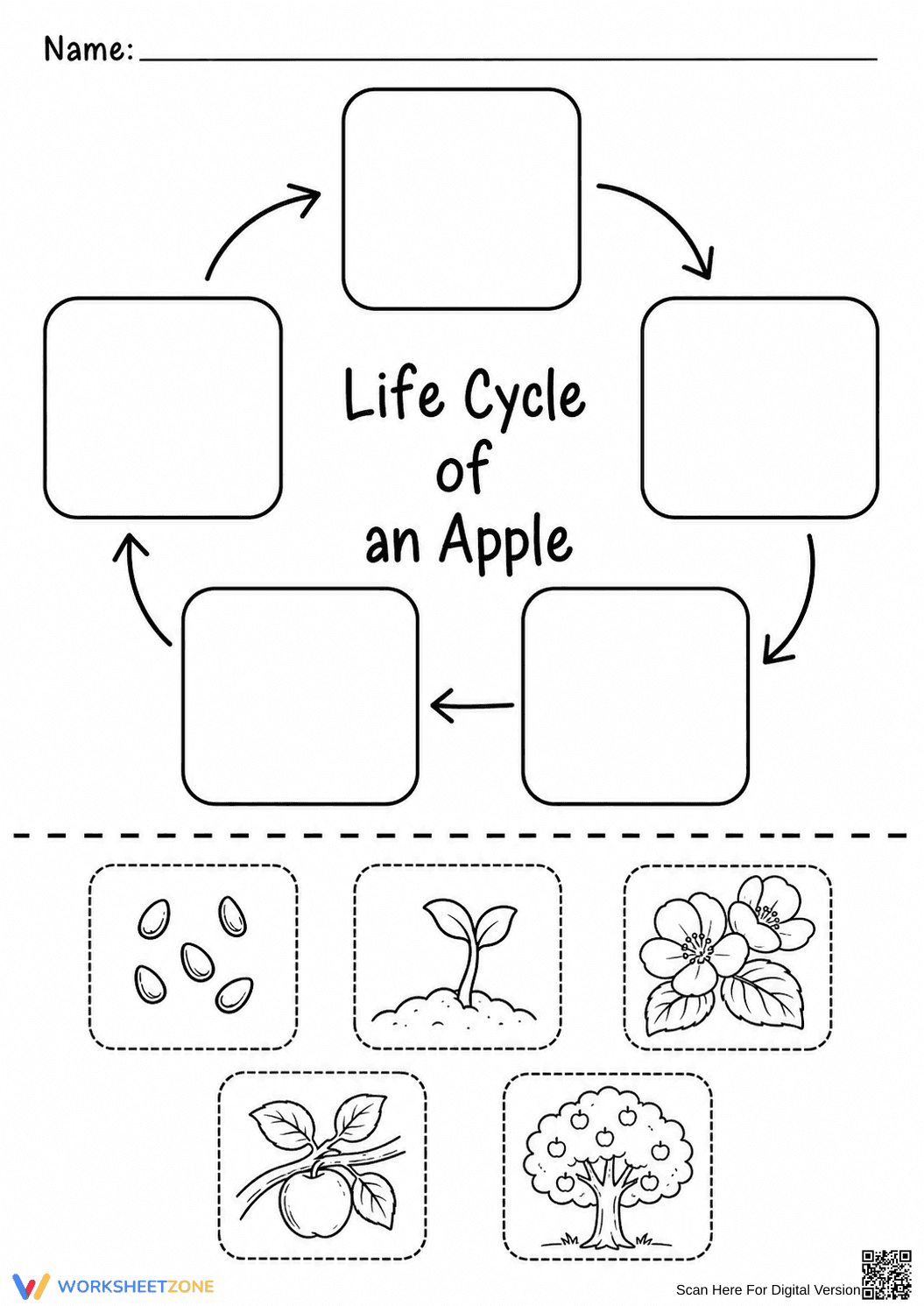
This Grade K-2 science worksheet helps students visualize and sequence the life cycle of an apple tree. By identifying five distinct stages from seed to fruit-bearing tree, learners develop foundational biological knowledge and chronological reasoning. It provides a hands-on way to explore how living things grow and change over time.
At a Glance
- Grade: K-2 · Subject: Science
- Standard:
K-LS1-1— Use observations to describe patterns of what plants and animals need to survive- Skill Focus: Biological Sequencing
- Format: 2 pages · 5 tasks · Answer key included · PDF
- Best For: Early elementary science centers and sub plans
- Time: 15–20 minutes
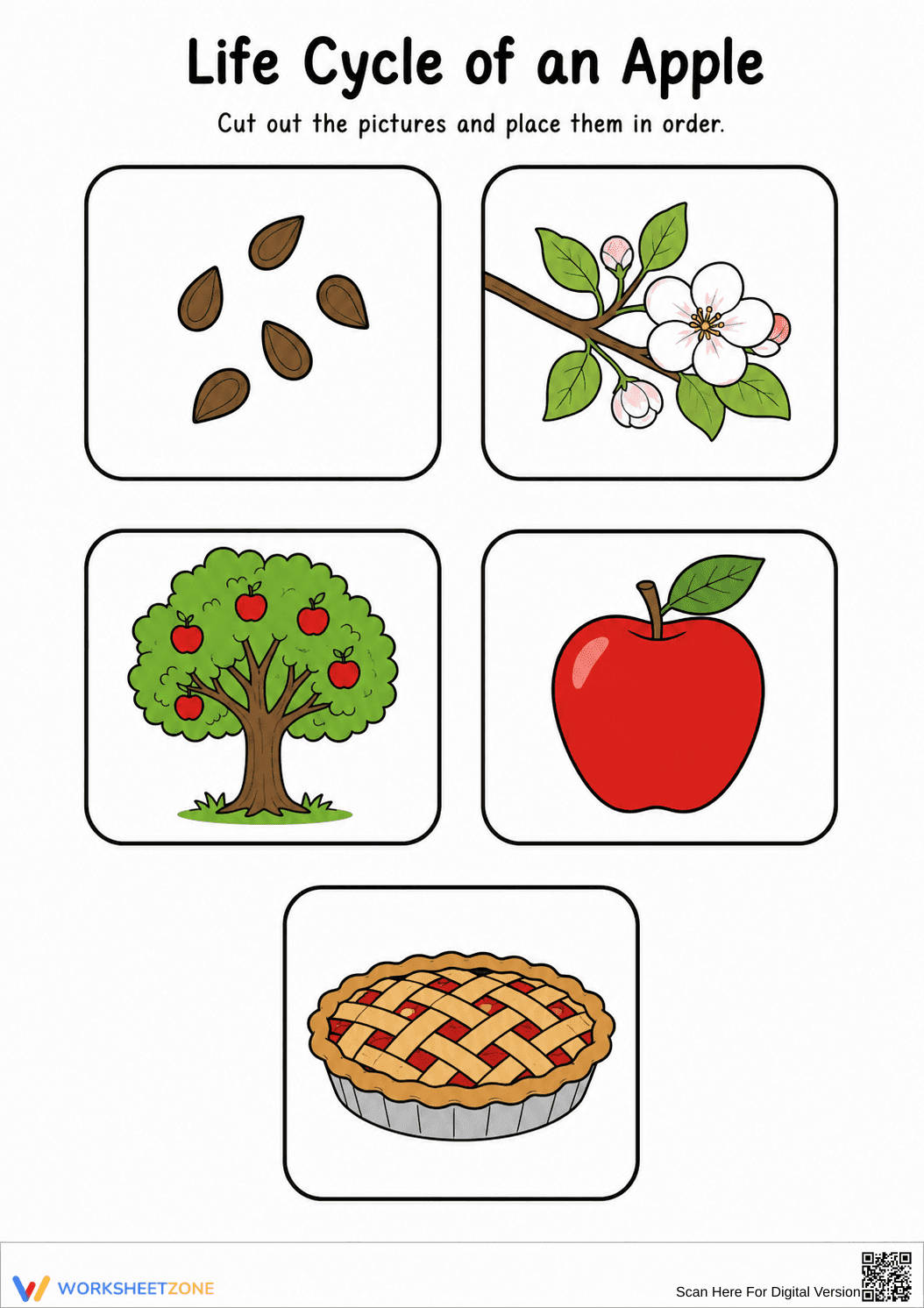
This 2-page PDF includes a black-and-white interactive cut-and-paste activity and a full-color reference sheet. The worksheet features five clear illustrations: seeds, a sprout, blossoms, a mature apple tree, and a harvested apple. The layout uses a circular flow diagram with directional arrows to reinforce the concept of a continuous biological cycle.
Zero-Prep Workflow
- Print: Select the black-and-white page for student use (30 seconds).
- Distribute: Provide scissors and glue sticks to each student (1 minute).
- Review: Use the included color version to check student work or display on a smartboard (30 seconds).
Total teacher preparation time is under 2 minutes, making it an ideal choice for emergency sub folders or quick science rotations.
Standards Alignment
This resource aligns with `K-LS1-1`, focusing on observing patterns in plant growth and survival. It also supports CCSS.ELA-LITERACY.RI.K.3 by requiring students to describe the connection between a series of scientific events. Both standard codes can be copied directly into lesson plans, IEP goals, or district curriculum mapping tools.
How to Use It
Use this worksheet during a "Plants" or "Fall" unit after reading a non-fiction text about orchards. It serves as an excellent formative assessment to see if students can distinguish between the blossom and sprout stages. Expected completion time is 15 to 20 minutes depending on fine motor skill levels.
Who It's For
This activity is designed for Kindergarten through 2nd-grade students, including English Language Learners who benefit from visual sequencing. It pairs naturally with a real-world apple tasting or a seed-planting experiment to bridge the gap between paper tasks and physical science.
According to Fisher & Frey (2014), visual non-linguistic representations like sequencing diagrams significantly enhance the retention of scientific processes in early childhood education. This worksheet utilizes the K-LS1-1 standard to help students organize biological facts into a coherent chronological structure. By engaging in the tactile "cut and paste" method, learners reinforce the connection between the seed, sprout, flower, and fruit stages. Research from the NAEP suggests that early exposure to life cycle patterns builds the necessary schema for more complex environmental science in later grades. This resource provides a structured, evidence-based approach to mastering the apple life cycle while supporting fine motor development and scientific vocabulary acquisition. Educators can rely on this tool to provide the repetition and visual scaffolding required for young learners to achieve mastery in basic life science observations and data recording.


