




























Views
Downloads

Apple Tree Life Cycle Worksheet | Grade 3 Essential

Paste this activity's link or code into your existing LMS (Google Classroom, Canvas, Teams, Schoology, Moodle, etc.).
Students can open and work on the activity right away, with no student login required.
You'll still be able to track student progress and results from your teacher account.
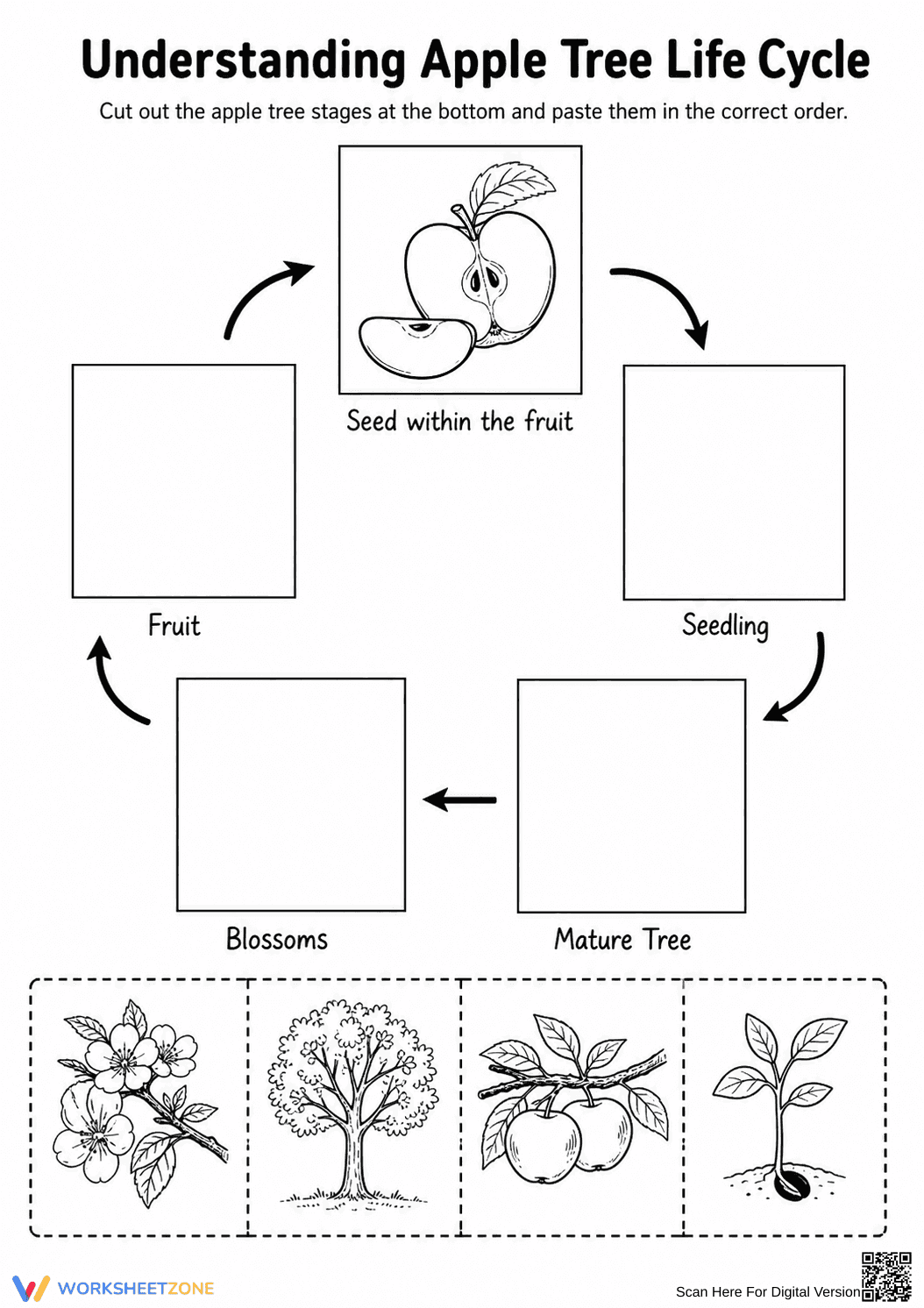
This interactive apple tree life cycle worksheet helps students visualize and sequence the biological stages of plant growth. By engaging in a hands-on cut-and-paste activity, learners internalize how an apple progresses from a seed within fruit to a mature, blossom-bearing tree. It is an ideal resource for reinforcing foundational biology concepts through active participation.
At a Glance
- Grade: 3 · Subject: Science
- Standard:
3-LS1-1— Develop models to describe that organisms have unique and diverse life cycles- Skill Focus: Life cycle sequencing
- Format: 1 page · 5 tasks · Cut-and-paste activity · PDF
- Best For: Science centers and independent practice
- Time: 15–20 minutes
This single-page PDF features a circular flow diagram with five designated slots for the apple tree's developmental stages. At the bottom of the page, students find four high-quality illustrations including Blossoms, Mature Tree, Fruit, and Seedling with dotted cutting lines. The "Seed within the fruit" stage is pre-labeled to provide a clear starting point for the sequencing task, ensuring students understand the cyclical nature of plant life.
Zero-Prep Workflow
- Print: Generate the required number of copies for your class in under 1 minute.
- Distribute: Hand out the sheets along with scissors and glue sticks to each student.
- Review: Spend 30 seconds explaining the circular arrows to ensure students follow the correct chronological order.
This worksheet is particularly effective as a "grab-and-go" sub plan or a quiet-time activity during science rotations, requiring less than 2 minutes of total teacher preparation time.
Standards Alignment
This resource is aligned with `3-LS1-1`: "Develop models to describe that organisms have unique and diverse life cycles but all have in common birth, growth, reproduction, and death." It also supports literacy by requiring students to follow a multi-step technical procedure. Both standard codes can be copied directly into lesson plans, IEP goals, or district curriculum mapping tools.
How to Use It
Use this worksheet as a formative assessment after a read-aloud about orchards or plant biology. Observe students as they arrange the cutouts before they apply glue; this allows you to identify misconceptions about the transition from blossoms to fruit. It typically takes 15 to 20 minutes for students to complete the cutting, ordering, and pasting process during a standard science block.
Who It's For
This activity is designed for 3rd-grade students but is highly adaptable for Grade 2 or Grade 4 learners requiring visual scaffolds. It is an excellent pairing for a classroom seed-planting experiment or a field trip to a local apple orchard. The visual nature makes it accessible for English Language Learners (ELLs) and students with IEPs who benefit from kinesthetic learning.
According to the RAND AIRS 2024 report on elementary science instruction, hands-on modeling of biological processes significantly improves long-term retention of life science concepts compared to passive reading alone. This worksheet utilizes the 3-LS1-1 standard to guide students through the specific stages of the apple tree life cycle, including germination, growth, and reproduction. By physically manipulating the stages of the cycle, students move from abstract understanding to concrete mastery of plant biology. Research from Fisher & Frey (2014) emphasizes that such interactive sequencing tasks serve as vital scaffolds in the gradual release of responsibility model. This resource provides a structured environment for students to demonstrate their understanding of how organisms change over time, ensuring they meet grade-level expectations for modeling complex natural systems in early childhood education. It serves as a reliable tool for documenting student progress in understanding the commonalities of all living things.


