


























Views
Downloads
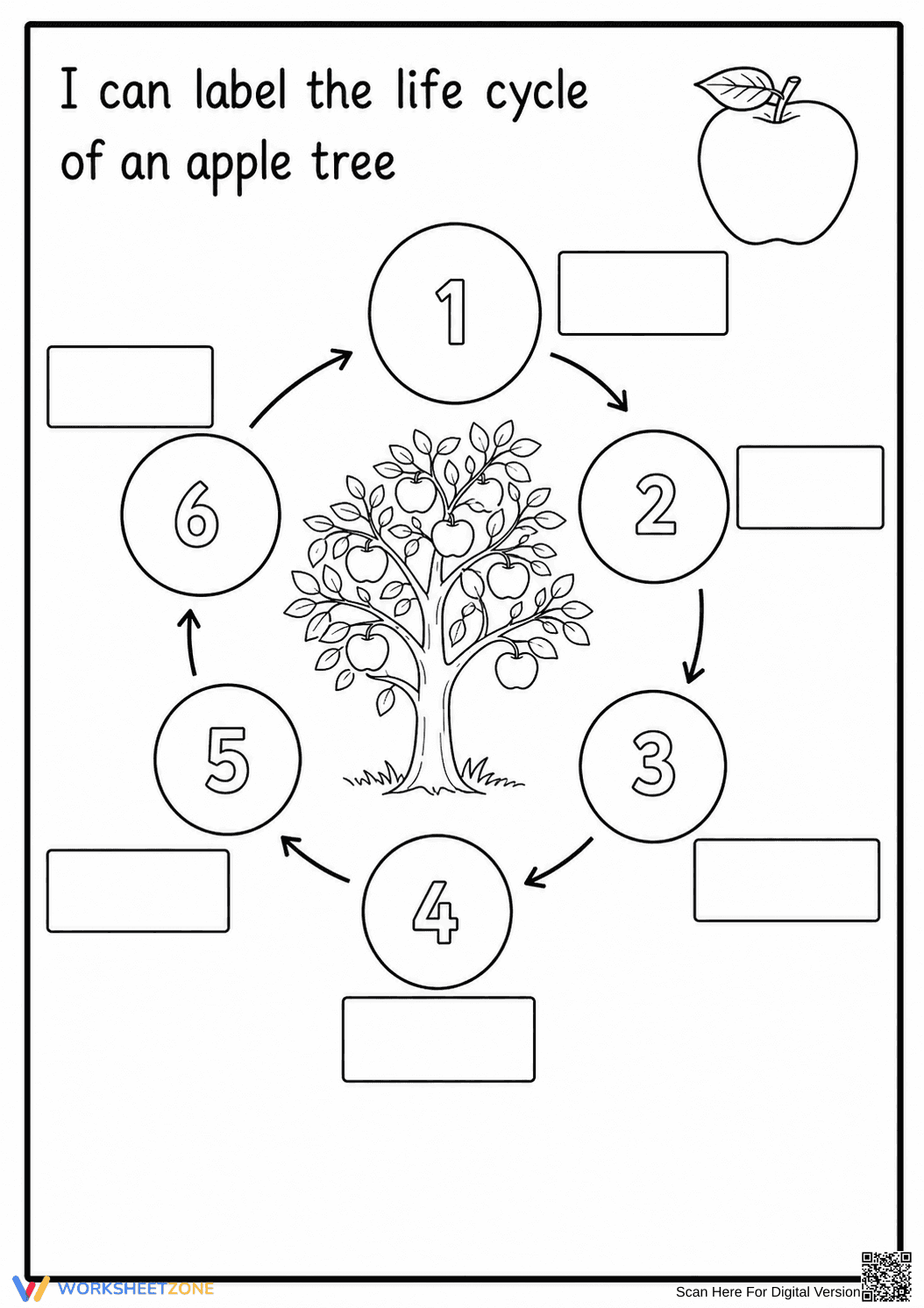


Grade 3 Apple Life Cycle — Printable No-Prep Worksheet
Paste this activity's link or code into your existing LMS (Google Classroom, Canvas, Teams, Schoology, Moodle, etc.).
Students can open and work on the activity right away, with no student login required.
You'll still be able to track student progress and results from your teacher account.
This Grade 3 science worksheet helps students visualize and sequence the biological stages of plant growth. By labeling the six distinct phases of an apple tree's development, learners actively build foundational vocabulary and grasp how organisms grow, reproduce, and change over time.
At a Glance
- Grade: 3 · Subject: Science
- Standard:
3-LS1-1— Develop models describing diverse organism life cycles.- Skill Focus: Sequencing plant life cycles
- Format: 2 pages · 6 problems · PDF
- Best For: Independent practice or science centers
- Time: 15–20 minutes
This two-page resource features a clear diagram illustrating the continuous loop of an apple tree's growth. The first page requires students to write stage names in blank boxes corresponding to numbered illustrations. The second page provides detailed visual cues—from seeds to mature trees—that can be used for matching, cutting and pasting, or guided vocabulary practice.
- Print (1 minute): Simply print the two-page PDF. The black-and-white design is ink-friendly and perfect for student coloring.
- Distribute (1 minute): Hand out the worksheets along with pencils and optional coloring supplies. No special materials or complex teacher setup are required.
- Review (3 minutes): Quickly check the six labeled stages as a class to ensure accurate sequencing.
With under two minutes of total teacher prep time, this activity is an excellent addition to any emergency sub plan or busy afternoon science block.
This activity is directly aligned to 3-LS1-1, which requires students to develop models to describe that organisms have unique and diverse life cycles but all have in common birth, growth, reproduction, and death. By mapping out the apple tree's journey from seed to fruit, students create a concrete model of this biological concept. Both standard codes can be copied directly into lesson plans, IEP goals, or district curriculum mapping tools.
Deploy this worksheet during the independent practice phase of a plant biology unit, right after direct instruction on how seeds germinate and grow. It also functions perfectly as a hands-on science center activity where students can color and discuss the stages collaboratively. As a formative assessment tip, observe whether students correctly place the flowering stage before the fruit-bearing stage, as this is a common misconception. Expect students to complete the labeling and coloring within 15 to 20 minutes.
This resource is designed for third-grade general education students, though its highly visual nature makes it easily accessible for second graders or English Language Learners needing vocabulary support. The clear illustrations provide built-in differentiation for visual learners. Pair this worksheet with a read-aloud book about Johnny Appleseed or a time-lapse video of a plant sprouting to deepen student engagement and context.
Understanding biological sequencing through visual models is a critical component of early elementary science education. This worksheet supports mastery of 3-LS1-1 by having students develop models describing diverse organism life cycles. According to Fisher & Frey (2014), providing students with structured, visual graphic organizers significantly improves their ability to retain complex academic vocabulary and sequence scientific processes accurately. By actively labeling the six distinct stages of the apple tree—from a dormant seed to a mature, fruit-producing plant—learners transition from passive observation to active modeling. This hands-on interaction with the material reinforces the continuous nature of biological growth, reproduction, and eventual decay. Integrating such targeted, standards-aligned visual tasks ensures that foundational science concepts are firmly established before students progress to more complex ecological systems and food webs in upper elementary grades.


