2nd Grade Dandelion printable worksheets
These 2nd grade dandelion printable worksheets cover three skill areas — plant anatomy labeling, life cycle sequencing, and seed dispersal comparison — built around a plant most second graders have already touched, blown apart, and walked past without realizing they were looking at a working model of wind dispersal. The set gives teachers a focused spring-unit resource; each worksheet handles a distinct concept so teachers can sequence them across a week or pull individual ones to fit a single lesson.
What Each Worksheet Targets
The anatomy labeling worksheet asks students to identify the taproot, stem, leaves, and flower head on a diagram. The taproot matters here more than in most plant lessons: dandelions drive their roots more than a foot into the ground, which is why pulling one by hand usually produces a snapped stem and a root that stays put. That detail — surprising to most 7-year-olds the first time they try it outdoors — gives the label "taproot" real meaning before students write it on the diagram.
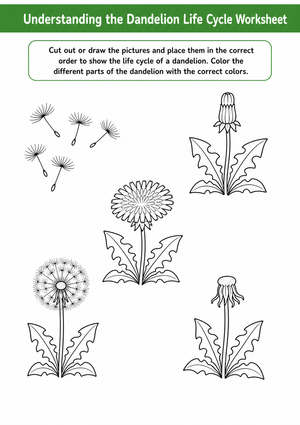
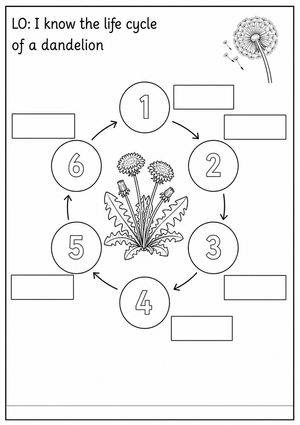
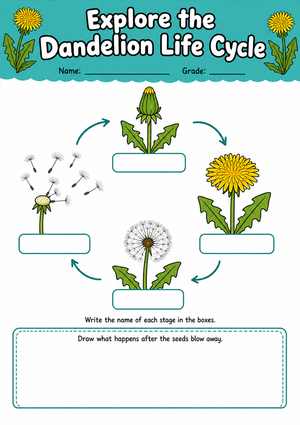
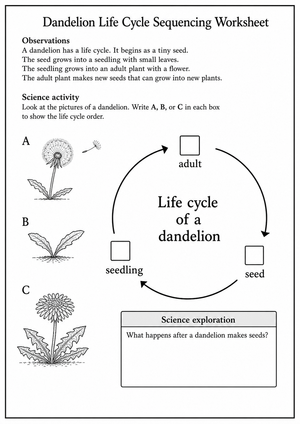
The life cycle sequencing worksheet presents the stages out of order: seed, germination, seedling, rosette, yellow flower, and white puffball. Students arrange them chronologically, either by cutting and pasting or by numbering a scrambled image set. The rosette stage is often new territory — most students have not noticed that dandelion leaves press flat against the ground as a competitive growth strategy, and naming that stage specifically encourages closer observation of plants they walk past every day.
The seed dispersal worksheet widens the focus. Students sort seeds from several plants — dandelion, maple, burr, coconut — by dispersal method: wind, animal, water. The dandelion's pappus is the anchor comparison point. By the time students reach this worksheet, they have already labeled the plant and sequenced its life cycle; the dispersal activity asks them to explain why the pappus structure exists, not just name it.
Student Mistakes That Surface Consistently in This Unit
The most predictable sequencing error is placing the puffball stage immediately after the seed. Both stages look roughly circular in a diagram, and students who have never watched a dandelion flower close up and reopen as a puffball treat the two as visual twins. The fix is straightforward: show students a yellow dandelion flower in hand — or in a short video — before they touch the sequencing worksheet. Once they have seen the flower stage, the correct order stops being a guessing game.
On anatomy labeling, students regularly write "root" next to the rosette of leaves. The leaves grow flat and low to the ground, and to a second grader, "close to the ground" reads as root-like. Correcting this requires pointing out that the root in the diagram is below the soil line — invisible on the page — and that the flat leaf arrangement is actually a competitive survival strategy, not a root structure. An outdoor moment where a student tries and fails to pull up a dandelion makes this argument faster than any verbal explanation.
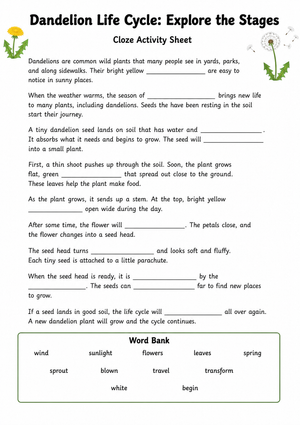
The vocabulary confusion between "germination" and "growth" runs through this unit every year. Students pick up the word germinate, use it throughout their writing, and apply it to stages it does not belong to — "the plant germinates into a puffball" appears in student work more often than most teachers expect. Addressing this distinction directly and briefly on day one prevents it from compounding: germination ends the moment the first shoot breaks ground, and everything after that is growth.
Where These Worksheets Fit in the Lesson Sequence
The labeling worksheet works best as a diagnostic at the start of the unit, before direct instruction. Have students attempt it without preparation. Whatever they mark incorrectly — and they will label the rosette as a root, they will skip the taproot entirely — tells teachers exactly where to spend instructional time before moving forward. That cold attempt is the most efficient formative data the plant unit produces.
The sequencing worksheet belongs in the middle of the unit, after outdoor observation. Teachers who take the class outside to find dandelions in different stages before completing the sequencing activity consistently see fewer ordering errors. Even a ten-minute walk on the school lawn, where students can find a yellow flower and a white puffball at the same time, changes what the worksheet accomplishes. The 2nd grade dandelion printable worksheets are structured to run as a three-day sequence — labeling, then sequencing, then dispersal — or spread across a full week with read-alouds and class discussion woven in between.
The seed dispersal worksheet works as a consolidation activity at the end of the unit. It asks students to apply what they know about the pappus to evaluate unfamiliar seeds — a concrete step toward transferable scientific thinking. That transfer is what makes the activity worth saving for last rather than introducing it alongside the initial anatomy lesson.
Standard Alignment
The life cycle and anatomy content aligns with NGSS 2-LS4-1, which asks second graders to make observations confirming that offspring resemble their parents. The life cycle sequence establishes that a dandelion seed produces a dandelion plant — not a generic flower — which is the conceptual core of that standard. In classroom terms, the sequencing worksheet is direct preparation for students to make that claim in writing and support it with what they observed outdoors.
The seed dispersal activities address NGSS 2-LS2-2, which focuses on how plants depend on animals, wind, and water to move seeds into new environments. This standard is frequently taught through text alone, leaving students with vocabulary but no mechanism. The dandelion pappus gives students a physical structure to examine, describe, and compare — they can explain how it works before they are asked to write about it formally.
Adjusting Each Worksheet for Different Learners
Students who are still building reading fluency handle the anatomy labeling worksheet well because the task is diagram-based rather than text-heavy. These students can complete the labeling with confidence while peers who are ready for more challenge work through the written-response section of the dispersal worksheet, which asks them to explain — not just identify — how the pappus structure determines where the seed travels. Running both worksheets in parallel, with students diverging at the written-response section, keeps the class working on the same content without sorting by ability group.
For students ready for extension, one added prompt turns any labeling exercise into a reasoning task: "What would happen to this plant if it had a shallow root instead of a taproot?" That question requires no extra materials and pushes students to think about cause and effect in biological systems, which is above grade-level expectation but well within the curiosity range of a motivated second grader. The 2nd grade dandelion printable worksheets include enough structural detail in the diagrams that this kind of follow-up questioning layers in easily without modifying the worksheet itself.
Students who find fine motor tasks challenging do better with the cut-and-paste sequencing format than with a write-in numbering version. If both formats are available, letting those students self-select removes a barrier that has nothing to do with their understanding of plant life cycles.
Frequently Asked Questions
Do these worksheets require an outdoor observation component to be effective?
No, and they will still teach the content without going outside — but the sequencing errors described above are more common when students have worked only from diagrams. If outdoor access is limited, a brief video showing a dandelion transitioning from yellow flower to white puffball does most of the same conceptual work. The worksheets function independently; the outdoor component accelerates how quickly students hold the correct stage order in memory.
What if dandelions are not in season when I teach this unit?
The anatomy and sequencing worksheets work year-round with photo support. Several science education databases offer close-up photographs of each dandelion stage that teachers can project during instruction. The seed dispersal worksheet is entirely season-neutral — students are comparing and sorting, not observing live specimens. If the unit falls outside spring, pairing the 2nd grade dandelion printable worksheets with a classroom plant growth timeline gives students the temporal context they would otherwise build through direct observation on the school grounds.
Are these worksheets appropriate for first or third grade?
The anatomy labeling worksheet is accessible to first graders with vocabulary support — most of the task is matching labels to diagram parts, which does not require strong reading fluency. Third graders benefit most from the seed dispersal comparison, which they can extend into a paragraph explaining how structure determines function. The sequencing worksheet is most precisely calibrated to second-grade expectations, where students are beginning to organize biological events chronologically and connect each stage to the one that follows it.
Clear All