




























Views
Downloads

Apple Tree Life Cycle Wheel | Essential Grade 1 Science

Paste this activity's link or code into your existing LMS (Google Classroom, Canvas, Teams, Schoology, Moodle, etc.).
Students can open and work on the activity right away, with no student login required.
You'll still be able to track student progress and results from your teacher account.
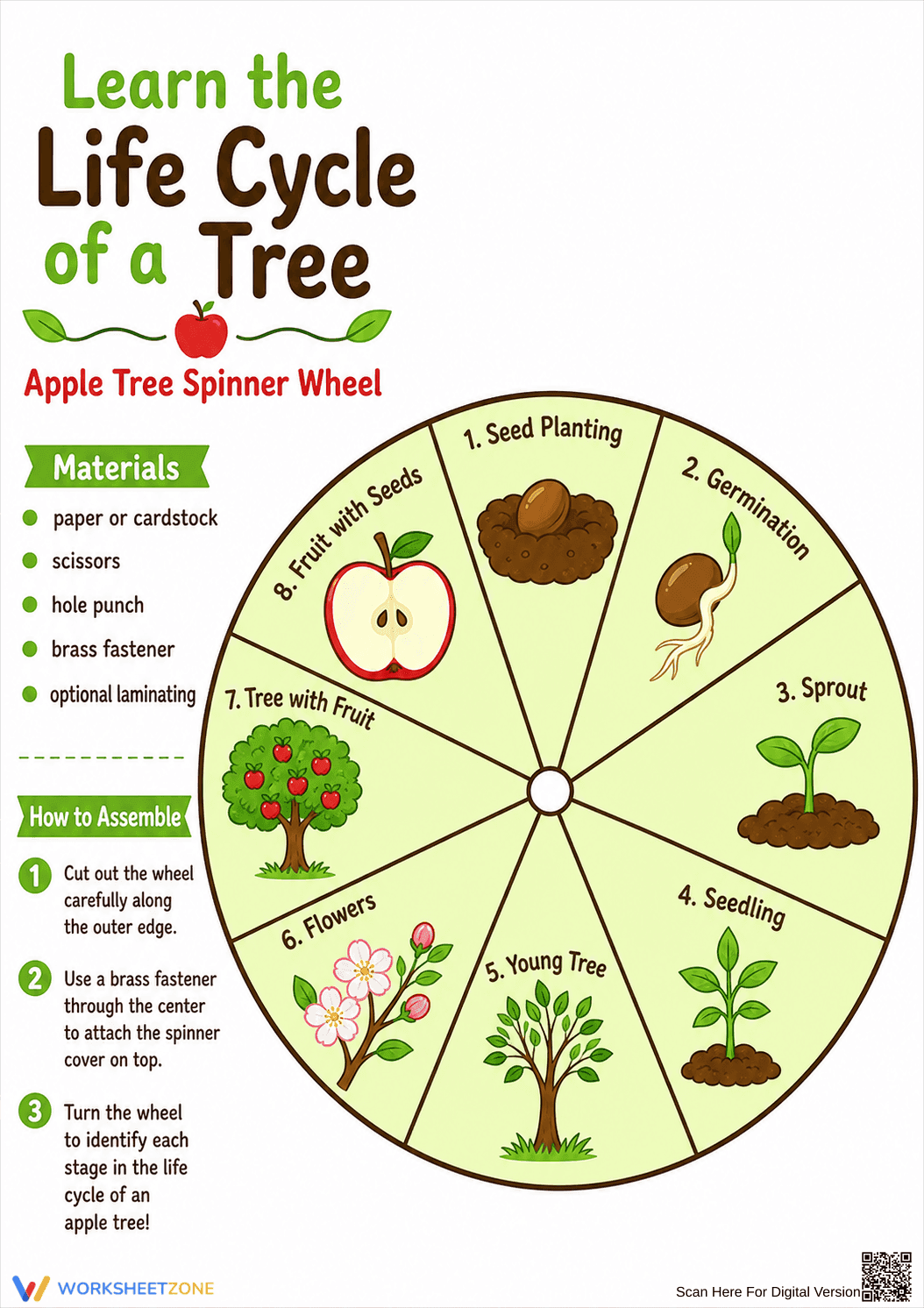
This interactive Apple Tree Life Cycle Wheel provides a tactile way for students to visualize the 8 distinct stages of plant development. By assembling this spinner, learners engage with biological sequences from seed planting to fruit production, reinforcing foundational botanical concepts through active construction and observation of natural growth patterns.
At a Glance
- Grade: 1 · Subject: Science
- Standard:
1-LS1-1— Describe how plant parts help them survive, grow, and meet their needs- Skill Focus: 8-stage botanical life cycle
- Format: 1 page · 8 stages · Assembly guide included · PDF
- Best For: Hands-on science centers and interactive notebooks
- Time: 15–20 minutes
This 1-page PDF includes a comprehensive circular diagram divided into eight illustrated segments: seed planting, germination, sprout, seedling, young tree, flowers, tree with fruit, and fruit with seeds. It features a clear materials list and a three-step assembly guide, ensuring students can independently create their learning tool with minimal teacher assistance or complicated setup.
The zero-prep workflow for this activity is designed for maximum efficiency in busy classrooms. First, print the single-page template (30 seconds). Next, distribute the sheets to students for cutting and assembly (1 minute). Finally, review the stages as a group using the completed spinners (10 minutes). Total teacher preparation time is under 2 minutes, making it an ideal choice for emergency sub plans or spontaneous science lessons.
This resource is aligned to the primary standard 1-LS1-1, focusing on how plants use their external parts to grow and survive. By identifying the transition from flowers to fruit, students see the functional relationship between plant structures. This standard code can be copied directly into lesson plans, IEP goals, or district curriculum mapping tools.
To use this worksheet effectively, introduce it during the "Explore" phase of a 5E science lesson. Have students predict the order of the stages before fastening the wheel. It also serves as a formative assessment tool; teachers can observe students as they rotate the wheel to explain the sequence of growth. Expected completion time ranges from 15 to 20 minutes.
This activity is designed for Grade 1 students but is highly effective for Kindergarten and Grade 2 learners. It supports visual and kinesthetic learners through its craft-based approach. Pair this resource with a non-fiction text about orchards or a live seed-planting demonstration to provide a comprehensive botanical learning experience.
Research from Fisher & Frey (2014) emphasizes that multi-modal learning tools, such as this interactive life cycle wheel, significantly enhance the retention of complex biological sequences in early childhood education. By combining visual illustrations with tactile assembly, the worksheet aligns with the 1-LS1-1 standard, which requires students to observe and describe patterns in plant growth and survival. The 8-stage progression provides a more granular view than traditional four-stage models, allowing for a deeper understanding of the transition from flowering to fruit production. Studies in the ScienceDirect TpT Analysis suggest that hands-on spinner activities reduce cognitive load by allowing students to focus on one stage at a time while maintaining a sense of the whole cycle. This resource serves as a vital bridge between direct instruction and independent exploration, ensuring that Grade 1 learners can articulate the chronological development of an apple tree with scientific accuracy and confidence.


