2nd Grade Tulip PDF Worksheets for Science Lessons
These 2nd grade tulip pdf worksheets give second-grade teachers a set of ready-to-print resources for one of the most conceptually distinct plant studies in the elementary science curriculum — the tulip, a plant that stores energy underground in a bulb rather than starting fresh each year from a seed. The set targets six stages of growth and builds vocabulary, sequencing, and observation-recording skills across the full arc of the tulip's annual cycle.
The Specific Skills Each Worksheet Builds
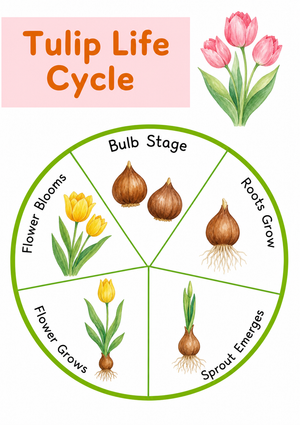
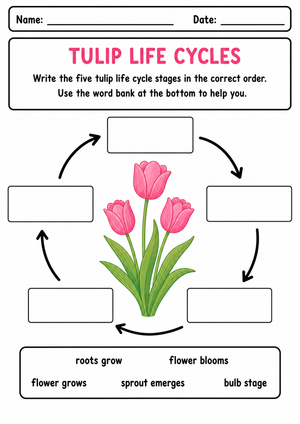
The core task across the set is diagram labeling. Students receive a detailed illustration of a tulip at a specific growth stage — dormant bulb, emerging roots and shoots, leafed-out stem, closed bud, open flower, seed pod — and use a word bank to name each structure. Repeated contact with the same vocabulary across different stages cements terms like dormant, shoot, and bud more durably than a one-time vocabulary list ever does.
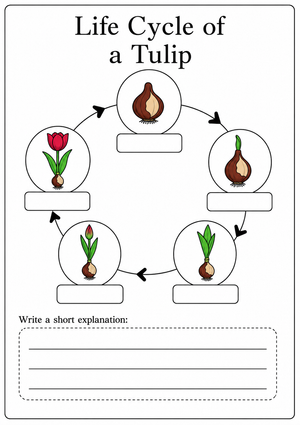
A second skill thread involves cut-and-paste sequencing. Students sort six illustrated cards into chronological order, glue them down, and write a caption beneath each image. That writing step matters: when students explain a stage in their own words, they surface gaps in understanding that a multiple-choice question would never reveal. The third skill area across the set is comparative analysis — students complete a simple T-chart comparing the tulip cycle to a sunflower or bean plant, noting that both share roots, stems, leaves, and flowers, but that the tulip's starting point is a bulb rather than a seed. That comparison is where second graders start thinking like botanists.
Student Misconceptions That These Worksheets Help You Catch
The dominant error in this unit is classification: students call the tulip bulb a seed. Developmentally, this makes sense — second graders have usually only encountered seeds as plant starting points, so they map the bulb onto that existing mental model. The labeling tasks force the issue early, because students have to write bulb in a field that clearly points to a structure three to four times larger than a bean. That moment of noticing the mismatch opens the conversation about what a bulb actually stores and why it behaves differently.
A second consistent error shows up in sequencing: students place the open flower directly after the bulb, skipping the roots-and-shoots stage entirely. They know a bulb produces a flower — they've seen tulips in a front yard — but the underground work that precedes the first green shoot is invisible in daily experience. Worksheets that show a cross-section view of the bulb with downward-growing roots help correct this before it hardens into a misconception. Watch also for students who reverse root and shoot direction, drawing roots reaching upward toward sunlight.
Building These Worksheets Into a Tulip Life Cycle Unit
The most effective sequencing across the unit follows a predict — observe — record pattern. Before distributing any worksheet, place a physical tulip bulb on the document camera and ask students what they think will happen first underground. After discussion, hand out the bulb-stage labeling worksheet so students annotate what they already believe. As the unit progresses — ideally alongside a cold-treatment project where students refrigerate bulbs for three to four weeks before planting in clear cups — the sequencing worksheet functions as a culminating retrieval task rather than an introduction to unfamiliar content.
For teachers who run a Monday morning warm-up routine, the comparison worksheet works well as an independent five-minute task after the class has moved through all six stages. Students who finish quickly extend the comparison in writing; students who are still consolidating use their completed diagram as a reference while they work. The cut-and-paste sequencing worksheet, by contrast, produces richer results during small-group science center rotations, where you can listen to the reasoning students use while sorting cards — that verbal reasoning reveals far more than the final glued product does.
Standard Alignment
These worksheets support NGSS 2-LS2 Ecosystems: Interactions, Energy, and Dynamics, which asks second graders to examine how plants depend on water, light, and temperature to grow. The tulip's cold dormancy requirement is a direct entry point into that standard: students trace how a bulb needs a sustained cold period before it can sprout, connecting the plant's biological needs to winter and spring conditions in the real world. The written caption tasks on the sequencing worksheet also address CCSS W.2.2 (informative/explanatory writing), so teachers address two standards in one activity without forcing an artificial cross-curricular connection.
Differentiating the Set Across a Range of Learners
For students still developing fine motor control, pre-cutting the sequencing cards before the lesson removes a barrier that has nothing to do with science understanding. The labeling worksheet can be adjusted for early readers by reducing the word bank to three terms instead of six, allowing students to focus on matching rather than spelling under pressure.
Students who move quickly through the core tasks benefit from an added writing prompt: "Explain why a tulip can grow back each spring without a new seed being planted." That question requires connecting the bulb's energy-storage function to the concept of dormancy — a genuinely higher-order task, not simply more of the same. For students receiving language support, adding small illustrations next to each word in the word bank provides a visual anchor the text alone cannot offer. The 2nd grade tulip pdf worksheets in this set use a word bank format that teachers can annotate by hand before printing, making that adjustment straightforward without requiring a separate file.
Frequently Asked Questions
Do students need to see a real tulip bulb before completing the labeling worksheet?
They do not need to, but a brief introduction — even just passing a bulb around the room before the lesson — makes the labeling task significantly more grounded. When students have held the bulb and noticed its papery outer layers and dense weight, the diagram connects to something tangible rather than purely abstract. The worksheets function independently, but a two-minute physical introduction shortens the conceptual distance students have to cross.
When in the unit should the sequencing worksheet be introduced?
After students have encountered all six stages at least once through read-alouds, video clips, or the labeling worksheets — not before. Sequencing is a retrieval exercise: it asks students to reconstruct knowledge they have already built. Introducing it too early turns the task into a guessing activity. Using it as a culminating check-in, ideally after the class has watched a chilled bulb begin to sprout in a clear cup, produces much richer student work and surfaces remaining gaps in understanding.
How should these worksheets be used for assessment versus practice?
The labeling worksheets work best as formative practice — they generate quick evidence of where vocabulary instruction needs reinforcement, but they do not distinguish a student who truly understands bulb function from one who simply copied a neighbor's labels. The written caption task on the sequencing worksheet gives a clearer picture of actual understanding: a student can paste cards in the right order by chance, but writing a sentence explaining why roots grow before the shoot appears cannot be faked in the same way. The 2nd grade tulip pdf worksheets in this set each include an answer key, which keeps scoring manageable during a busy science unit.
Can parents support this unit at home without classroom materials?
The labeling worksheets transfer well to home once vocabulary has been introduced in class — they require no materials beyond a pencil. The sequencing worksheet is harder to send home without prior classroom exposure, because the card-sorting process benefits from at least one guided attempt where students can talk through their reasoning. A better home connection is asking students to notice and photograph any spring-blooming bulb plants in their neighborhood, then bring that observation back to connect with the 2nd grade tulip pdf worksheets they complete in class.
Clear All