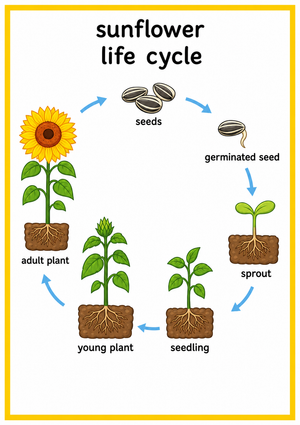
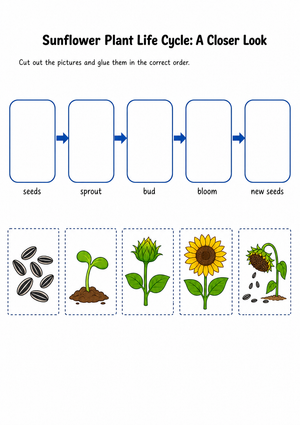
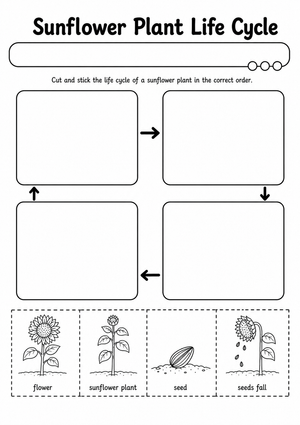
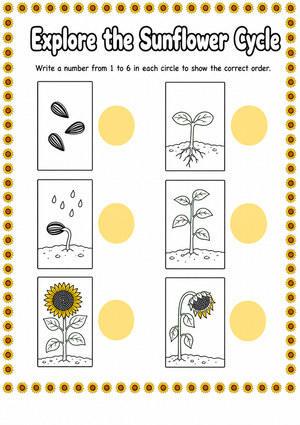
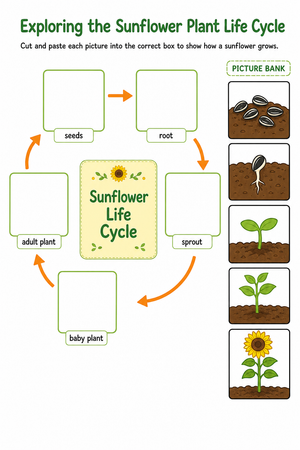
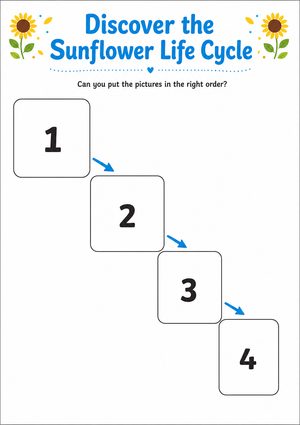
These 2nd grade sunflower life cycle pdf worksheets give teachers a print-ready set for building plant biology sequencing, anatomical vocabulary, and observation recording at the second-grade level. Sunflowers work well as a model organism here because the transformation is visible and extreme — a striped seed smaller than a fingernail eventually becomes a flower head taller than the student tending it, which gives those abstract stage names something concrete to attach to.
The Skills and Content Across the Set
The set targets five skill areas that second graders typically need to work through before the full life cycle concept settles.
- Stage sequencing: Students arrange illustrated cards showing seed, germination, seedling, young plant, adult plant, and seed production in correct chronological order. The cut-and-paste format forces a committed placement decision for each stage before the glue goes down — there is no half-finished version to hand in.
- Plant anatomy labeling: Students identify and label roots, stem, leaves, petals, and flower head, then write a brief function for each structure. The target is getting students to explain what roots do, not just point to where they are.
- Observation recording: Structured charts give students space to record height measurements, sketch their sprout's current appearance, and note visible changes week by week. These work best when the class is sprouting seeds in clear plastic cups and can watch root development through the cup wall.
- Pollinator connections: Short illustrated passages explain how bees transfer pollen between flowers, placing the sunflower's reproductive stage within a broader ecological picture. Text-dependent questions follow each passage.
- Vocabulary practice: Students match terms — including germination, seedling, pollination, and heliotropism — to definitions, then use each term in a written sentence to consolidate meaning before applying the words to other tasks.
What Student Work Typically Shows on These Tasks
The most consistent error on the sequencing task is placing the seedling card before germination rather than after it. Students see a seed, they see a green sprout breaking through soil — and those two things already make sense together. The hidden underground event of germination feels like an interruption between steps that seem adjacent. Having students narrate their card order aloud before gluing is the fastest diagnostic: the ones who pause at the germination card and say "I don't know where this goes" are the students who need a direct explanation of what actually happens inside a seed when water enters it.
On the labeling worksheet, students almost always position roots at or just above the soil line — drawn at the stem base or hovering at soil level. They know roots exist, but the mental image of roots extending downward and outward through underground soil has not formed yet. The cross-section diagram used in this worksheet makes that underground architecture visible, which is more effective than telling students roots go down, because they can see the full root system in spatial relation to the plant above ground.
A third persistent issue: students write that germination happens "when you water the seed" rather than describing the internal biological event — the seed absorbing moisture until the coat splits and the embryo activates. Students who hold the first version are describing a human action, not a plant process, and that framing becomes a problem when they are asked to explain what germination is rather than what triggers it. The vocabulary worksheet targets this distinction directly by defining germination from the plant's perspective.
Standard Alignment
NGSS formally places life cycles at third grade under 3-LS1-1, which asks students to develop models showing that organisms have diverse life cycles but share the common arc of birth, growth, reproduction, and death. Many districts introduce plant life cycles in second grade as direct preparation for that standard, and the sequencing and labeling worksheets serve that function cleanly. Students who arrive at third grade able to sequence a sunflower's stages and explain what germination means arrive with the conceptual vocabulary 3-LS1-1 assumes. The observation recording worksheet also connects to NGSS 2-LS2-1, which addresses the conditions plants need to grow — students tracking changes in their sprouting cups in response to water and light are doing exactly the work that standard describes.
Where These Worksheets Fit in a Sunflower Unit
The strongest multi-day sequence starts with seeds in cups before the first lesson. Plant them, then introduce the anatomy labeling worksheet as a whole-group activity — display it on the projector while students annotate their own copies alongside you. On day two, the sequencing cut-and-paste works well at science centers while you pull a small group to read the pollinator passage together. By day three, students return to their sprouting cups to complete the first row of their observation chart, connecting the labeled diagram from day one to the actual seedling now emerging from the soil. The moment when the cross-section diagram they drew lines up with visible root growth through the cup wall is when the biology becomes real for most eight-year-olds.
The 2nd grade sunflower life cycle pdf worksheets also function well as standalone formative checks outside a full unit. The sequencing task takes roughly twelve minutes and gives a clear read on which students have internalized stage order and which are pattern-matching from memory without real understanding. Running it as a warm-up the day after your introductory lesson — then reviewing results before the next class — gives enough lead time to pull three or four students for a brief small-group re-teach before the class moves on to pollinators.
Fitting These Worksheets to Students at Different Readiness Points
Students who struggle with vocabulary recall benefit from a modified labeling task where the stage names are printed in a word bank at the bottom. The cognitive demand shifts from retrieval to recognition, which is a more manageable entry point when the terms are genuinely new. The sequencing worksheet can be simplified to three stages first — seed, seedling, adult plant — and then completed in full once that basic arc is stable. That two-pass approach works better than introducing all six stages simultaneously for students still building their sense of biological sequencing in general.
For students who finish early and accurately, the observation chart becomes more demanding with one straightforward extension: before each recording session, they write a prediction for what they expect to see the following week, then revisit it to check accuracy. The 2nd grade sunflower life cycle pdf worksheets pair well for these students with a short comparison task — mapping the sunflower's stages onto a bean plant life cycle, which many second graders have also grown, reinforces the principle that life cycles share a common structure even when the specifics differ between species.
Frequently Asked Questions
Do students need access to a live plant, or do the diagrams work on their own?
The labeling and sequencing worksheets are self-contained — students work entirely from printed diagrams. The observation recording worksheet is built around a live plant but functions as a structured drawing activity when students sketch stages from a classroom poster or projected image instead. Teachers growing seeds in cups will find that introducing 2nd grade sunflower life cycle pdf worksheets during the first week of sprouting gives students a physical reference point for what the printed diagrams are actually showing.
What vocabulary should students already know before starting the labeling task independently?
Students should have basic terms in place: seed, root, stem, and leaf. The vocabulary matching worksheet introduces germination, seedling, pollination, and heliotropism with printed definitions, so those terms do not need to be pre-taught — the worksheet handles the introduction, and the written sentence practice that follows builds familiarity before students encounter those words on the sequencing and labeling tasks.
These are listed as second-grade resources, but NGSS places life cycles at third grade. Does that create a mismatch?
Many state frameworks and district curriculum maps address plant life cycles in second grade, either through state-specific standards or through scope and sequence documents that front-load third-grade NGSS concepts. These worksheets fit that preparation year naturally. If your school officially places life cycles at third grade, the content and reading level work equally well as introductory third-grade material — the biological content and vocabulary complexity sit comfortably at that transition point between the two grades.












 Interactive Worksheet Maker
 Quiz Maker
 Word Search Maker
 Crossword Puzzle Maker
 Word Scramble Generator
 Sentence Scramble Generator
 Handwriting Worksheet Generator
 Name Tracing Generator
 Fill In The Blank Generator