


























Views
Downloads

Printable Apple Life Cycle Worksheet | Grade 3 Science
Paste this activity's link or code into your existing LMS (Google Classroom, Canvas, Teams, Schoology, Moodle, etc.).
Students can open and work on the activity right away, with no student login required.
You'll still be able to track student progress and results from your teacher account.
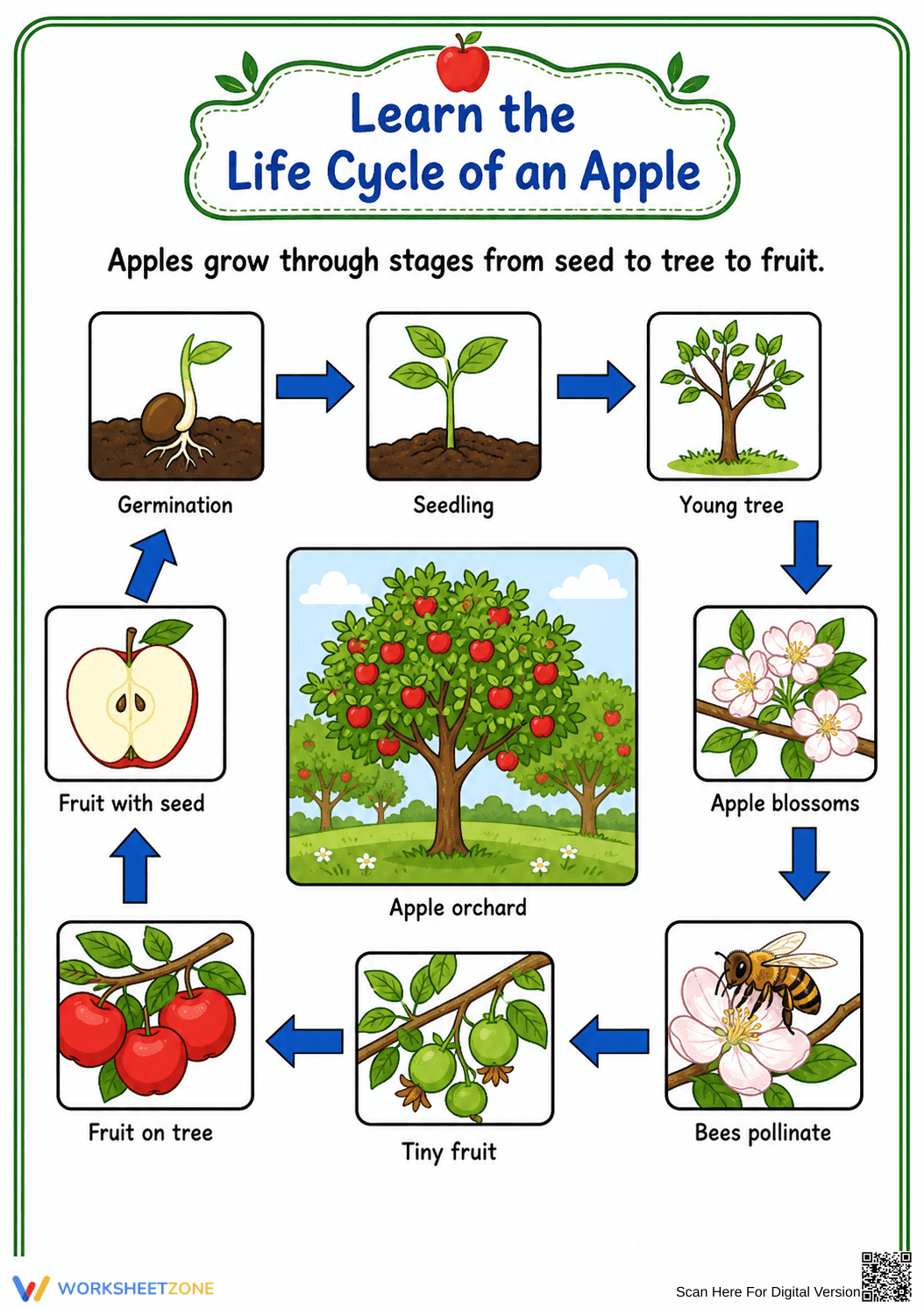
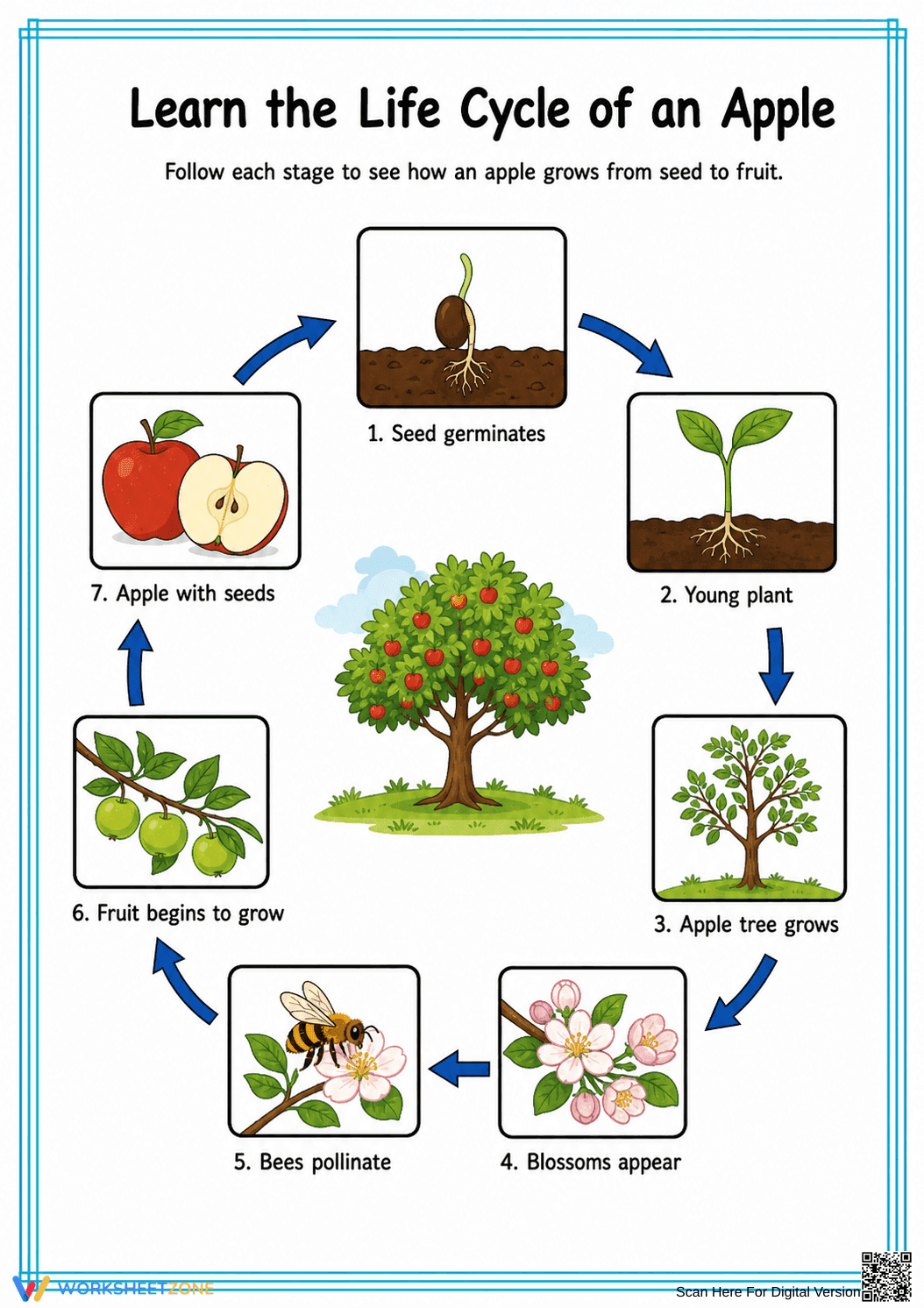
This educational science resource helps students visualize and understand the complete life cycle of an apple. By following clear, sequential diagrams, young learners will trace the journey from a tiny seed to a mature, fruit-bearing tree, mastering core concepts of plant growth, pollination, and reproduction.
At a Glance
- Grade: 3 · Subject: Science
- Standard:
3-LS1-1— Describe that organisms have unique and diverse life cycles.- Skill Focus: Plant Life Cycles
- Format: 2 pages · 0 problems · No answer key required · PDF
- Best For: Visual reference and direct instruction
- Time: 10–15 minutes
This download includes two beautifully illustrated reference pages that map out the stages of an apple's development. The first page features an eight-step cycle detailing germination, seedling growth, blossoming, bee pollination, and fruit maturation. The second page offers a simplified seven-step numbered sequence perfect for younger students. Both pages utilize clear typography, directional arrows, and vibrant imagery to make botanical concepts accessible without requiring an answer key.
Implementing this visual aid requires zero prep.
- Print (1 minute): Download the PDF and print.
- Distribute (1 minute): Hand out as a reference sheet or display on a smartboard.
- Review (5 minutes): Walk the class through the arrows, discussing the role of bees.
Total teacher preparation takes under two minutes, making this an excellent option for sub plans or science mini-lessons.
This resource is directly aligned to 3-LS1-1, supporting students as they develop models to describe that organisms have unique and diverse life cycles but all have in common birth, growth, reproduction, and death. It also provides foundational knowledge for understanding ecosystem interactions and plant biology. Both standard codes can be copied directly into lesson plans, IEP goals, or district curriculum mapping tools.
This versatile diagram works perfectly before direct instruction to activate prior knowledge or as an anchor chart during a broader unit on plant biology. Teachers can project the image onto a whiteboard and have students physically point to the stages as they explain the sequence aloud. For a quick formative assessment, cover the text labels and ask students to verbally identify what is happening in each picture. Expected completion time for a guided review is 10 to 15 minutes.
This material is designed primarily for third-grade science students, though its clear visuals make it highly effective for second and fourth graders as well. The straightforward language and sequential arrows provide excellent scaffolding for English Language Learners and visual learners who benefit from graphic organizers. It pairs perfectly with a hands-on seed planting activity or a read-aloud book about orchards and farming.
Understanding biological sequencing through visual models is a critical component of early elementary science education. When students engage with the 3-LS1-1 standard to describe that organisms have unique and diverse life cycles, they build essential cognitive frameworks for later, more complex biological studies. According to EdReports 2024, utilizing clear, sequential diagrams significantly improves student retention of scientific processes by reducing cognitive load and providing a concrete visual anchor for abstract concepts like pollination and germination. This apple life cycle resource directly supports these evidence-based instructional strategies by offering a highly structured, visually intuitive pathway from seed to fruit. By explicitly mapping out each developmental stage with directional cues, educators can ensure that all learners can successfully grasp the fundamental patterns of growth and reproduction in the natural world.


