These 2nd grade bean plant worksheets give teachers a ready set of resources for moving students from hands-on planting to genuine scientific documentation — labeling seed anatomy, sequencing the life cycle, and recording growth observations across several days. The set covers both the structural vocabulary of the bean plant and the environmental reasoning behind how it grows.
What Each Worksheet Targets
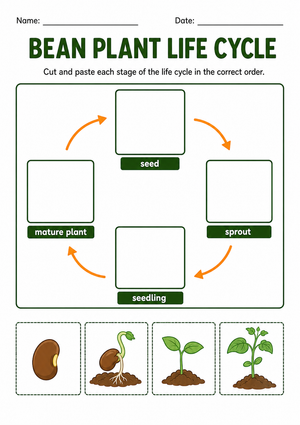
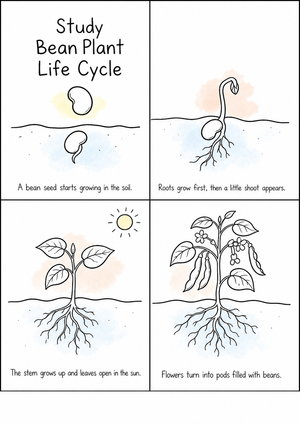
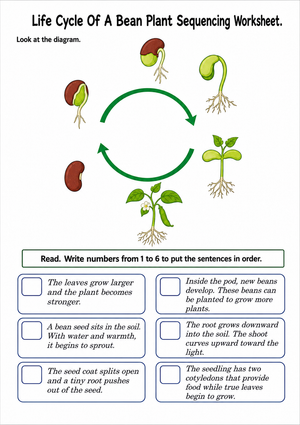
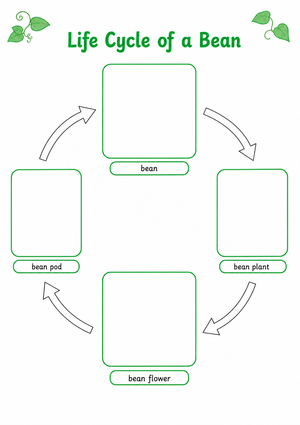
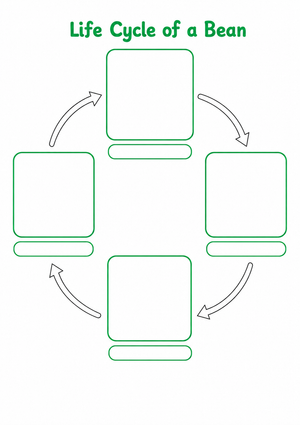
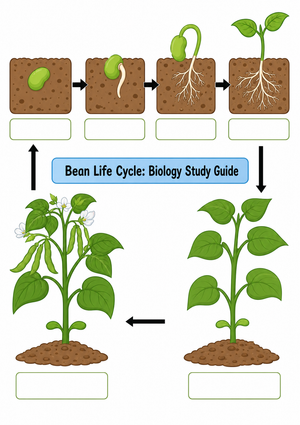
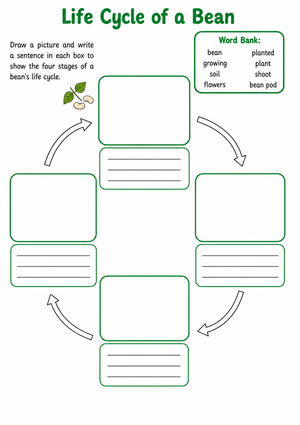
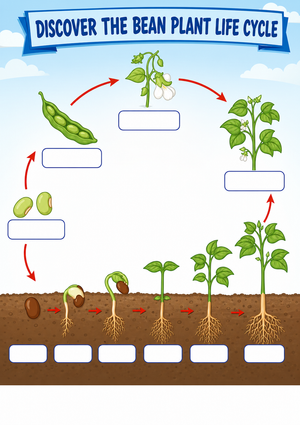
Each worksheet focuses on a distinct slice of the bean plant unit rather than covering everything at once. Students work through seed anatomy diagrams where they label the seed coat, embryo, and cotyledon on a cross-section illustration. Separate worksheets address the five life cycle stages — dormant seed, germination, seedling, adult plant, and seed pod production — through cut-and-paste sequencing and written caption work. There are also observation log worksheets built for daily use, with fields for date, height in centimeters, a sketch, and one sentence of scientific description.
The environmental variables worksheets ask students to predict and then record what happens when a bean receives no sunlight or inadequate water. Students mark a prediction, then revisit the same worksheet after three days of observation to compare what they expected with what actually happened. That prediction-then-evidence format is one of the more important thinking moves in early elementary science — it treats observation as a test of an idea rather than a description of what the plant looks like today.
Student Errors Worth Anticipating Before You Teach This Unit
The cotyledon is where most second graders get turned around. Because it resembles a leaf inside the seed, students routinely label it "leaf" on the seed diagram, and nothing in a typical class discussion clears this up without direct correction. The distinction matters because the cotyledon's job — storing food for the embryo before the plant can photosynthesize — is the hinge concept for understanding why seeds don't need light to germinate. This is worth two focused minutes before students pick up any labeling worksheet.
Sequencing errors cluster around germination. Students tend to place "root appears" after "stem appears" because the root grows underground and isn't visible first in their cup or bag. Showing brief germination footage before the sequencing worksheet fixes this quickly. A related mistake: students frequently draw roots pointing sideways or upward on the mature plant diagram. Root direction becomes obvious when students watch a bean grow in a clear plastic cup against a window — roots curve downward within the first week, and that image stays with them.
On the observation logs, the most common writing problem is restating the measurement instead of describing change. Students write "My plant is 4 cm" rather than "My plant grew 2 cm since Tuesday and has two new leaves." Posting a modeled example beside the growing station — one weak entry and one strong entry with the difference annotated — cuts this pattern considerably by the second week.
Working These Worksheets Into Your Science Block
The most natural entry point is a seed dissection. Soak beans overnight, hand them out, and let students split the seed coat and locate the embryo before they ever see a diagram. Once they've held the cotyledon in their fingers, the labeling worksheet becomes a record of something they just observed rather than an abstract vocabulary exercise. The concrete experience first, the written representation after — that sequence matters for seven-year-olds in a way it often doesn't for older students.
For the life cycle sequencing worksheets, a science center rotation works well. One group cuts and orders the life cycle stages, another sketches each stage from a specimen or photograph, and a third reads two sentences about each stage and matches them to an unlabeled image. Rotating through all three in a single period gives students three passes at the same content through different formats, which is more durable than reading a chart once and completing one task.
The observation logs function best as a morning routine task during the two or three weeks the plants are growing. The five minutes right after morning meeting — before the academic block starts — is enough time for students to check their plant, fill in the date and measurement, sketch any change, and return to their seat. That daily habit builds measurement fluency and gives you a running formative record of which students are using precise language versus vague description. The 2nd grade bean plant worksheets logs also serve as a natural anchor for the whole-class debrief at the end of the unit, when students can look back across their entries and describe the arc of growth.
Standard Alignment
The primary standard this set addresses is NGSS 2-LS2-1: "Plan and conduct an investigation to determine if plants need sunlight and water to grow." The environmental variables worksheets map directly to this expectation — students form a prediction, observe a simple comparison (one plant in full light, one in a dark corner), and record results over several days. This is the standard that asks second graders to treat a question as something testable, not just something answerable from a read-aloud. The labeling and sequencing worksheets support the science and engineering practices around obtaining information and communicating findings, which thread through multiple performance expectations in the NGSS K–2 band.
Adjusting the Worksheets for a Range of Learners
For students still building reading fluency, the labeling worksheets work better when the word bank is printed directly on the worksheet rather than on a separate reference card. Reducing memory load — not requiring students to hold a word while scanning the diagram — lets them concentrate on where each part belongs rather than on reading recall. You can print a version with a visible word bank alongside the standard version and decide at the table which student gets which.
Students who finish quickly and accurately benefit from being pushed into explanatory writing. After labeling the seed parts, they write one sentence per part describing its function. After sequencing the life cycle, they add a connective phrase between each stage — "After the seed coat splits, the radicle pushes downward because..." This moves them past identification into causation, which is the actual cognitive target of the unit. The 2nd grade bean plant worksheets format supports this kind of extension naturally because the diagrams and sequences are already printed; the deeper task is adding the explanation layer, not creating new problems from scratch.
For students receiving language support, partnered completion works well on the observation logs. One student dictates the description while the other records it, and both keep a copy. The act of speaking the scientific description aloud still builds the vocabulary and reasoning even when writing is shared.
Frequently Asked Questions
How long does germination take, and how do I keep students engaged during the wait?
Most bean varieties sprout within seven to ten days in a warm classroom with consistent moisture. Pre-soaking seeds for 24 hours before planting often shaves two or three days off that window. Using the 2nd grade bean plant worksheets observation logs during the waiting period keeps students engaged — they record the seed's current appearance, check daily for any change, and practice descriptive language even before anything visible happens. Looking closely at something that isn't moving yet is itself a legitimate science skill.
What happens if some plants die or fail to germinate?
Plant one or two extra beans per student, or keep a few teacher cups going at a classroom station. If a student's plant fails, they adopt an extra and still have growth to document. The failure is also worth a brief class conversation — was the soil too dry? Too waterlogged? Students who experience plant failure often produce the most thoughtful entries on the environmental variables worksheet afterward because the failure makes the variables feel real.
Are these worksheets suitable for students who have never planted anything before?
Yes, and that's the common situation. Second graders vary widely in outdoor and gardening experience, and the worksheets don't assume any prior knowledge — they build from diagrams and observations made during the unit itself. The seed anatomy worksheet is strongest when it follows the hands-on dissection activity, which gives every student the same concrete reference point regardless of their background at home.












 Interactive Worksheet Maker
 Quiz Maker
 Word Search Maker
 Crossword Puzzle Maker
 Word Scramble Generator
 Sentence Scramble Generator
 Handwriting Worksheet Generator
 Name Tracing Generator
 Fill In The Blank Generator