




























Views
Downloads

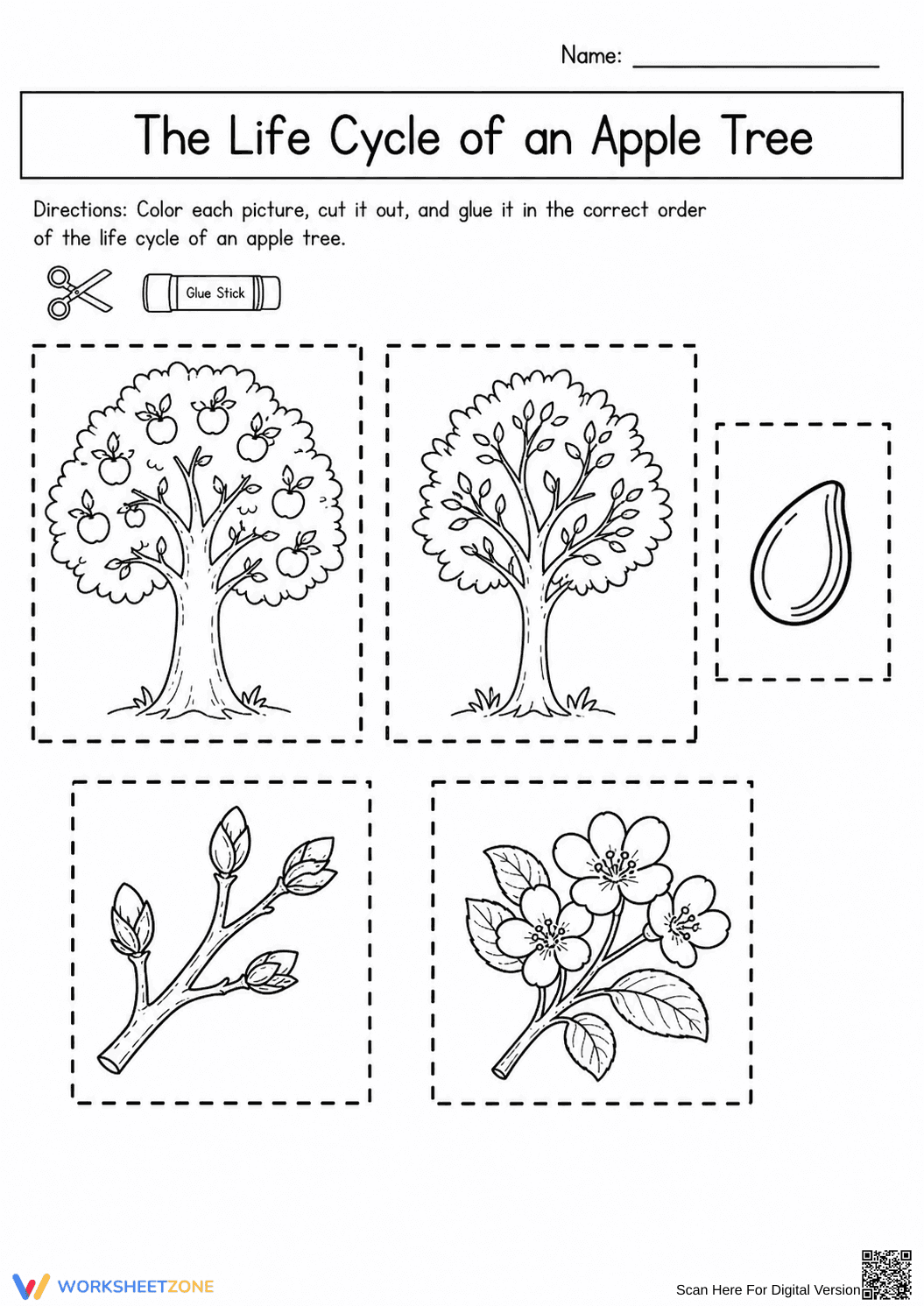

Apple Tree Life Cycle — Printable No-Prep Worksheet

Paste this activity's link or code into your existing LMS (Google Classroom, Canvas, Teams, Schoology, Moodle, etc.).
Students can open and work on the activity right away, with no student login required.
You'll still be able to track student progress and results from your teacher account.
Students master the chronological stages of plant growth with this hands-on apple tree life cycle activity. By sequencing visual representations from seed to fruit-bearing tree, learners develop a concrete understanding of biological patterns and environmental science while practicing essential fine motor skills.
At a Glance
- Grade: K-2 · Subject: Science
- Standard:
K-LS1-1— Use observations to describe patterns of what plants need to survive and grow- Skill Focus: Sequencing and plant biology
- Format: 2 pages · 5 problems · PDF
- Best For: Early science centers and sub plans
- Time: 15–20 minutes
This 2-page PDF includes a primary sequencing diagram and a dedicated cut-and-paste sheet. Students interact with five distinct stages: seed, sprout, sapling, blossoms, and mature apple tree. The layout features clear dashed borders for cutting and large placement boxes to support developing hand-eye coordination and spatial awareness.
Zero-Prep Workflow
- Print: Select the two pages and print enough copies for your group (30 seconds).
- Distribute: Provide students with scissors and glue sticks for the interactive component (1 minute).
- Review: Use the completed diagrams for a whole-class discussion on plant needs and seasonal changes (5 minutes).
Total teacher prep time is under 2 minutes, making this an ideal emergency sub plan or Friday science activity.
Standards Alignment: Primary standard `K-LS1-1`: Use observations to describe patterns of what plants and animals (including humans) need to survive. This worksheet supports the growth aspect of life science by visualizing the transition from seed to adult. Both standard codes can be copied directly into lesson plans, IEP goals, or district curriculum mapping tools.
How to Use It: Use this as a summative assessment after a read-aloud about seasons or orchards. It works best during the elaborate phase of a 5E lesson model. Teachers should observe if students can identify the blossom stage correctly before the fruit stage, which serves as a formative check for understanding pollination precursors. Expected completion time is 15 to 20 minutes.
Who It's For: Designed for Kindergarten through 2nd-grade students, including English Language Learners who benefit from visual sequencing. It pairs naturally with an anchor chart showing real-world photos of apple orchards or a classroom seed-planting experiment to bridge the gap between paper and nature.
The use of sequencing activities in early childhood science is supported by Fisher & Frey (2014), who emphasize that visual scaffolds help students internalize complex biological processes. This `K-LS1-1` aligned resource focuses on the plain-English skill of describing patterns in plant growth. Research from the RAND AIRS 2024 report indicates that hands-on cut and glue tasks significantly improve retention of chronological information in learners aged 5-8 compared to passive observation. By engaging multiple senses—visual, tactile, and cognitive—this worksheet ensures that the foundational concepts of life cycles are mastered. It provides a structured environment for students to practice fine motor control while simultaneously building the vocabulary necessary for future botanical studies. This resource is a reliable tool for meeting state science frameworks regarding living systems and their development over time.


