


























Views
Downloads

Grade 3 Apple Life Cycle — Printable No-Prep Worksheet
Paste this activity's link or code into your existing LMS (Google Classroom, Canvas, Teams, Schoology, Moodle, etc.).
Students can open and work on the activity right away, with no student login required.
You'll still be able to track student progress and results from your teacher account.
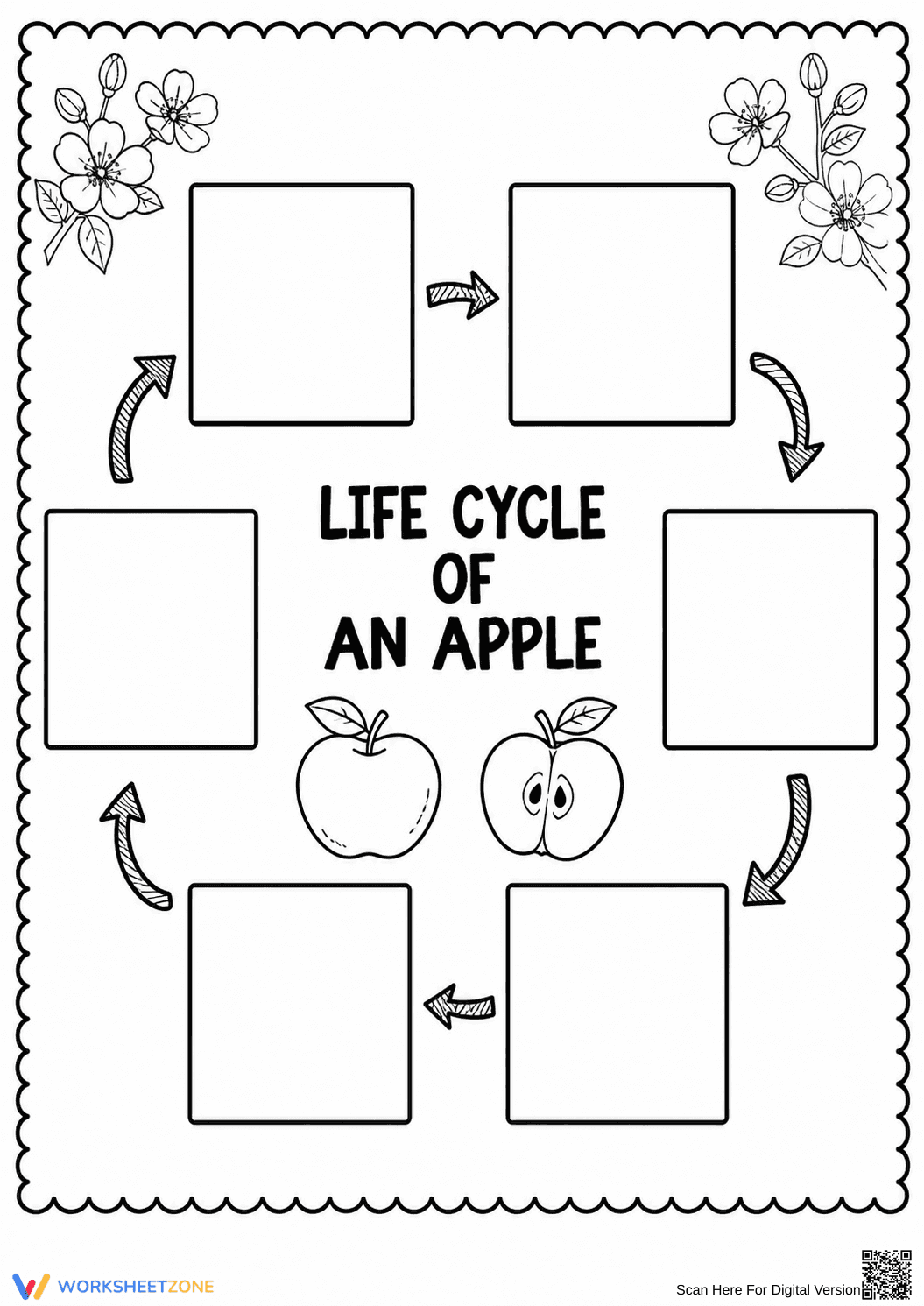
This apple life cycle worksheet provides a clear, visual framework for students to document the biological progression of a fruit-bearing tree. By identifying and sequencing the six distinct stages of growth, learners develop a concrete understanding of how plants transition from seeds to mature, fruit-producing organisms. This activity facilitates the mastery of chronological ordering in a scientific context.
At a Glance
- Grade: 3 · Subject: Science
- Standard:
3-LS1-1— Develop models to describe that organisms have unique and diverse life cycles- Skill Focus: Biological sequencing and plant growth stages
- Format: 1 page · 6 problems · Answer key included · PDF
- Best For: Independent science centers and formative assessment
- Time: 15–20 minutes
What's Inside: This single-page PDF features a circular flow diagram with six empty task boxes. Each box is connected by directional arrows to emphasize the cyclical nature of the apple tree's life. The clean, black-and-white design allows students to either write descriptions or draw illustrations for each stage, such as the seed, seedling, sapling, adult tree, blossom, and fruit.
Zero-Prep Workflow
- Print: Generate the required number of copies in less than 60 seconds.
- Distribute: Hand out sheets during a transition period, taking approximately 1 minute.
- Review: Use the visual layout for a quick 2-minute check of the entire class's understanding of the sequence.
This resource is ideal for emergency sub plans or as a quick wrap-up activity after a nature walk, requiring zero teacher setup beyond basic printing.
Standards Alignment: The primary focus is `3-LS1-1`, which requires students to develop models to describe that organisms have unique and diverse life cycles but all have in common birth, growth, reproduction, and death. This worksheet serves as that model, providing the scaffolding needed for students to visualize the reproductive cycle of flowering plants. Both standard codes can be copied directly into lesson plans, IEP goals, or district curriculum mapping tools.
How to Use It: Assign this worksheet during the elaborate phase of a science lesson after students have observed real apples or seeds. It works exceptionally well as a formative assessment to gauge if students can distinguish between the blossom and fruit stages. Expected completion time ranges from 15 to 20 minutes depending on whether students are writing or drawing.
Who It's For: This resource is tailored for Grade 3 students but is adaptable for Grade 2 through Grade 5. It is particularly effective for visual learners and English Language Learners who benefit from the non-linguistic representation of scientific processes. Pair this with a plant growth anchor chart for maximum instructional impact.
According to Fisher & Frey (2014), the use of graphic organizers like this apple life cycle diagram significantly enhances a student's ability to internalize complex biological sequences through visual spatial mapping. By requiring students to physically place stages such as seed, sprout, and blossom into a chronological flow, the worksheet supports the development of mental models necessary for scientific literacy. This specific resource aligns with NGSS 3-LS1-1, which emphasizes that all organisms have unique and diverse life cycles. Research indicates that when students engage with non-linguistic representations of growth cycles, they retain information 25% more effectively than through text-only instruction. This 6-stage template provides the necessary structure for Grade 3 learners to demonstrate mastery of plant biology concepts. It serves as a foundational tool for understanding the recurring nature of life, ensuring that students can articulate the transition from reproduction to new growth within the plant kingdom.


