


























Views
Downloads
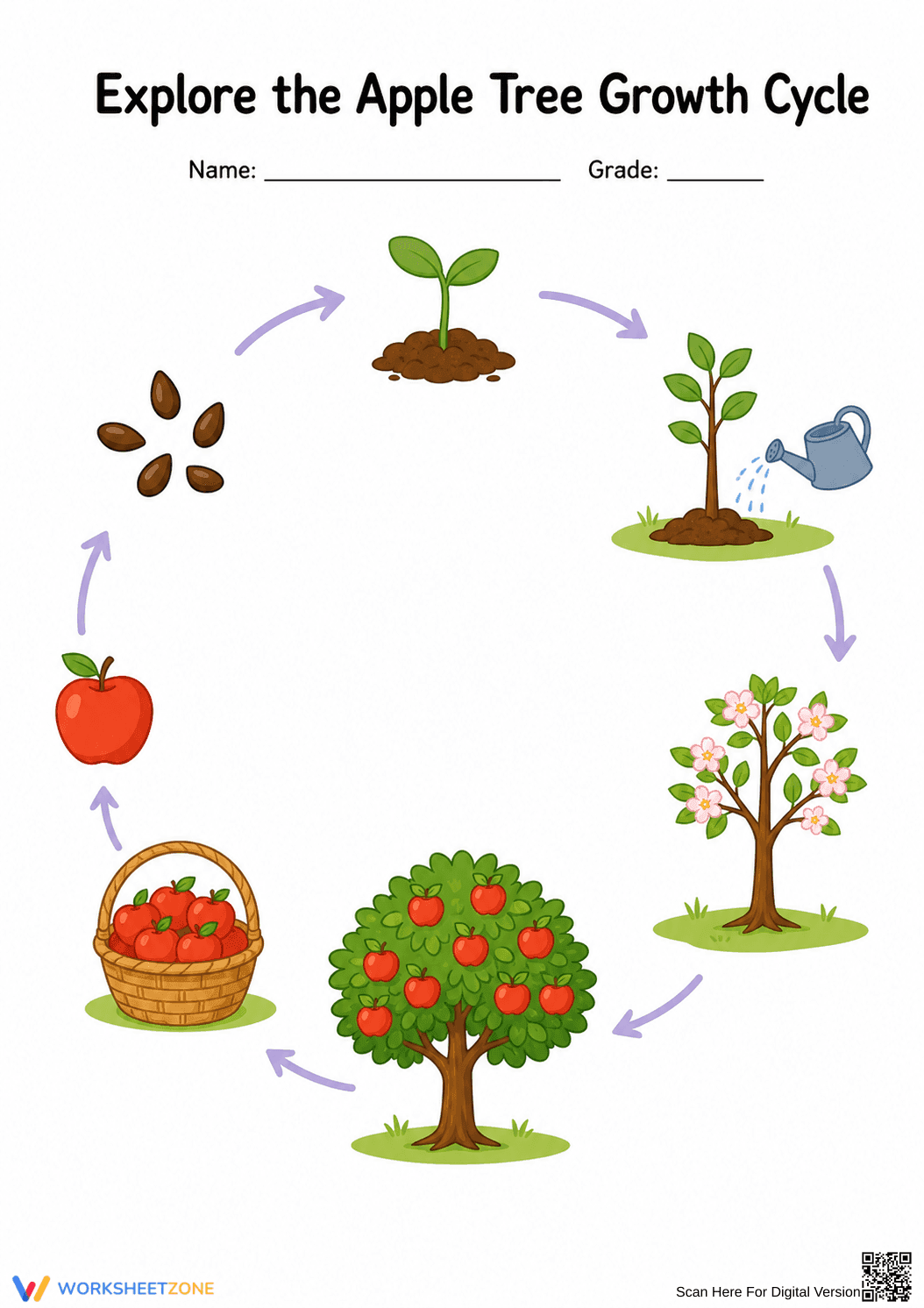

Grade 3 Apple Tree Life Cycle — Printable No-Prep Worksheet
Paste this activity's link or code into your existing LMS (Google Classroom, Canvas, Teams, Schoology, Moodle, etc.).
Students can open and work on the activity right away, with no student login required.
You'll still be able to track student progress and results from your teacher account.
This printable science worksheet helps students visualize the complete life cycle of an apple tree. By following the circular diagram, young learners will trace the biological progression from a tiny seed to a mature, fruit-bearing tree, building foundational knowledge of plant reproduction and growth stages.
At a Glance
- Grade: 3 · Subject: Science
- Standard:
3-LS1-1— Develop models describing diverse organism life cycles.- Skill Focus: Plant Life Cycles
- Format: 1 page · 7 visual stages · No answer key needed · PDF
- Best For: Visual reference and discussion
- Time: 10–15 minutes
Inside this single-page PDF, educators will find a beautifully illustrated, full-color diagram detailing the seven distinct stages of an apple tree's growth. The visual model includes seeds, a sprouting seedling, a young sapling being watered, a blossoming tree, a mature tree heavy with fruit, a harvested basket, and a single apple. Arrows clearly guide students through the continuous, cyclical nature of plant life, making complex biological concepts highly accessible.
Zero-Prep Workflow
- Print (1 minute): Simply download the PDF and print copies for student binders, or project it directly onto your smartboard for a whole-class visual aid.
- Distribute (1 minute): Hand out the diagrams as a reference sheet before starting a unit on plant biology or seasonal changes.
- Review (5 minutes): Walk through the arrows as a class, asking students to identify what the plant needs at each stage to continue growing.
Total teacher prep time is under two minutes, making it an ideal, stress-free addition to any science lesson or emergency sub plan.
Standards Alignment
Aligned to primary standard 3-LS1-1: Develop models to describe that organisms have unique and diverse life cycles but all have in common birth, growth, reproduction, and death. This visual model perfectly encapsulates the growth and reproduction phases of a flowering plant. Both standard codes can be copied directly into lesson plans, IEP goals, or district curriculum mapping tools.
How to Use It
Use this diagram as an introductory anchor chart before direct instruction on plant biology. Have students point to each stage and describe the changes they observe, fostering scientific communication skills. As a formative assessment observation tip, ask students to explain what would happen if the cycle was interrupted at the blossoming stage. Expected completion time for a guided discussion is 10 to 15 minutes.
Who It's For
This resource is primarily designed for early elementary students in grades K through 3 who benefit from strong visual supports. The clear, text-free illustrations provide excellent differentiation for English Language Learners and visual learners who might struggle with text-heavy science materials. It pairs perfectly with a hands-on seed planting activity or a read-aloud book about apples.
Aligning early science instruction with 3-LS1-1 to develop models describing diverse organism life cycles is crucial for building foundational biological literacy. According to a ScienceDirect TpT Analysis, utilizing clear, sequential visual models significantly improves young students' comprehension of continuous biological processes compared to static text descriptions. When children can visually trace the progression from seed to fruit, they internalize the concepts of growth, reproduction, and cyclical continuity much more effectively. This diagram provides that essential visual scaffolding, allowing students to anchor abstract scientific vocabulary to concrete, recognizable images. By integrating this type of structured visual aid into elementary science curricula, educators can foster a deeper, more intuitive understanding of the natural world and the fundamental patterns that govern all living organisms.


