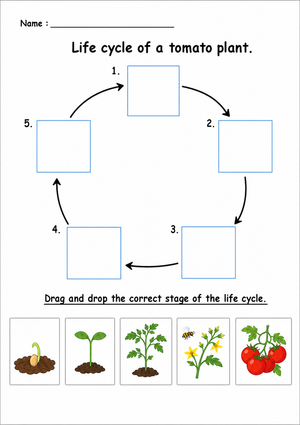
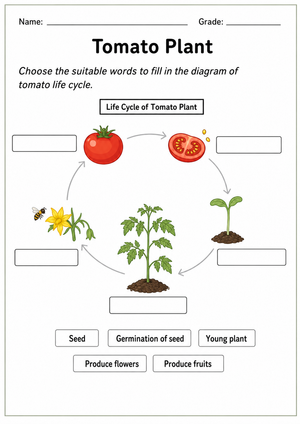
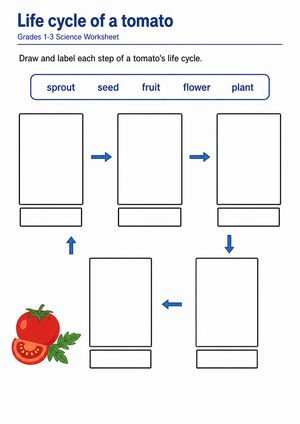
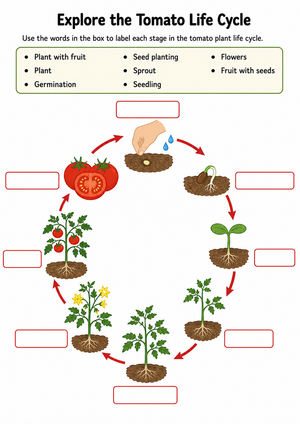
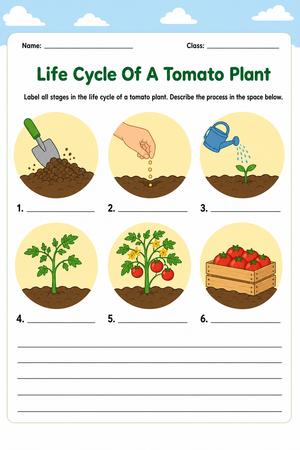
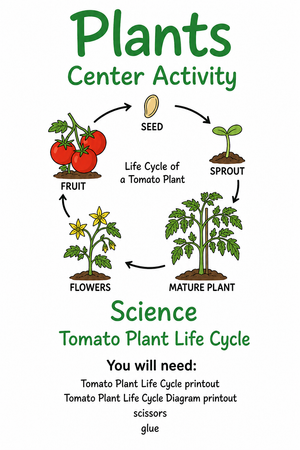
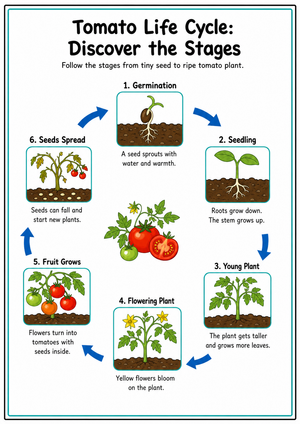
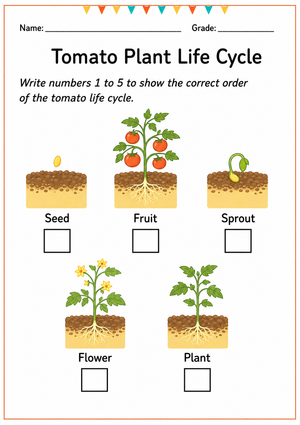
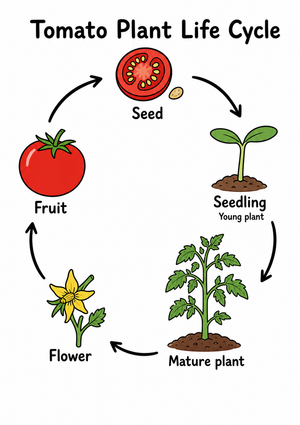
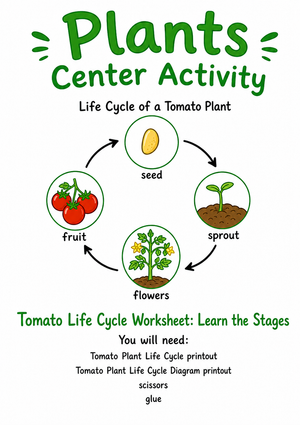
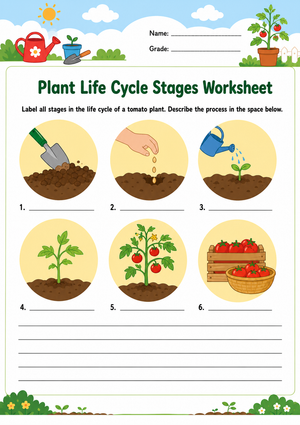
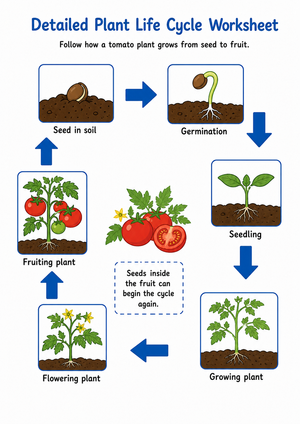
These tomato worksheets for 2nd grade cover six stages of the plant life cycle, the structural role of roots, stems, leaves, and flowers, what a tomato plant needs to grow, and the botanical question that trips up adults as often as it does kids — whether a tomato is a fruit or a vegetable. Teachers get a set that moves from concrete labeling tasks to genuine classification thinking, without needing supplemental materials to fill the gaps.
What the Set Covers
Each worksheet targets a distinct concept within second-grade plant science. The life cycle worksheets ask students to sequence six stages — seed, germination, seedling, vegetative growth, flowering, and fruit — using both images and brief written descriptions. A separate anatomy worksheet presents an unlabeled tomato plant diagram; students write in the name and function of each part: roots, stem, leaves, flowers, and fruit. Two more worksheets address what the plant needs to survive: one pairs each requirement (sunlight, water, carbon dioxide, soil nutrients) with a visual prompt, and the other asks students to explain in their own words why the plant would fail without each resource. The final worksheet presents the fruit-versus-vegetable question with evidence on both sides and asks students to make a claim supported by reasoning.
That range matters. Sequencing the life cycle is largely a memorization task, but explaining why roots matter or arguing that a tomato is a fruit requires students to apply what they know. That shift from recall to reasoning is exactly what plant science at this grade should be building toward.
Mistakes Students Make When Sequencing the Life Cycle
The most consistent error across classrooms is conflating germination with the seedling stage. Students tend to treat germination as the moment the plant becomes visible above the soil — when in fact germination happens underground, the moment the seed coat splits and the root emerges. They place the seedling card first because they've only ever seen plants from the surface up. A quick pre-teaching moment — drawing the cross-section of soil on the board, showing the root pushing down before anything pushes up — reduces this error significantly before students touch the worksheet.
A second recurring problem involves the flowering stage. Students who correctly identify that fruit develops from a flower will still omit pollination when asked to explain the transition, because they read the flower-to-fruit sequence as automatic. The worksheets prompt students to explain what happens to the flower before the fruit appears, which surfaces that gap and gives teachers a concrete moment to address it rather than discovering the misconception on an end-of-unit assessment.
How to Work These Worksheets Into a Plant Unit
The tomato worksheets for 2nd grade function well as both anchor activities and review checkpoints, depending on where you place them in the unit. The life cycle sequencing worksheet lands best on the second day of instruction — after an initial lesson that introduces the stages but before students have the sequence fully memorized — because it forces active recall rather than passive review. The anatomy worksheet works better mid-unit, once students have observed a real tomato plant or at minimum a detailed photograph, so they're labeling something they can visualize rather than working from abstraction alone.
If your school has a garden or a sunny windowsill, growing a single tomato plant from seed while running this unit pays off in ways no diagram can replicate. Students who have watched a true leaf emerge after the cotyledons sequence the life cycle more confidently because they have lived through part of it. The observation worksheets give them a consistent format for recording weekly changes — stem height, leaf count, root visibility at the soil line — so that data accumulates across the unit rather than disappearing after each class period.
For the final week, the fruit-versus-vegetable worksheet makes a strong discussion anchor. Give students five minutes to complete it individually, then run a brief structured argument where they defend their classification. Second graders almost always begin with the culinary definition and have to work toward the botanical one. Watching that revision happen in real time is one of the better formative assessment moments the set produces.
Standard Alignment
The primary standard these worksheets address is NGSS 2-LS2-2, which asks students to develop a simple model that mimics the function of an animal or plant in dispersing seeds or pollinating plants. The life cycle and flower-to-fruit worksheets connect directly to this standard, particularly the pollination explanation prompt. The anatomy and plant-needs worksheets support NGSS 2-LS2-1, which requires students to plan and conduct investigations to determine what plants need to grow. In classroom terms, these two standards appear in the same instructional unit, and the worksheets address both without requiring teachers to pull resources from separate sources. Many states with NGSS-aligned standards map this content to second-grade life science benchmarks covering organisms and their environments, making the set transferable across curricula.
Adjusting the Worksheets for Students at Different Readiness Levels
The tomato worksheets for 2nd grade span a wider readiness range than a typical plant unit resource because the tasks vary in cognitive demand. Students who need more support do better with the sequencing worksheet when stage labels are provided and they only need to arrange them in order — a teacher can make a printed word bank by cutting apart a spare copy of the answer key, which takes about two minutes and removes the spelling load without removing the sequencing challenge. For the anatomy worksheet, simply tracing the arrows from label to plant part is the lower-demand entry point; asking students to add one sentence explaining each function moves the task up a level.
Students who move through the foundational worksheets quickly can extend the classification worksheet into a written argument: a clear claim, two pieces of botanical evidence, and an acknowledgment of the culinary counterargument. This mirrors the structure of evidence-based writing that appears in second-grade ELA standards, so it doubles as cross-curricular practice without requiring a separate assignment to be created.
Frequently Asked Questions
Can these worksheets replace a science textbook chapter on plants?
The set covers the specific concepts — life cycle stages, plant anatomy, growth requirements, and basic classification — that most second-grade plant units require. Teachers using a basal science program typically use these worksheets alongside it for additional structured practice. Teachers running a unit without a textbook have used the set as the primary written component without any content gaps.
How should I handle student pushback when they insist a tomato is a vegetable?
Let them push back — that's productive. The classification worksheet asks students to identify which definition they're using (botanical or culinary), not simply to pick a side. When students argue tomato is a vegetable, ask them to name the rule they're applying. Most will describe flavor or kitchen use. Then ask whether that same rule would make a strawberry a vegetable. The worksheet starts that conversation; it doesn't end it.
Is this set appropriate for grades other than 2nd?
The tomato worksheets for 2nd grade align to second-grade NGSS standards, but the anatomy and classification worksheets are regularly used in 3rd grade at the start of a broader plant unit as a review and diagnostic tool. The life cycle sequencing worksheets occasionally appear in 1st grade when a teacher wants to introduce the concept informally before the formal standard arrives the following year.
Do students need background knowledge before starting these worksheets?
No prior knowledge is required for the sequencing or anatomy worksheets — the visual prompts carry enough information for a student encountering the content for the first time. The growth-requirements and classification worksheets benefit from at least one introductory lesson beforehand, particularly for the pollination concept, which lacks the strong everyday-life reference point that seeds and fruit carry for most second graders.












 Interactive Worksheet Maker
 Quiz Maker
 Word Search Maker
 Crossword Puzzle Maker
 Word Scramble Generator
 Sentence Scramble Generator
 Handwriting Worksheet Generator
 Name Tracing Generator
 Fill In The Blank Generator