


























Views
Downloads
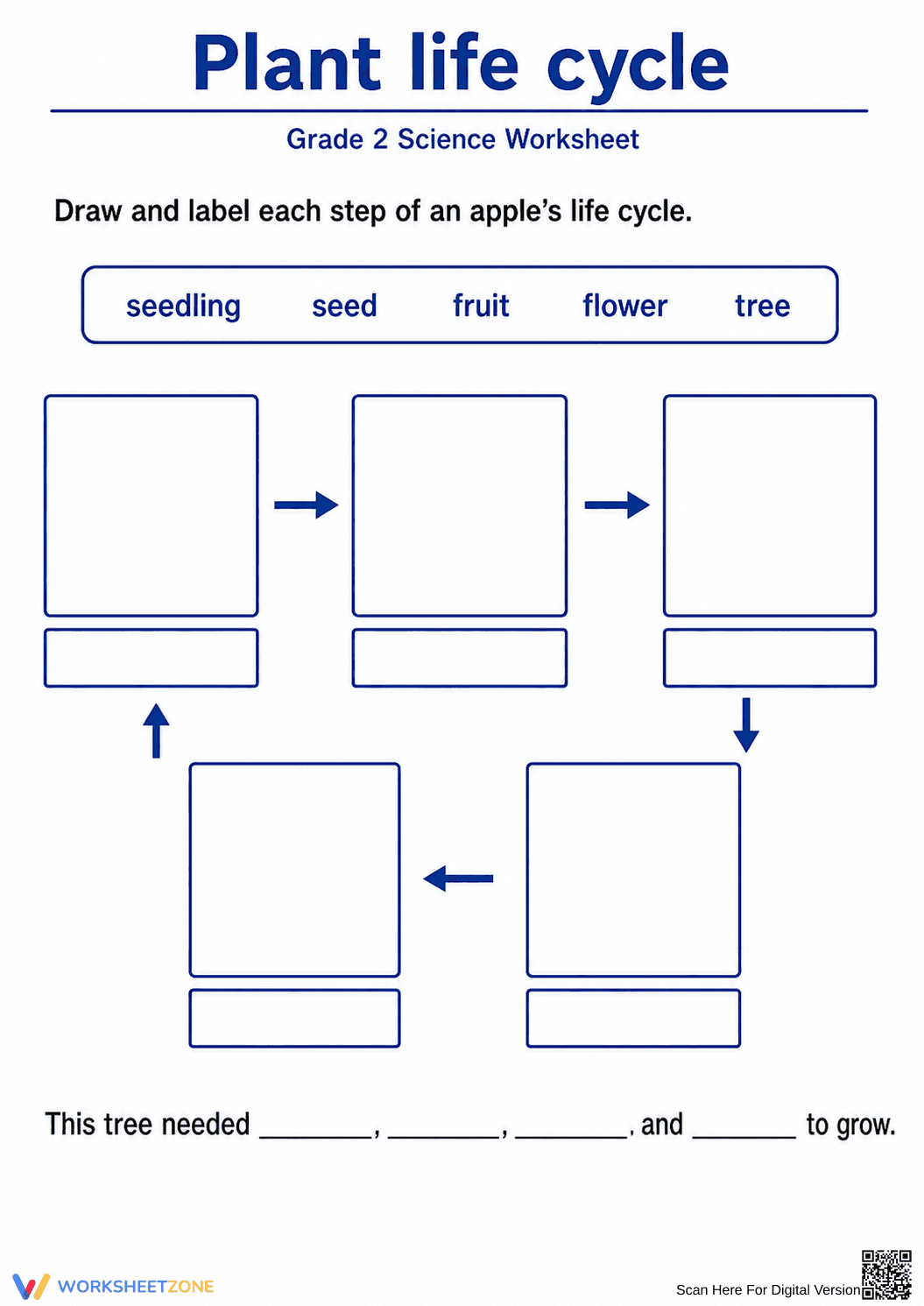

Grade 2 Plant Life Cycle — Printable No-Prep Worksheet
Paste this activity's link or code into your existing LMS (Google Classroom, Canvas, Teams, Schoology, Moodle, etc.).
Students can open and work on the activity right away, with no student login required.
You'll still be able to track student progress and results from your teacher account.
This Grade 2 science worksheet helps students visualize and sequence the biological stages of an apple tree. By integrating drawing and labeling, learners demonstrate a clear understanding of plant growth from seed to fruit. This printable activity effectively bridges the gap between simple observation and foundational scientific documentation.
At a Glance
- Grade: 2 · Subject: Science
- Standard:
2-LS2-1— Determine what plants need to grow and thrive- Skill Focus: Plant Life Cycle Sequencing
- Format: 1 page · 14 problems · Answer key included · PDF
- Best For: Independent science center or sub plan
- Time: 20–30 minutes
What's Inside
This PDF features a circular life cycle diagram specifically designed for young learners. It includes five distinct boxes for original illustrations paired with corresponding labeling fields. A helpful word bank containing terms such as seedling, seed, and flower supports vocabulary acquisition. The bottom of the page includes a fill-in-the-blank section focused on the four essential requirements for plant growth, ensuring a comprehensive review.
Zero-Prep Workflow
This resource offers a highly efficient zero-prep workflow consisting of three simple steps. First, print the required copies for your classroom (30 seconds). Second, distribute the worksheets and briefly review the provided word bank with the class (1 minute). Third, allow students to work independently while you move around the room for formative assessment (20 minutes). The total teacher preparation time is under two minutes, providing a reliable and stress-free resource for emergency sub plans.
Standards Alignment
The primary alignment for this resource is 2-LS2-1: Plan and conduct an investigation to determine if plants need sunlight and water to grow. This worksheet specifically targets the understanding of plant needs while supporting the broader life cycle concepts often introduced in early elementary science. Both standard codes can be copied directly into lesson plans, IEP goals, or district curriculum mapping tools.
How to Use It
Deploy this worksheet during the elaborate phase of a 5E lesson cycle. After students have observed real seeds or seedlings, use this as a formative assessment to check for sequencing accuracy. An observation tip: watch for students who struggle to differentiate between a seedling and a mature tree, as this reveals a misconception about growth stages. Expected completion typically takes 20 to 30 minutes.
Who It's For
Designed for second-grade students, this resource is excellent for general education classrooms, English Language Learners who benefit from the visual-to-labeling scaffolding, and special education students working on sequencing goals. It pairs naturally with a classroom seed-planting experiment, a nature walk, or a reading passage about apple orchards.
According to the RAND AIRS 2024 analysis of elementary science materials, the integration of visual modeling with academic vocabulary labeling significantly increases long-term retention of biological sequences in early learners. This worksheet utilizes a structured framework that aligns with these findings, emphasizing the importance of student-generated representations in scientific inquiry. By requiring students to both draw and label the stages of an apple's life cycle, the resource forces active cognitive processing of the transitions between birth, growth, and reproduction. Furthermore, educators highly value these zero-prep materials because they maintain rigorous alignment with the 2-LS2-1 standard—determining what plants need to grow—while drastically reducing administrative burden. This balance of pedagogical depth and practical utility ensures that students achieve mastery of the 14 included tasks without sacrificing valuable instructional time to complex setup procedures.


