


























Views
Downloads
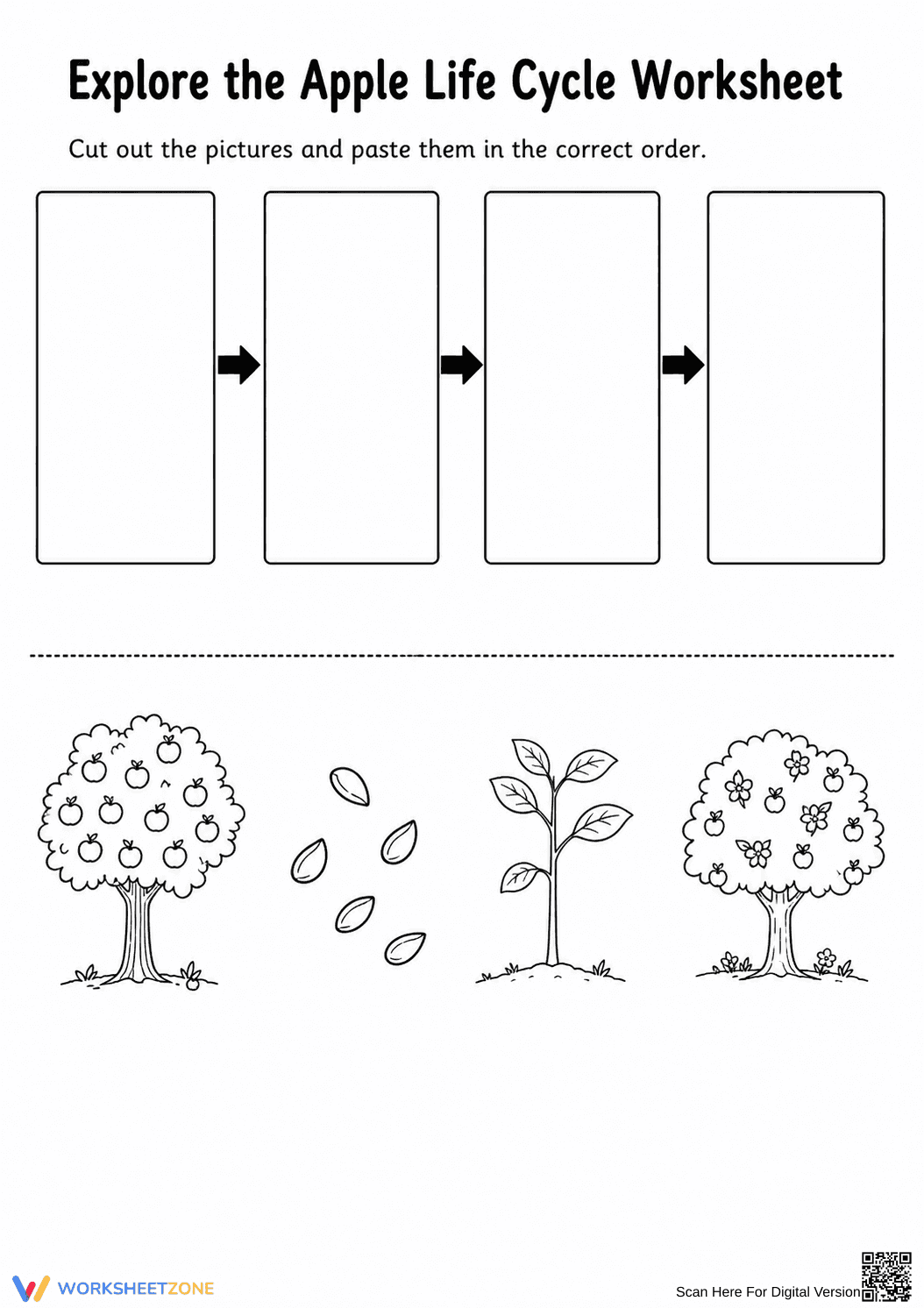

Essential Apple Life Cycle Worksheet | Grade K-2
Paste this activity's link or code into your existing LMS (Google Classroom, Canvas, Teams, Schoology, Moodle, etc.).
Students can open and work on the activity right away, with no student login required.
You'll still be able to track student progress and results from your teacher account.
This printable apple life cycle worksheet helps early elementary students visualize and sequence the biological stages of a fruit-bearing tree. By engaging in a hands-on cut-and-paste activity, learners identify patterns in plant growth from seed to mature tree. It provides a clear, visual framework for understanding how living things change over time.
At a Glance
- Grade: K-2 · Subject: Science
- Standard:
K-LS1-1— Use observations to describe patterns of what plants and animals need to survive- Skill Focus: Chronological sequencing of plant growth
- Format: 1 page · 4 tasks · Cut-and-paste · PDF
- Best For: Science centers and fine motor practice
- Time: 15–20 minutes
This single-page PDF features a clean, four-stage sequencing map with directional arrows to guide student logic. The bottom section contains four high-contrast, black-and-white illustrations: seeds, a sapling, a flowering tree, and a fruit-bearing tree. The layout is designed for easy cutting with safety scissors and includes clear borders for pasting.
Teachers can implement this activity in under two minutes. Simply print the required number of copies (1 minute), distribute with scissors and glue (30 seconds), and facilitate a brief class discussion on the results (30 seconds). This worksheet is an ideal "grab-and-go" resource for substitute folders or sudden schedule changes.
The primary alignment is `K-LS1-1`, focusing on observing patterns in living organisms. It also supports `3-LS1-1` by introducing the concept that organisms have unique and diverse life cycles. Both standard codes can be copied directly into lesson plans, IEP goals, or district curriculum mapping tools.
Use this as a formative assessment after a read-aloud about seasons or orchards. Observe if students can distinguish between the flowering stage and the fruiting stage to gauge their understanding of plant reproduction. Expected completion time is 15 to 20 minutes depending on fine motor proficiency.
This resource is designed for Kindergarten through 2nd-grade students, including English Language Learners who benefit from visual-heavy tasks. It pairs naturally with a classroom seed-planting experiment or a non-fiction text about apple harvests.
According to the RAND AIRS 2024 report on early childhood science, tactile sequencing activities significantly improve long-term retention of biological concepts compared to passive observation. This worksheet utilizes the K-LS1-1 standard to bridge the gap between abstract life cycles and concrete visual patterns. By requiring students to physically manipulate the stages of an apple tree—from seed to sapling to mature fruit-bearer—the activity reinforces the chronological nature of plant development. Research by Fisher & Frey (2014) suggests that such scaffolded, hands-on tasks are essential for developing the cognitive schemas necessary for more complex scientific inquiry in later grades. This resource provides a structured yet accessible entry point for young learners to master the foundational skill of identifying life cycle patterns in the natural world.


