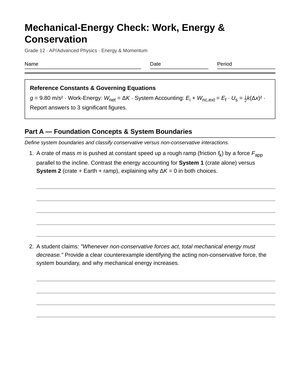
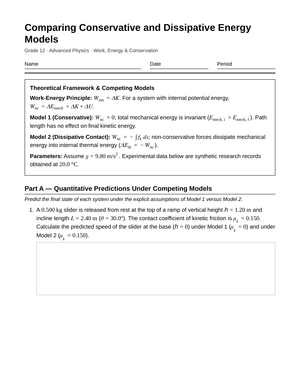
Energy units can feel abstract until students have something concrete in front of them, and that's exactly where conservation of energy worksheets earn their place in a physical science classroom. They turn a big, invisible principle into pages students can label, graph, and argue about. This guide walks through how US middle school teachers can choose, differentiate, and time these worksheets to match NGSS energy standards and move students past the misconceptions that trip them up every year.
What Conservation of Energy Worksheets Cover
Conservation of energy worksheets give middle school physical science teachers a print-and-go way to reinforce one big idea: energy is never created or destroyed, it only changes form or moves from one object to another. Most sets land squarely in grades 6-8, though upper elementary teachers introducing energy transfer can pull simpler pages for early exposure. A strong worksheet asks students to track energy as it shifts between kinetic, potential, thermal, sound, and light forms, and to explain where that energy went rather than assuming it disappeared.
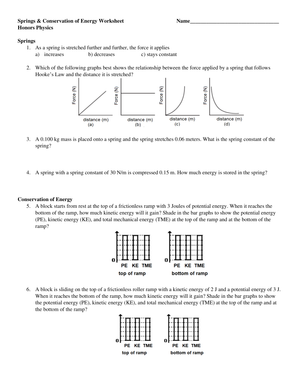
When you're planning a multi-day energy unit, these pages do the quiet work between your demonstrations and your summative test. They let students slow down, label a pendulum at the top and bottom of its swing, calculate how kinetic energy responds to changes in mass and speed, and write out arguments about energy transfer in their own words. Because the concept sits at the heart of the physical science curriculum, the same worksheet can serve as guided notes on Monday and a review station on Thursday. That repeated practice is where abstract ideas start to stick.
Matching Worksheets to NGSS MS-PS3 Standards
If you teach to the Next Generation Science Standards, conservation of energy worksheets map cleanly onto the MS-PS3 energy performance expectations. That alignment makes it easy to drop a worksheet into a standards-based lesson plan and defend the choice during a walkthrough or PLC review.
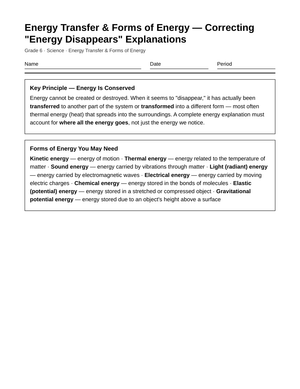
According to the Next Generation Science Standards, disciplinary core idea PS3.B states that the total change of energy in any system is always equal to the total energy transferred into or out of the system. This single principle anchors all three MS-PS3 performance expectations your worksheets should target.
Practically, that means matching worksheet tasks to specific expectations: MS-PS3-1 asks students to construct and interpret graphical displays showing how kinetic energy relates to an object's mass and speed, so look for graphing pages. MS-PS3-2 has students model how changing the arrangement of interacting objects changes the potential energy stored in a system, which pairs well with magnet and gravity diagrams. MS-PS3-5 asks students to build and present arguments that a change in an object's kinetic energy means energy was transferred to or from it.
Worksheet Types That Build Energy Reasoning
Not every worksheet does the same job, so it helps to keep a few formats on hand:
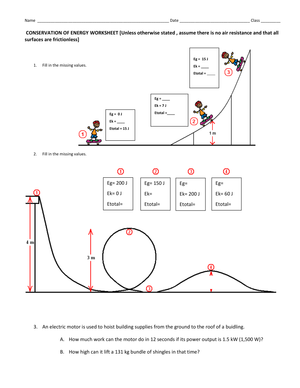
- Transformation diagrams that ask students to label kinetic and potential energy at each point of a motion.
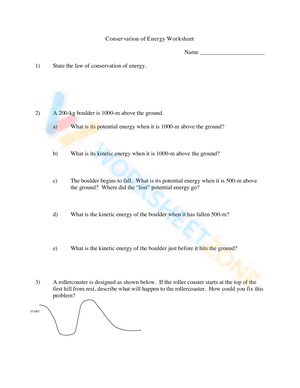
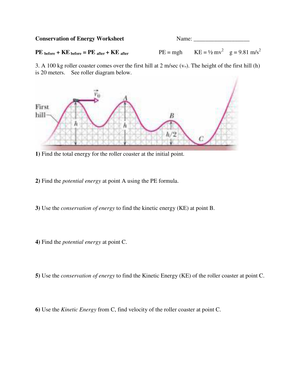
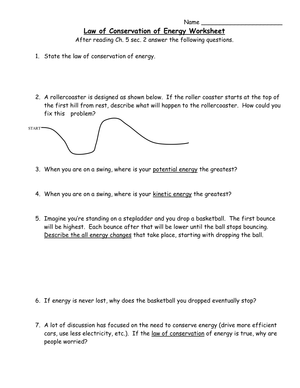
- Roller coaster and pendulum models where learners trace energy as it swaps between potential and kinetic across a track or swing.
- Graphing pages that plot kinetic energy against mass or speed, supporting the data-analysis skill in MS-PS3-1.
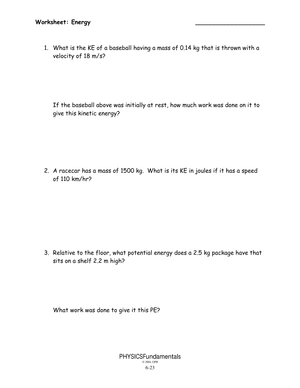
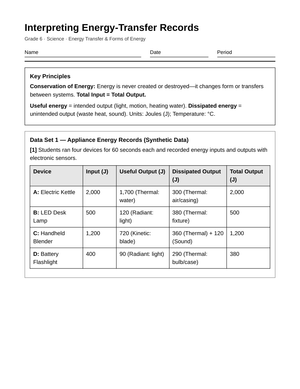
- Energy conservation word problems that push students to account for every joule and explain transfers in writing.
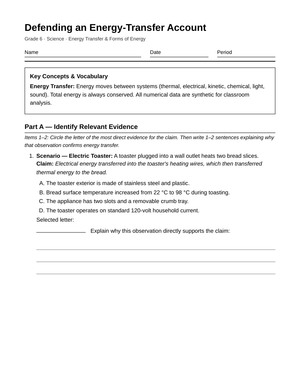
Rotating between these formats keeps practice from feeling repetitive and hits different NGSS science practices, from analyzing data to constructing explanations. A bouncing ball problem, for instance, forces students to confront where energy goes after each bounce instead of treating the slowdown as energy vanishing. Keeping two or three formats in a single unit also gives you natural ways to differentiate without building anything new.
Tackling the 'Energy Gets Used Up' Misconception
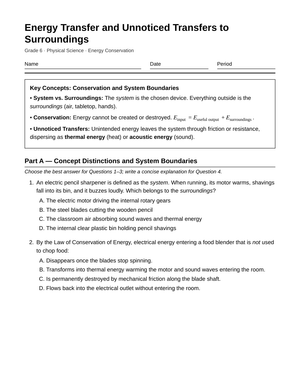
The most stubborn idea middle schoolers bring to an energy unit is that energy gets 'used up' or simply disappears. A ball stops bouncing, a toy car rolls to a halt, and students conclude the energy is gone. Well-designed worksheets attack this head-on by asking students to name the destination of the energy, usually thermal energy from friction or sound, rather than letting them stop at 'it ran out.'
Here's a pattern worth watching for: when students label a pendulum diagram correctly but still write that energy 'disappears' at the bottom of the swing, the gap is almost never about vocabulary. They can recite kinetic and potential, yet they don't yet believe the total stays constant. The fastest fix is a worksheet column that forces a running energy total at three or four points, because when the numbers are required to add up to the same figure every time, the conservation principle stops being a slogan and becomes something students can see on the page.
Classroom Implementation
These worksheets flex across the ways you actually run a classroom. For whole-class instruction, project a transformation diagram and work the first row together, then release students to finish independently. For small-group intervention, pull a simpler pendulum or bouncing-ball page and sit with the four or five students who still describe energy as disappearing, walking through one running-total example before they try their own.
Before a summative test, a mixed review worksheet that blends diagrams, a short graph, and two word problems gives you a quick read on who's ready. For advanced students, enrichment pages that add a second energy form or ask for a written argument in the style of MS-PS3-5 keep them stretched without extra prep on your end. One master set, differentiated by which pages you hand out, covers a full range of learners.
Frequently Asked Questions
1. What grade level typically covers conservation of energy worksheets?
Most conservation of energy worksheets target middle school grades 6-8, where the NGSS MS-PS3 energy standards live. Upper elementary teachers can use simpler energy-transfer pages to lay groundwork, building toward the full conservation reasoning students formalize in later grades.
2. How do these worksheets align with NGSS middle school physical science standards?
They map to the MS-PS3 energy performance expectations: graphing kinetic energy against mass and speed for MS-PS3-1, modeling stored potential energy for MS-PS3-2, and constructing energy-transfer arguments for MS-PS3-5. Choosing worksheets by expectation keeps practice tightly standards-aligned.
3. What is the difference between energy conservation and energy transfer?
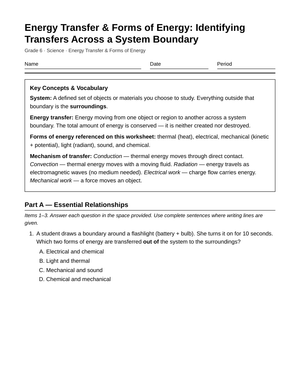
Conservation is the big principle that total energy stays constant. Transfer is one mechanism behind it, energy moving from one object or form to another. Worksheets should show that transfers and transformations happen while the total, per PS3.B, never changes.
4. How can teachers use these worksheets for small-group intervention versus whole-class review?
For whole-class review, use mixed pages that sample every concept before a test. For small-group intervention, pull one targeted page, often a running-total pendulum or bouncing-ball problem, and work it alongside students who still describe energy as being used up.
5. What real-world examples work best for teaching conservation of energy?
Pendulums, roller coasters, and bouncing balls are classroom favorites because students can picture the motion and track energy swapping between kinetic and potential. These concrete examples make an abstract principle visible and give worksheets a hook students already understand.












 Interactive Worksheet Maker
 Quiz Maker
 Word Search Maker
 Crossword Puzzle Maker
 Word Scramble Generator
 Sentence Scramble Generator
 Handwriting Worksheet Generator
 Name Tracing Generator
 Fill In The Blank Generator