


























1 / 2
0
Views
0
Downloads

0.0
0
Save
0 Likes
Share
Springs Conservation of Energy Worksheet
0 Views
0 Downloads
Paste this activity's link or code into your existing LMS (Google Classroom, Canvas, Teams, Schoology, Moodle, etc.).
Students can open and work on the activity right away, with no student login required.
You'll still be able to track student progress and results from your teacher account.
Information
Description
What It Is:
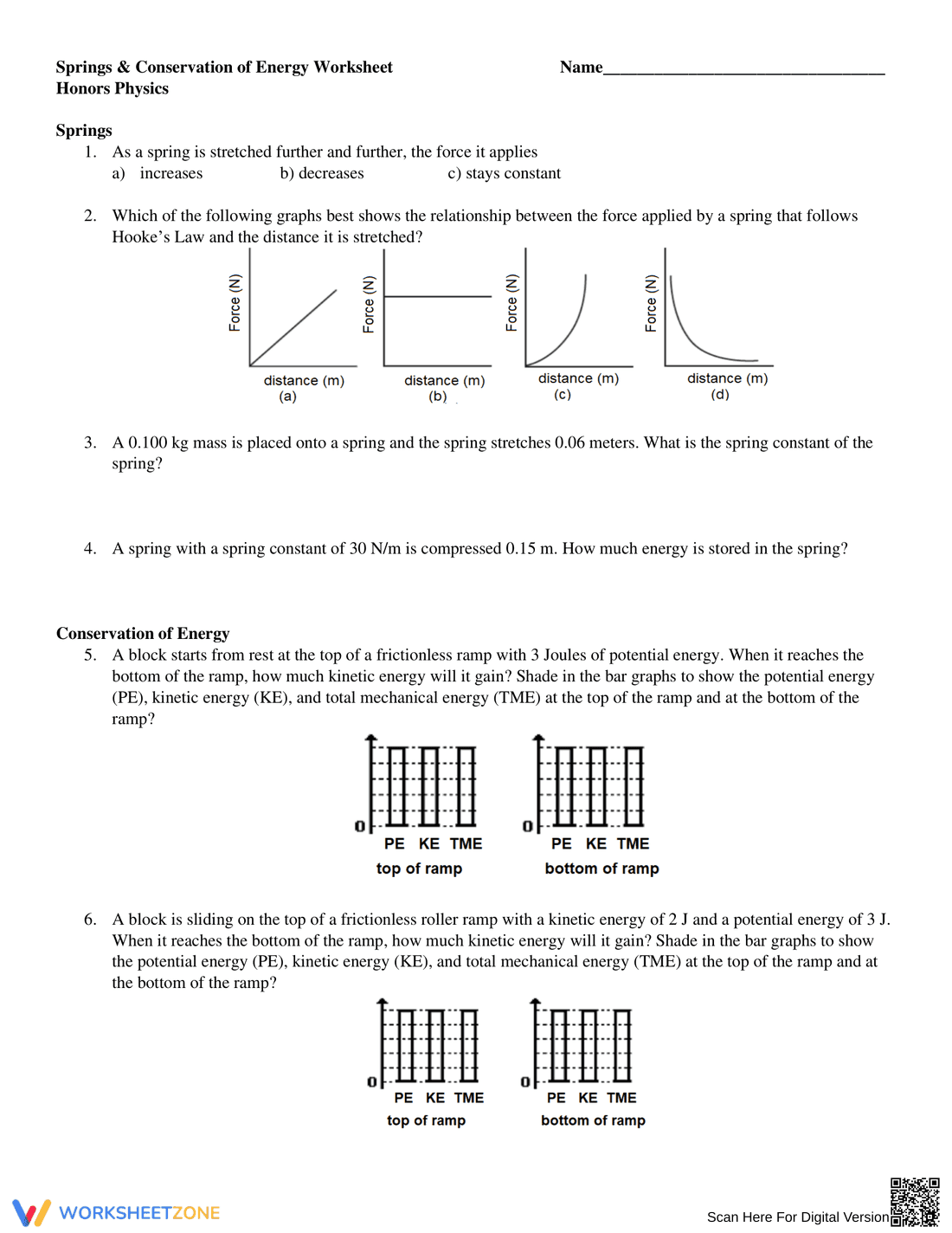
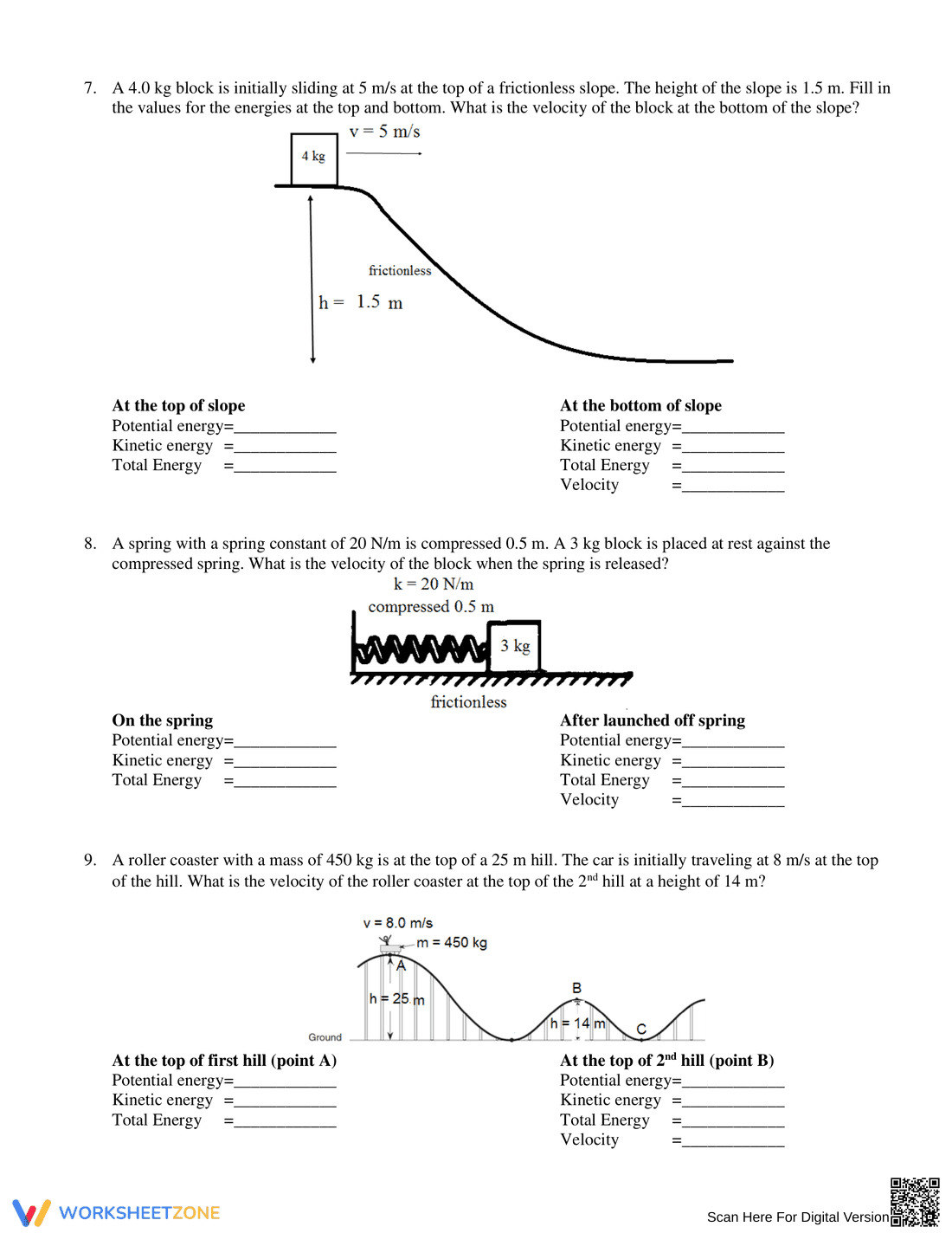
This is a physics worksheet focused on springs and conservation of energy. It includes multiple-choice questions about the force applied by a spring as it's stretched, graphical representation of Hooke's Law, and calculation problems involving spring constants and potential energy. The worksheet also features problems related to the conservation of energy on a frictionless ramp, requiring students to calculate kinetic energy gain and shade bar graphs to represent potential energy (PE), kinetic energy (KE), and total mechanical energy (TME) at different points.
Grade Level Suitability:
This worksheet appears suitable for high school physics, specifically grades 11-12. The concepts covered, such as Hooke's Law, spring constants, potential energy, kinetic energy, and total mechanical energy, are typically taught at this level. The calculations and graphical analysis also suggest a high school physics curriculum.
Why Use It:
This worksheet helps students understand and apply the principles of springs and conservation of energy. It reinforces their understanding of Hooke's Law, potential and kinetic energy, and the relationship between these concepts. The bar graph shading exercise provides a visual representation of energy transformation, solidifying their understanding of energy conservation. It also improves problem-solving skills related to physics calculations.
How to Use It:
Students should read the instructions and questions carefully. For the multiple-choice questions, they should select the correct answer based on their understanding of spring forces. For calculation problems, they need to apply relevant formulas and show their work. For the conservation of energy problems, they should calculate the kinetic energy gain and then shade the bar graphs to represent the potential, kinetic, and total mechanical energy at the top and bottom of the ramp.
Target Users:
This worksheet is designed for high school physics students, particularly those in honors or advanced placement physics courses. It is also suitable for teachers looking for practice problems and assessment tools related to springs and conservation of energy.
This is a physics worksheet focused on springs and conservation of energy. It includes multiple-choice questions about the force applied by a spring as it's stretched, graphical representation of Hooke's Law, and calculation problems involving spring constants and potential energy. The worksheet also features problems related to the conservation of energy on a frictionless ramp, requiring students to calculate kinetic energy gain and shade bar graphs to represent potential energy (PE), kinetic energy (KE), and total mechanical energy (TME) at different points.
Grade Level Suitability:
This worksheet appears suitable for high school physics, specifically grades 11-12. The concepts covered, such as Hooke's Law, spring constants, potential energy, kinetic energy, and total mechanical energy, are typically taught at this level. The calculations and graphical analysis also suggest a high school physics curriculum.
Why Use It:
This worksheet helps students understand and apply the principles of springs and conservation of energy. It reinforces their understanding of Hooke's Law, potential and kinetic energy, and the relationship between these concepts. The bar graph shading exercise provides a visual representation of energy transformation, solidifying their understanding of energy conservation. It also improves problem-solving skills related to physics calculations.
How to Use It:
Students should read the instructions and questions carefully. For the multiple-choice questions, they should select the correct answer based on their understanding of spring forces. For calculation problems, they need to apply relevant formulas and show their work. For the conservation of energy problems, they should calculate the kinetic energy gain and then shade the bar graphs to represent the potential, kinetic, and total mechanical energy at the top and bottom of the ramp.
Target Users:
This worksheet is designed for high school physics students, particularly those in honors or advanced placement physics courses. It is also suitable for teachers looking for practice problems and assessment tools related to springs and conservation of energy.


