


























Views
Downloads


Printable Energy Conservation Worksheet | Grade 6
Paste this activity's link or code into your existing LMS (Google Classroom, Canvas, Teams, Schoology, Moodle, etc.).
Students can open and work on the activity right away, with no student login required.
You'll still be able to track student progress and results from your teacher account.
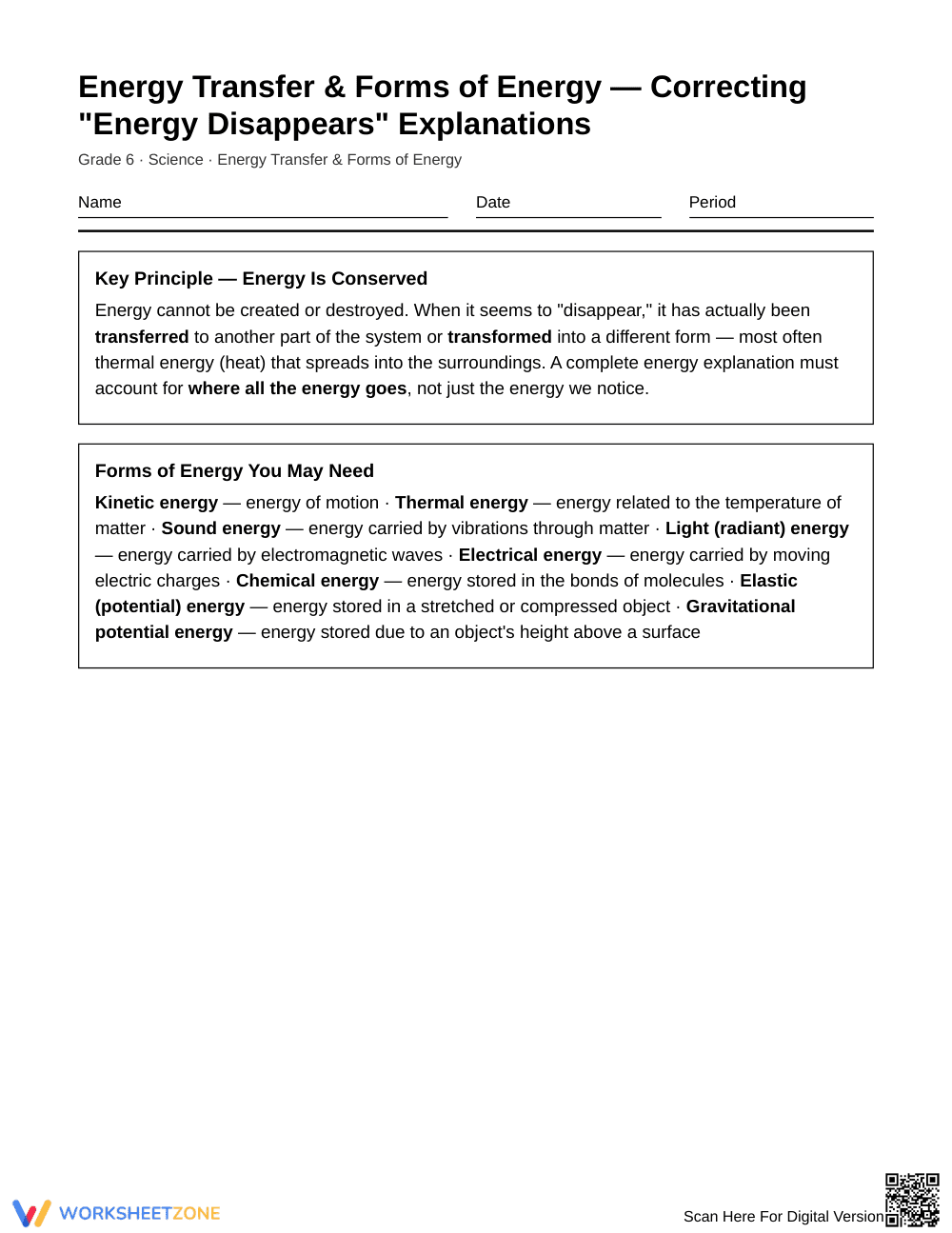
This Grade 6 Science worksheet builds students' ability to identify and correct the common misconception that energy disappears, guiding them through 8 real-world scenarios where they diagnose flawed explanations, trace correct energy paths, and rewrite complete, conservation-aligned responses.
At a Glance
- Grade: 6 · Subject: Science
- Standard: Energy Transfer & Forms of Energy — Explain that energy is transferred or transformed, never created or destroyed
- Skill Focus: Correcting "energy disappears" misconceptions using conservation of energy
- Format: 5 pages · 8 problems · Answer key included · PDF
- Best For: Misconception repair during energy unit instruction
- Time: 30–45 minutes
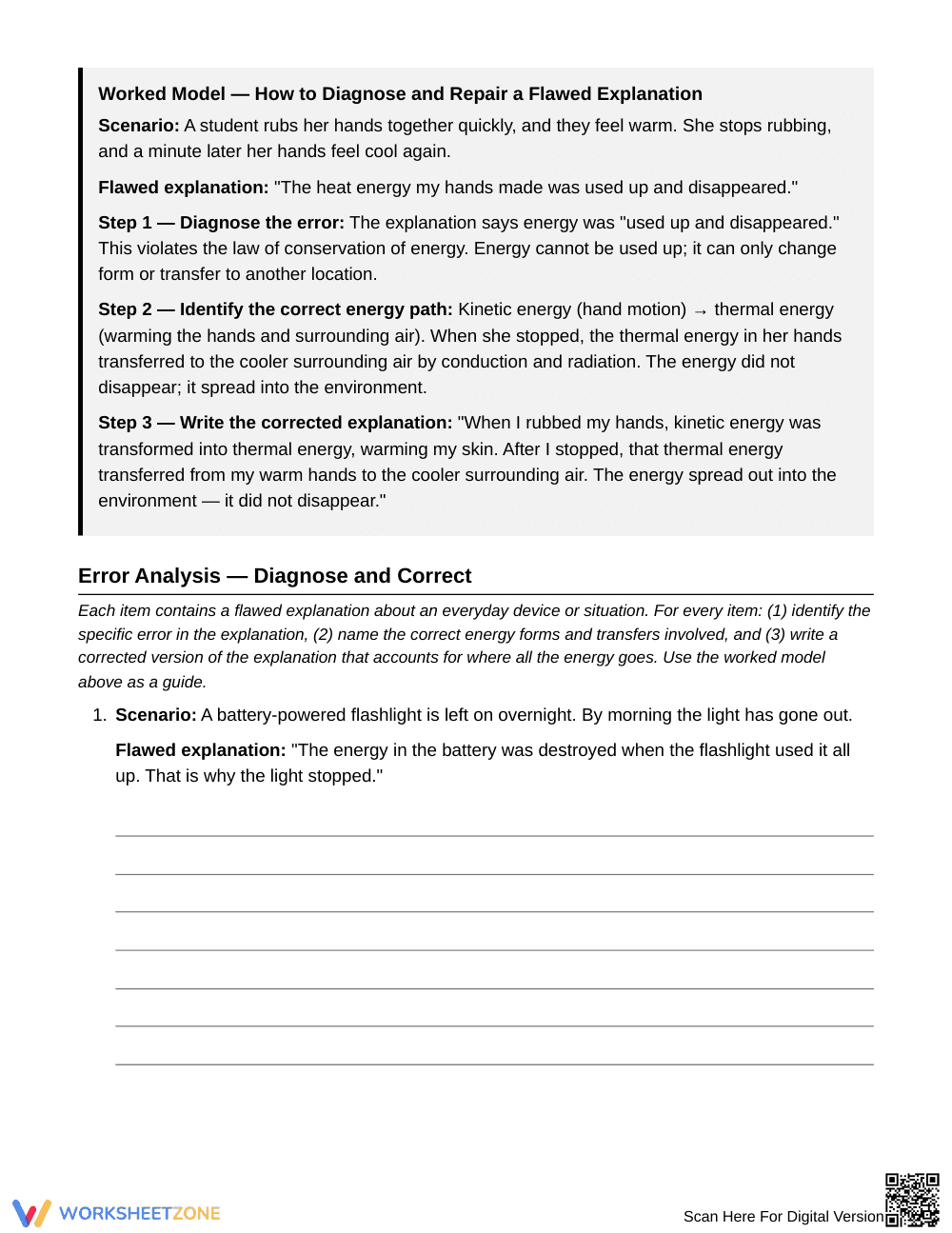
The worksheet opens with a Key Principle rule box stating the law of conservation of energy, followed by a reference list of eight energy forms. A fully worked model demonstrates a three-step diagnostic process using a hand-rubbing scenario. Students apply this same framework to all eight error-analysis items, supported by the answer key on the final pages of the 5-page PDF.
- Guided practice: The worked model walks students through all three steps, showing how kinetic energy converts to thermal energy and transfers to the environment.
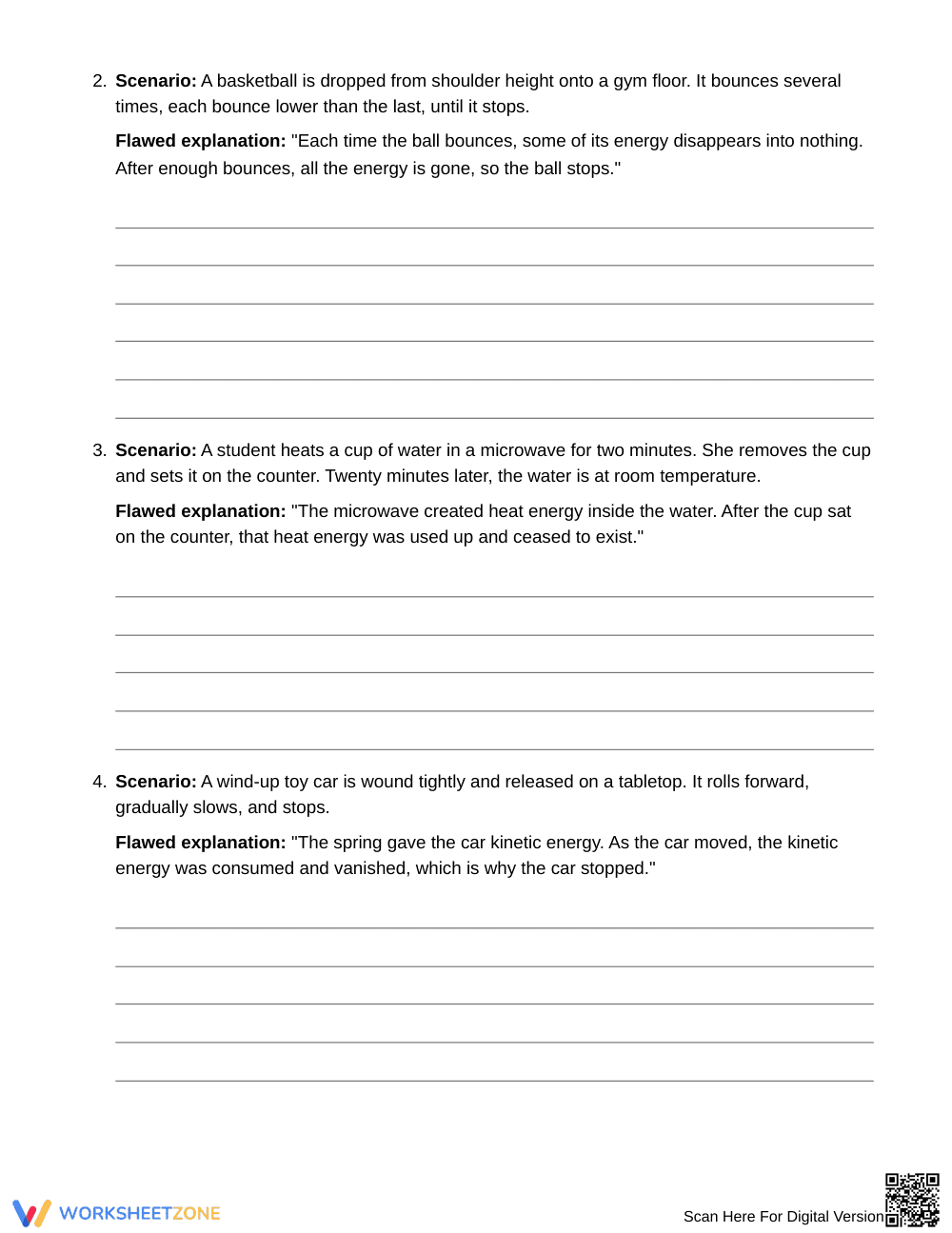
- Supported practice: Items 1–4 present familiar contexts like flashlights and bouncing balls, supporting students as they apply the framework independently.
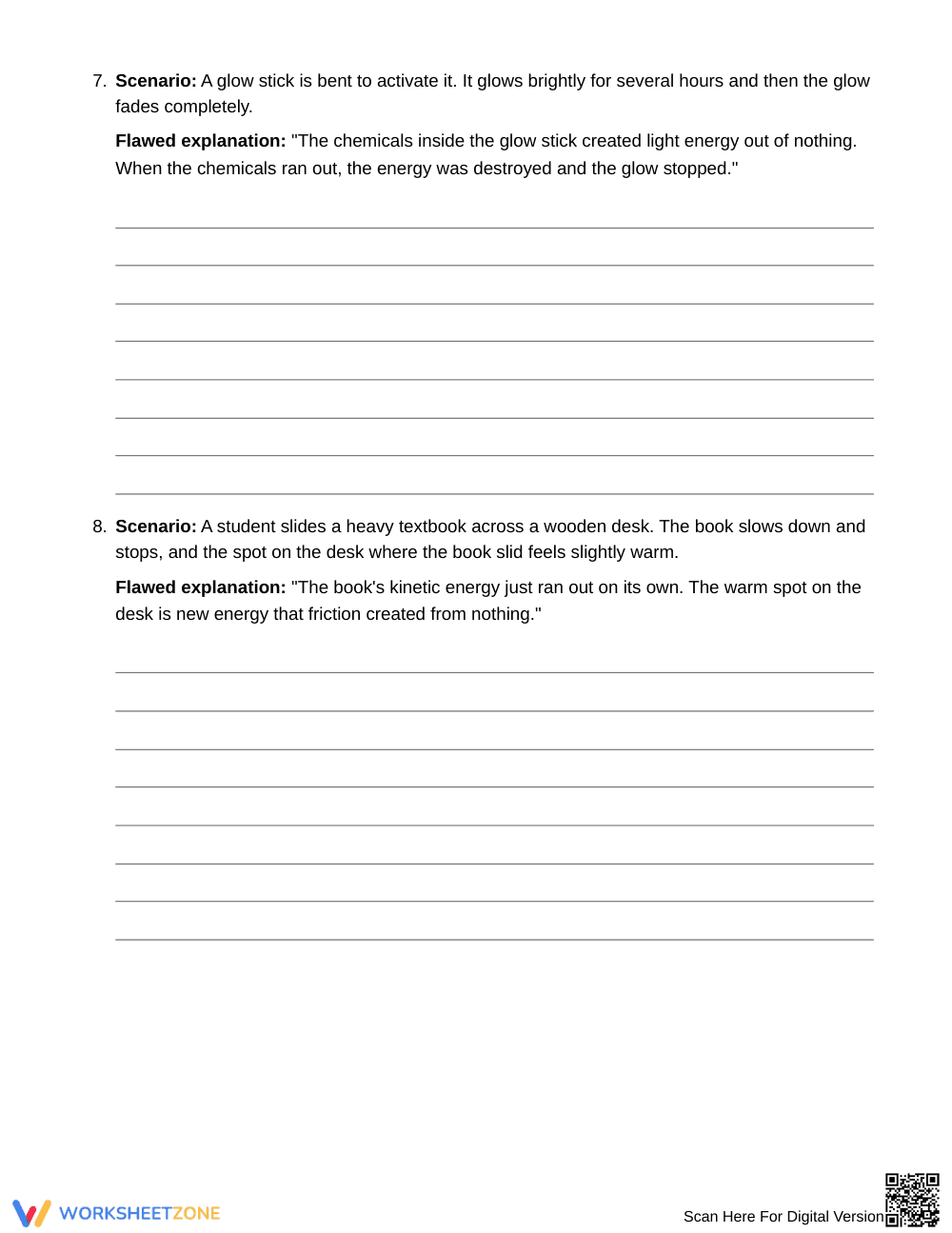
- Independent practice: Items 5–8 require students to handle multi-step transfers and chemical conversions, reducing scaffolding as student confidence builds.
How to Use It
Assign this worksheet after direct instruction on conservation of energy to consolidate understanding and surface lingering misconceptions. Completing it before a unit assessment provides a clear formative signal: look for answers that use the phrase "used up" without naming a destination form. Use items 1–4 as a mid-unit check and items 5–8 as an exit task. Most students finish in 30–45 minutes.
Research consistently identifies the "energy disappears" misconception as one of the most persistent barriers to energy literacy in middle school science. Fisher & Frey (2014) demonstrate that structured error-analysis tasks — where students diagnose, explain, and rewrite flawed reasoning — produce stronger conceptual gains than re-teaching alone, because students must actively confront the gap between their intuitive model and the scientific one. This 5-page, 8-problem worksheet targets that gap directly: each item presents a plausible but incorrect explanation rooted in the disappearance myth, then requires students to apply the law of conservation of energy to name the correct energy forms, trace the transfer or transformation pathway, and produce a complete corrected explanation. The three-step scaffold (diagnose, identify, rewrite) mirrors the gradual-release framework and gives teachers a clear formative window into whether students have internalized conservation as a quantitative accounting principle rather than a verbal rule.


