


























Views
Downloads





Ready Energy Transfer Records Worksheet | Grade 6 Science
Paste this activity's link or code into your existing LMS (Google Classroom, Canvas, Teams, Schoology, Moodle, etc.).
Students can open and work on the activity right away, with no student login required.
You'll still be able to track student progress and results from your teacher account.
This Grade 6 science worksheet guides students to interpret simple energy-transfer records and evaluate thermal systems. Students analyze input-output data for appliances and thermal equilibrium experiments, strengthening their ability to trace energy pathways, calculate dissipated heat, and confirm conservation laws with mathematical evidence.
At a Glance
- Grade: 6 · Subject: Science
- Standard: Analyze and interpret quantitative data to trace energy transfer and conservation
- Skill Focus: Interpret Simple Energy-Transfer Records
- Format: 5 pages · 10 problems · Answer key included · PDF
- Best For: Energy unit analysis and data practice
- Time: 40–50 minutes
What's Inside
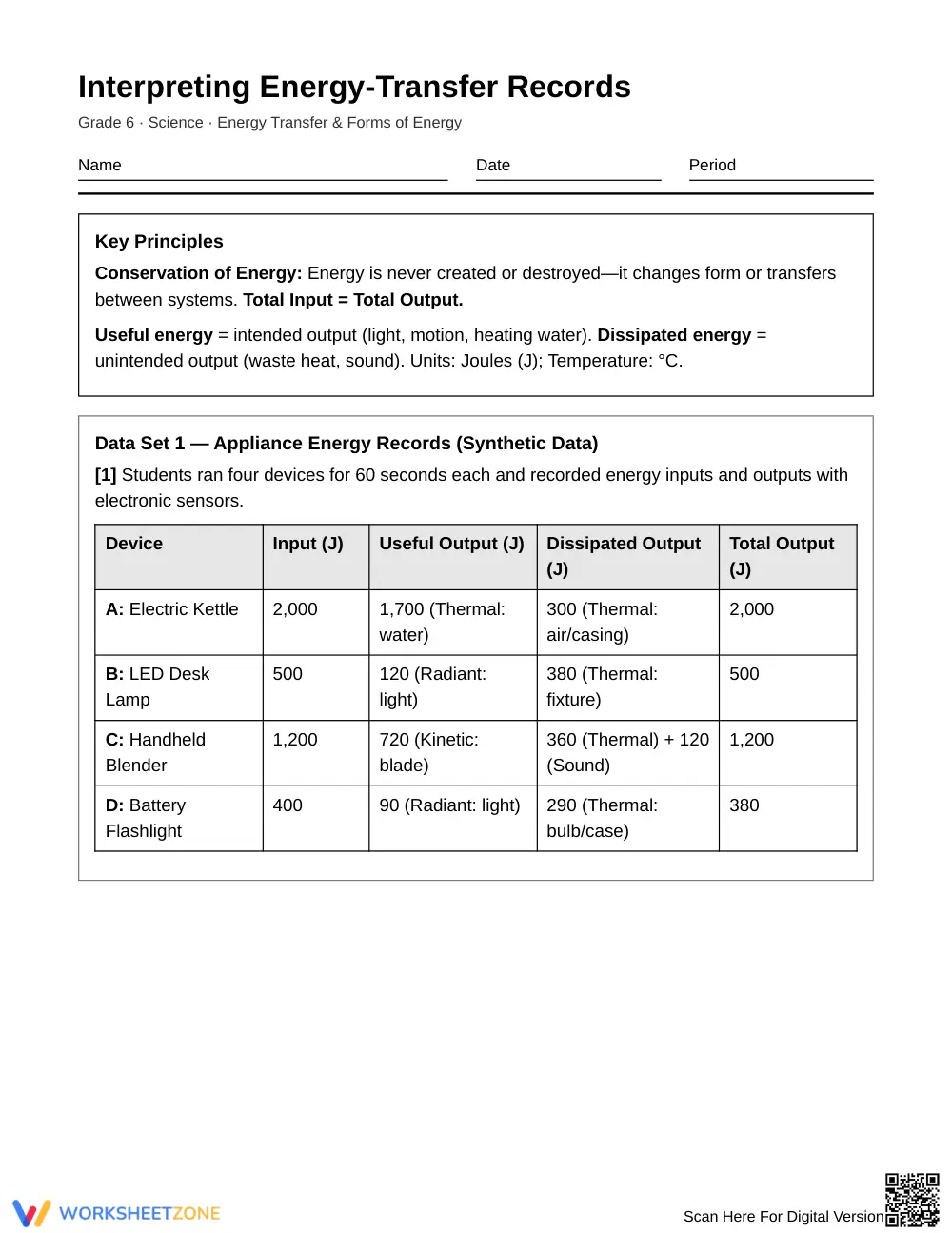
This 5-page printable resource includes two synthetic data sets, a Key Principles reference box defining Joules and conservation formulas, and 10 analytical prompts. Students examine appliance records and calorimetry trials across various containers. A complete 2-page answer key provides mathematical calculations and exemplar justifications.
Skill Progression
- Guided practice (Part A, 2 tasks): Students extract baseline values from appliance tables, identifying input figures and radiant or thermal outputs.
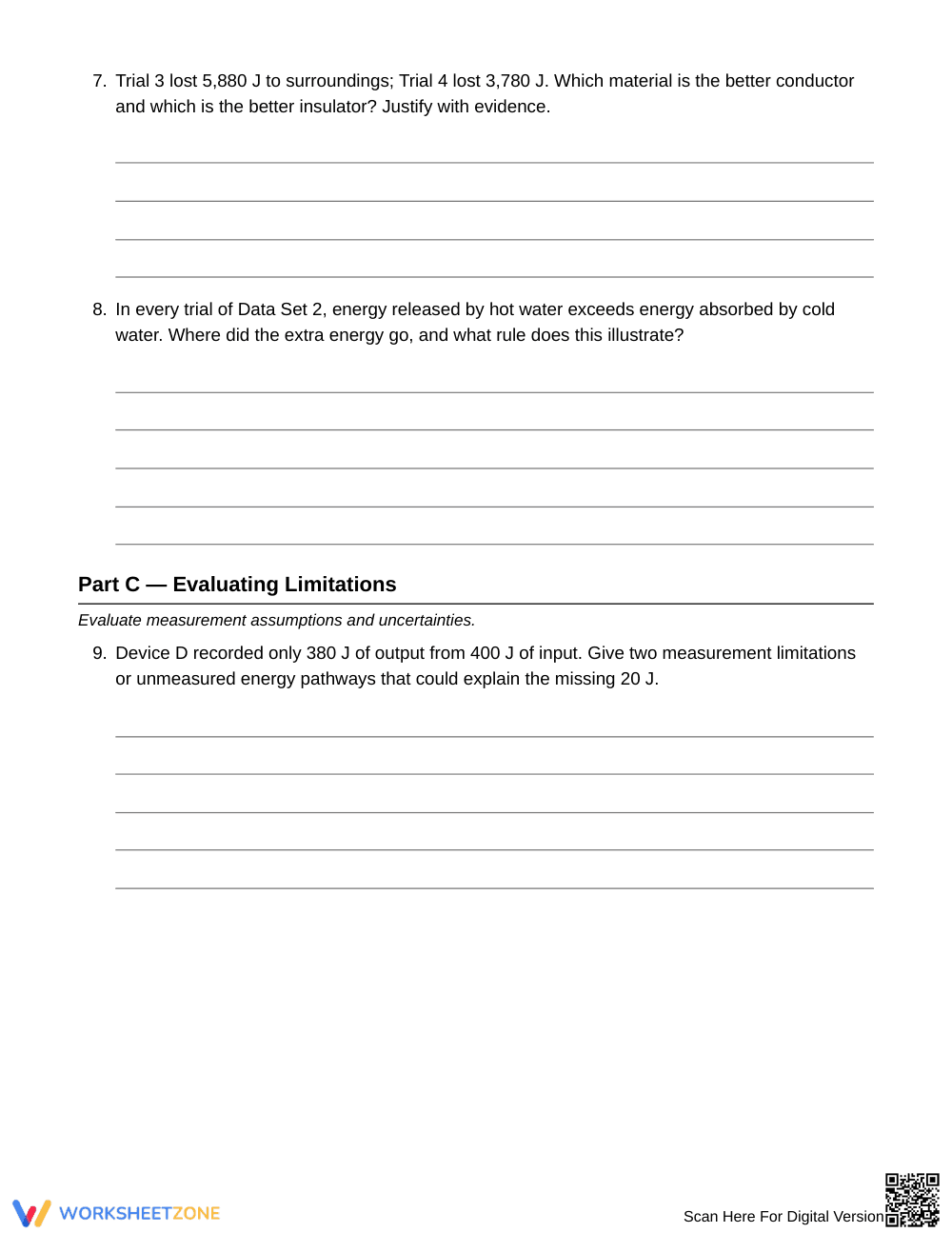
- Supported practice (Part B, 6 tasks): Learners calculate energy fractions, compare insulation performance, and verify conservation laws using quantitative balances.
- Independent practice (Part C, 2 tasks): Students critique experimental limitations and identify unmeasured thermal pathways without scaffolding.
This sequence implements gradual release, moving students from basic retrieval to critical evaluation.
Standards Alignment
This resource aligns with middle school science standards requiring students to analyze and interpret data describing energy transfer across systems. Learners verify that total input matches combined output forms. Both standard codes can be copied directly into lesson plans, IEP goals, or district curriculum mapping tools.
How to Use It
Use this worksheet after direct instruction on energy forms. Have student pairs review the Appliance Records table to check conservation balances before completing Parts B and C individually. Formatively observe whether students account for dissipated thermal energy when balancing totals. Completion requires 40 to 50 minutes.
Who It's For
This resource serves Grade 6 science classrooms, supporting both general education students and English learners through clear data tables. Pair it directly with a calorimetry lab or thermal simulation to connect concrete experimentation to quantitative analysis.
Interpreting quantitative energy-transfer records is an essential competency in middle school physical science, requiring students to synthesize numerical data with the core principle that energy cannot be created or destroyed. According to Fisher & Frey (2014), structured instructional gradual-release frameworks that sequence explicit data extraction before comparative analysis and experimental critique produce measurable gains in scientific literacy. This 5-page instructional worksheet provides Grade 6 learners with 10 focused tasks evaluating authentic electrical appliance metrics and thermal equilibrium trials. Students quantify useful versus dissipated energy, compare insulation efficiency across distinct materials, and detect unmeasured thermal losses in closed systems. By grounding abstract thermodynamic laws in clear numerical accounting, this activity prepares students for complex physical science coursework. Educators can implement this resource during post-investigation analysis, small-group instruction, or summative review to confirm conceptual mastery and data fluency.


