


























Views
Downloads


Essential System Boundary Energy Worksheet | Grade 6 Science
Paste this activity's link or code into your existing LMS (Google Classroom, Canvas, Teams, Schoology, Moodle, etc.).
Students can open and work on the activity right away, with no student login required.
You'll still be able to track student progress and results from your teacher account.
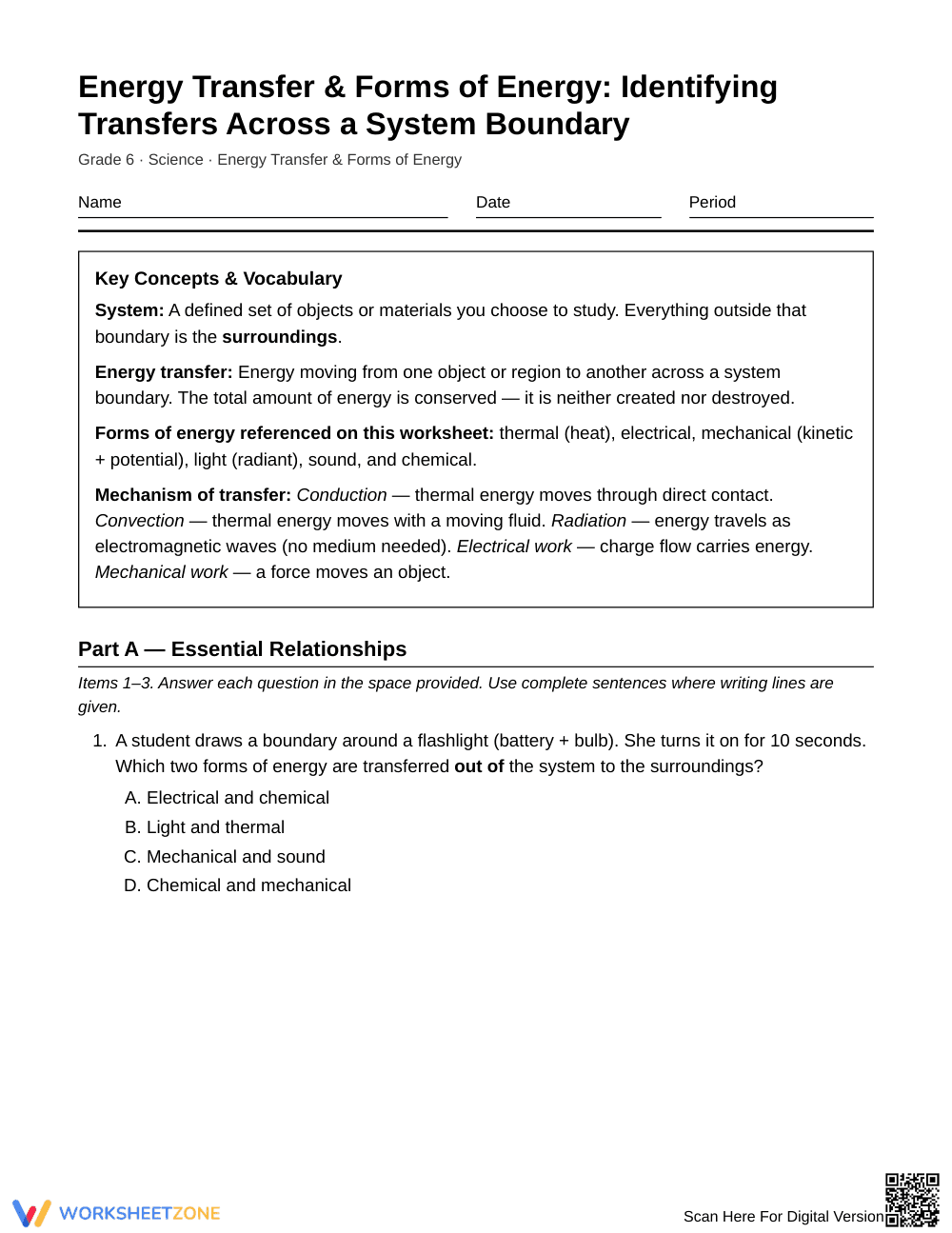
This Grade 6 science worksheet equips middle school students to accurately identify and analyze energy transfers across defined system boundaries. Through 12 multi-format items, learners examine how thermal, radiant, mechanical, electrical, and chemical energy flow between systems and their surroundings, deepening their conceptual understanding of physical science and energy conservation principles.
At a Glance
- Grade: 6 · Subject: Science
- Standard: Physical Science — Track energy flow into, out of, and within closed and open systems
- Skill Focus: Energy Transfers Across System Boundaries
- Format: 5 pages · 12 problems · Answer key included · PDF
- Best For: Physical science unit practice or assessment
- Time: 35–45 minutes
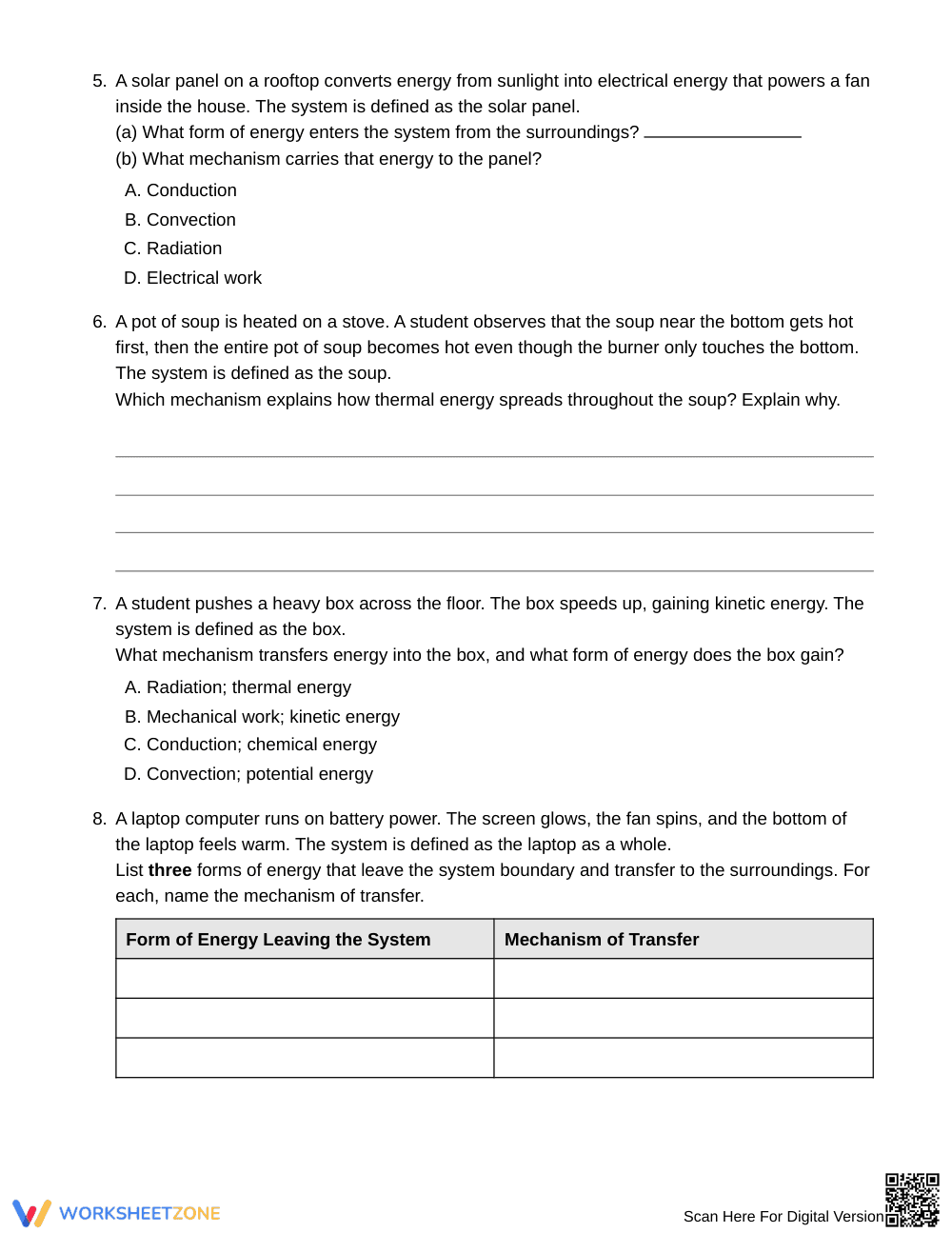
This 5-page worksheet includes a structured reference box with key terms covering systems, surroundings, energy forms, and transfer mechanisms such as conduction, convection, radiation, mechanical work, and electrical work. Students engage with multiple-choice questions, data-entry classification tables, scenario-based constructed responses, and multi-step transfer diagrams, supported by a comprehensive 4-page answer key.
Skill Progression
- Guided practice (Items 1–3): Students identify systems, surroundings, and energy forms in everyday contexts like flashlights and pots on burners using multiple-choice prompts and a structured table.
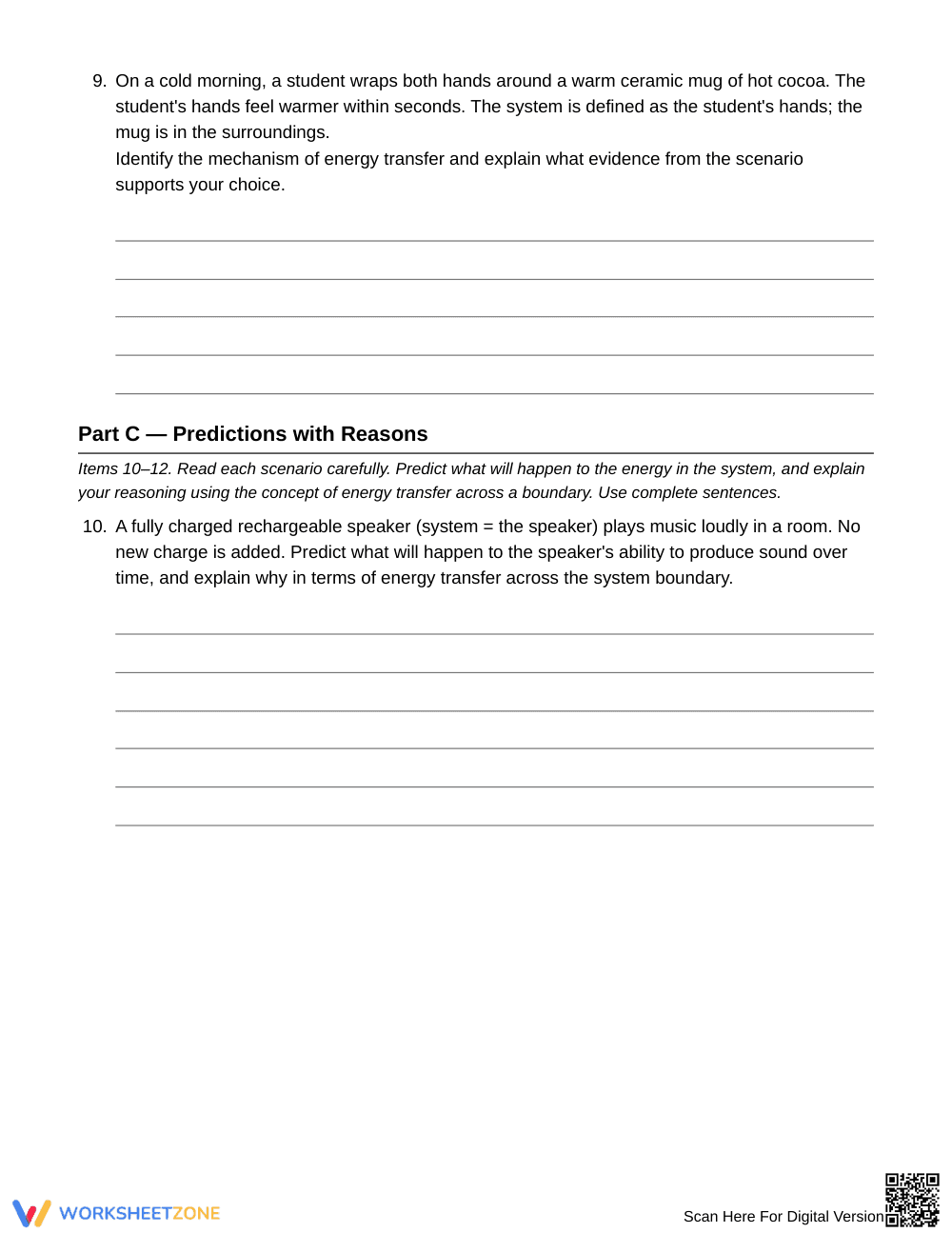
- Supported practice (Items 4–9): Learners examine specific transfer mechanisms—including conduction, convection, radiation, and mechanical work—through real-world scenarios and multi-row analysis tables.
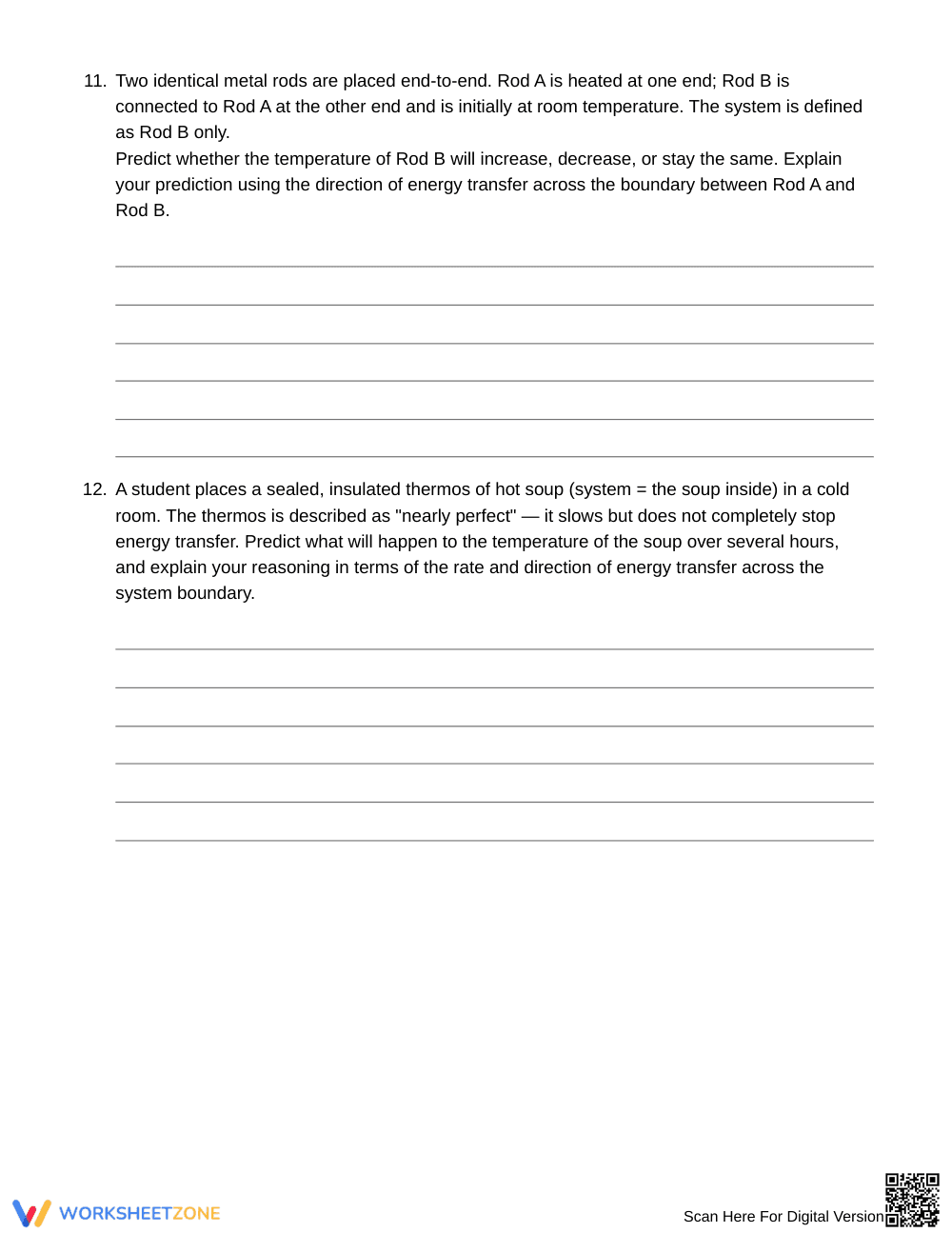
- Independent practice (Items 10–12): Students formulate multi-sentence scientific predictions regarding speakers, conductive metal rods, and insulated thermoses, defending their reasoning using boundary transfer models.
This sequence follows the gradual-release model, moving students from foundational terminology to independent system modeling.
Standards Alignment
This resource aligns with middle school physical science standards addressing energy conservation, transfer mechanisms, and system modeling. Students demonstrate how energy moves across defined boundaries via conduction, convection, radiation, and work without being created or destroyed. Both curriculum goals and performance expectations can be copied directly into lesson plans, IEP goals, or district curriculum mapping tools.
How to Use It
Administer this activity during the guided practice phase of an energy unit, following direct instruction on heat transfer mechanisms and system boundaries. For formative assessment, observe whether students correctly identify the boundary in Item 3 before naming the transfer direction; misconceptions frequently arise when students confuse the system with its surroundings. Expect completion within 35 to 45 minutes.
Who It's For
This worksheet serves sixth-grade science classrooms, introductory physical science courses, and targeted intervention groups. The built-in reference definitions support English learners and striving readers, while the predictive scenarios challenge advanced learners. Pair this printable with a hands-on thermal conduction lab or an interactive energy forms demonstration.
According to research on explicit science instruction summarized by Fisher & Frey (2014), scaffolding conceptual models through structured system boundaries significantly enhances student comprehension of abstract physical science phenomena. Middle school learners often struggle to distinguish between fundamental heat transfer mechanisms and the physical boundaries containing them. By pairing defined reference vocabulary with gradual-release problem sets, this resource reinforces how energy flows between systems and surroundings across mechanical, electrical, thermal, and radiant domains. Research in cognitive learning progressions indicates that requiring students to justify directional energy movement in structured written predictions solidifies transfer principles far more effectively than passive terminology recall alone. This comprehensive worksheet provides Grade 6 science educators with a targeted, standards-aligned instructional tool that systematically builds student mastery in modeling energy conservation, evaluating thermodynamic transfer pathways, and explaining scientific causality across diverse physical scenarios.


