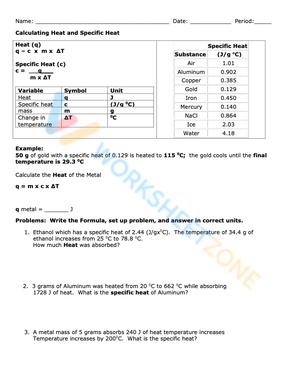
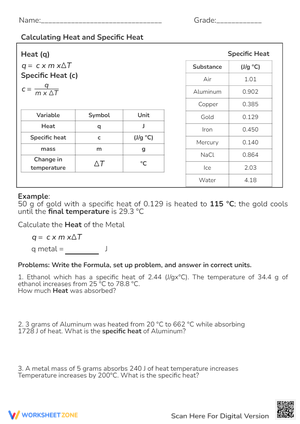
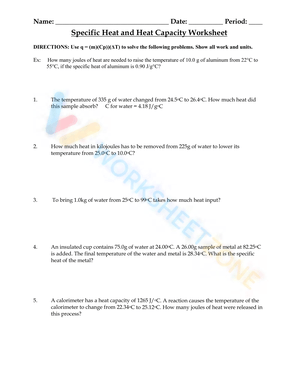
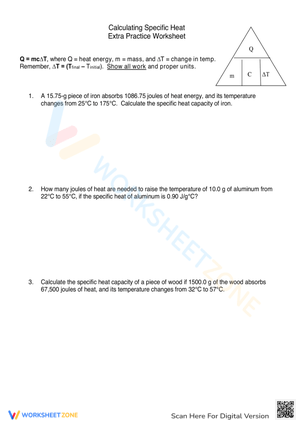
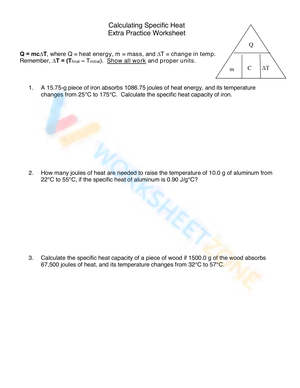
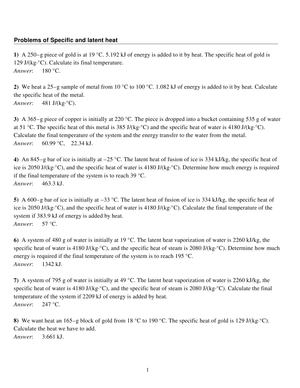
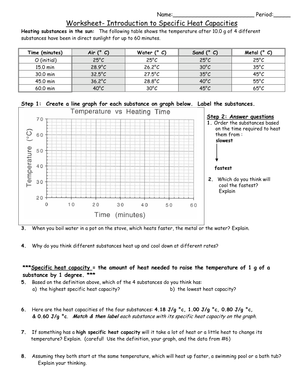
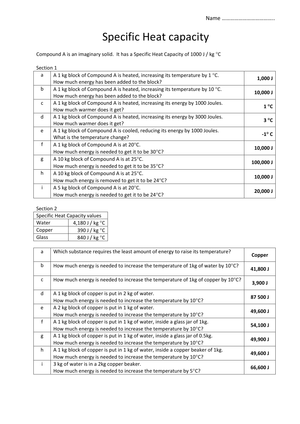
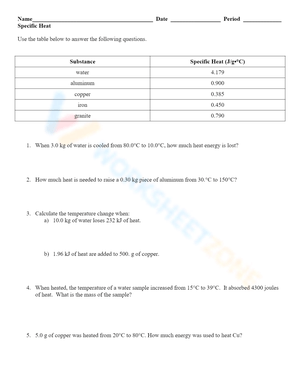
These specific heat worksheets give chemistry and physical science teachers a collection of standalone problems organized by target variable — students practice solving for heat energy, mass, temperature change, and specific heat capacity in turn, building algebraic fluency before the problems start mixing demands. The set spans from direct-substitution work with q=mcΔT all the way through two-substance calorimetry scenarios where the heat lost by a heated metal equals the heat gained by the surrounding water.
What q=mcΔT Actually Asks of Students
The formula looks approachable — four variables, straightforward multiplication. Students routinely assume one modeled example covers it. That assumption breaks down in the third or fourth problem, when the unknown shifts from q to mass or specific heat and the algebra requires genuine rearrangement rather than direct substitution. Each worksheet isolates one of these demands so students aren't simultaneously managing new algebra and unfamiliar conceptual content at the same time.
The subtler difficulty is ΔT. Students who handle the multiplication correctly will still produce wrong answers if they treat the final temperature as the temperature change. A problem that reads "water heated from 22°C to 68°C" has a ΔT of 46°C — not 68. In class, roughly a third of students write 68 on the first attempt. The worksheets build in multiple problems with non-zero starting temperatures precisely to surface and correct this error before it becomes a habit.
Skills and Concepts Covered Across the Set
- Solving q=mcΔT for each of the four variables across varied problem contexts
- Conceptual comparison questions — explaining why a metal buckle and a pool of water respond differently to the same afternoon sun
- Unit conversion work: moving between joules and kilojoules, grams and kilograms, Celsius and Kelvin
- Two-substance calorimetry problems applying conservation of energy across both substances simultaneously
- Material-identification problems — using a calculated specific heat value to match an unknown metal to a reference table
Frequent Student Errors Worth Watching For and Addressing
Beyond the ΔT confusion, the second most reliable error pattern involves units. Students who set up the algebra correctly will frequently drop units mid-calculation and arrive at a numerically accurate answer attached to the wrong label — or no label at all. The answer lines on these worksheets are formatted as "q = ___ J" or "m = ___ g" so students must confront the expected unit before they consider the problem finished. That small structural feature catches a surprising number of incomplete answers.
A conceptual error worth addressing before any calculation begins: many students believe specific heat is a property of an object's size rather than its material composition. A 10-gram block of aluminum and a 500-gram block of aluminum have the same specific heat capacity — 0.897 J/g°C. Students who haven't internalized this set up multi-step problems incorrectly when mass changes between sub-problems. One worksheet addresses this directly through a side-by-side comparison question before a single number is plugged in anywhere.
Standard Alignment
At the high school level, this set connects most directly to NGSS HS-PS3-4, which asks students to plan and conduct investigations showing that thermal energy transfer between two components at different temperatures produces a more uniform energy distribution within a closed system. The calorimetry problems in the worksheets build the quantitative foundation that standard assumes — a student who can't reliably calculate heat exchange from the formula will struggle to evaluate whether lab data is even plausible, let alone design a meaningful investigation. A specific heat worksheets that extends into the two-substance problems prepares students for the investigative reasoning HS-PS3-4 requires, not just the arithmetic. For middle school classrooms, the foundational problems align with MS-PS3-4, which asks students to plan investigations identifying relationships among energy transferred, material type, mass, and temperature change — exactly the conceptual territory these worksheets address before the calculator appears.
Building These Worksheets Into Your Lesson Sequence
Staggering the worksheets across the unit works better than assigning them all at once. Use a direct-substitution worksheet — the version that only asks students to solve for q — the same class day you introduce the formula. It functions as a formative check: if most of the class misses the ΔT step, that's a clear signal to re-teach before moving to algebraic rearrangement. Reserve the calorimetry worksheets for after students have had at least one hands-on lab experience, even a simple hot-water demo with two beakers. Students who have watched a thermometer reading stabilize as two substances reach equilibrium bring better intuition to the written problems than students working from description alone.
The 10 minutes at the start of class while attendance is taken and lab materials are distributed is a reliable slot for a single review problem pulled from a previously completed worksheet — but this time solved for a different variable. Returning to familiar numbers with a new target is an effective retrieval practice move that costs almost nothing in planning time and keeps formula fluency from fading between major assessments.
Adjusting the Worksheets for a Range of Learners
For students who are still unsteady with algebraic rearrangement, providing a reference card showing the four rearranged forms of q=mcΔT removes the algebra barrier without removing the thermal energy content. The goal at that level is accurate substitution and unit discipline, not deriving the rearrangement from scratch under pressure. These students still work every problem — they just have the formula forms in front of them rather than having to reconstruct them independently.
Students who are confident with the algebra move quickly to the identification and calorimetry problems. A useful extension: ask them to work backward from a published specific heat table and construct their own two-substance problem with a predetermined answer, then exchange with a partner to solve. Students who can write a valid problem understand the formula relationships at a level well above students who can only solve given problems. A specific heat worksheets that includes blank problem templates alongside the worked exercises supports this kind of extension without requiring the teacher to generate new material from scratch.
Frequently Asked Questions
At what point in a thermal energy unit do these worksheets fit best?
The direct-substitution worksheets belong in the first or second lesson after students encounter q=mcΔT. The conceptual comparison worksheets — the ones asking students to explain material differences without calculation — work well before the formula is introduced, building the intuition that makes the math meaningful. The calorimetry worksheets are most effective after at least one lab experience, so students have a physical reference for what "heat lost equals heat gained" looks like with actual equipment and real temperature readings.
How strictly should units be enforced on student work?
Enforce units on every step, every problem, from the first day the formula appears. A student who writes "q = 2,509" without a unit has not demonstrated mastery of the concept regardless of whether the number is correct. The habit of writing joules, grams, and degrees Celsius beside every value builds the unit-tracking discipline that dimensional analysis requires later in the course, and it costs students almost nothing once the habit is established.
How do these worksheets differ between middle school and high school use?
A specific heat worksheets used in middle school physical science concentrates on direct substitution and conceptual explanation — why does sand heat up faster than the ocean at the beach? High school chemistry versions add algebraic rearrangement, significant figure requirements, unit conversions between joules and kilojoules, and full two-substance calorimetry problems. The underlying formula is identical at both levels; what changes is the algebraic and analytical demand placed on students as they work through each problem.












 Interactive Worksheet Maker
 Quiz Maker
 Word Search Maker
 Crossword Puzzle Maker
 Word Scramble Generator
 Sentence Scramble Generator
 Handwriting Worksheet Generator
 Name Tracing Generator
 Fill In The Blank Generator