


























1 / 2
0
Views
0
Downloads

0.0
0
Save
0 Likes
Share
CONSERVATION OF ENERGY WORKSHEET
0 Views
0 Downloads
Paste this activity's link or code into your existing LMS (Google Classroom, Canvas, Teams, Schoology, Moodle, etc.).
Students can open and work on the activity right away, with no student login required.
You'll still be able to track student progress and results from your teacher account.
Information
Description
What It Is:
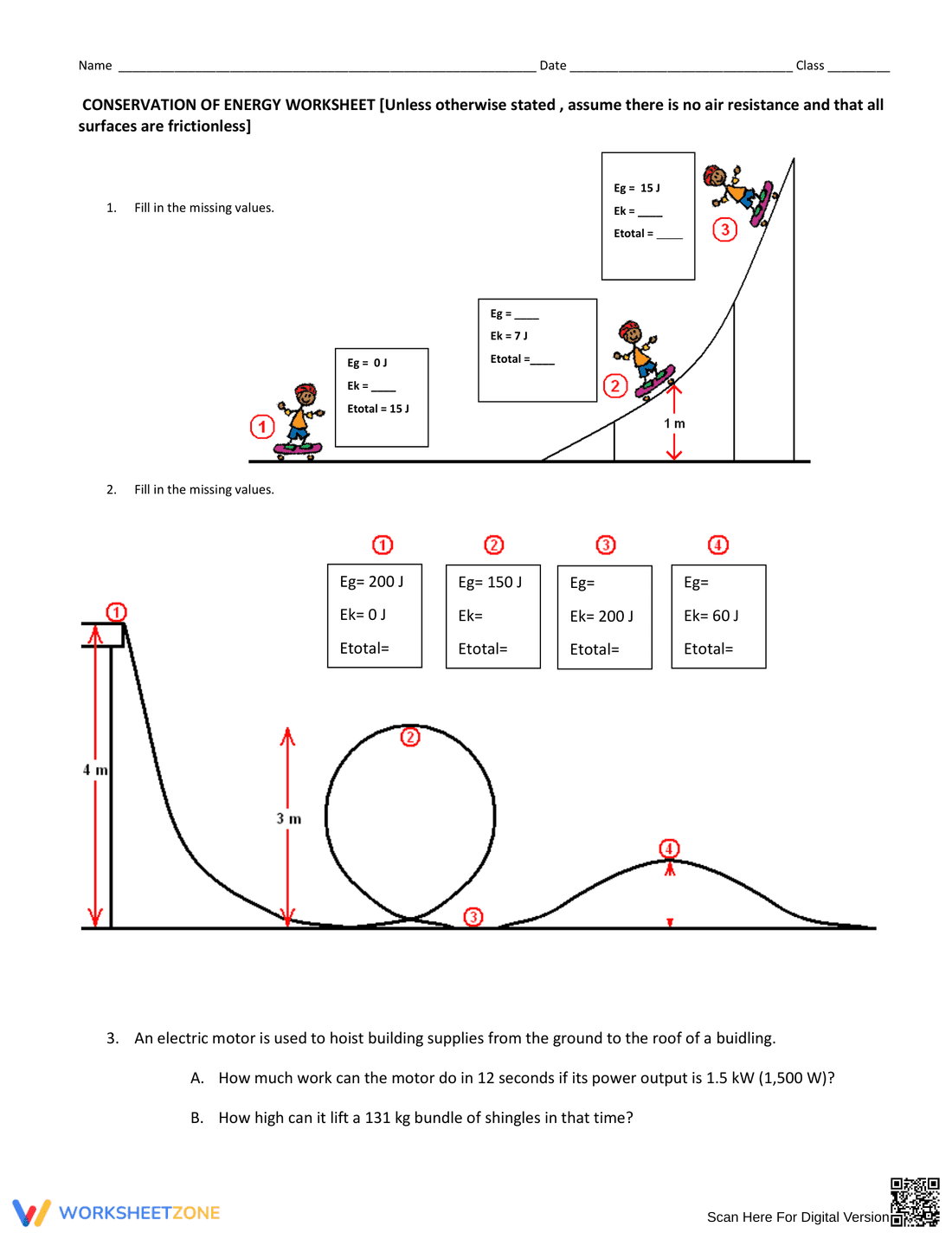
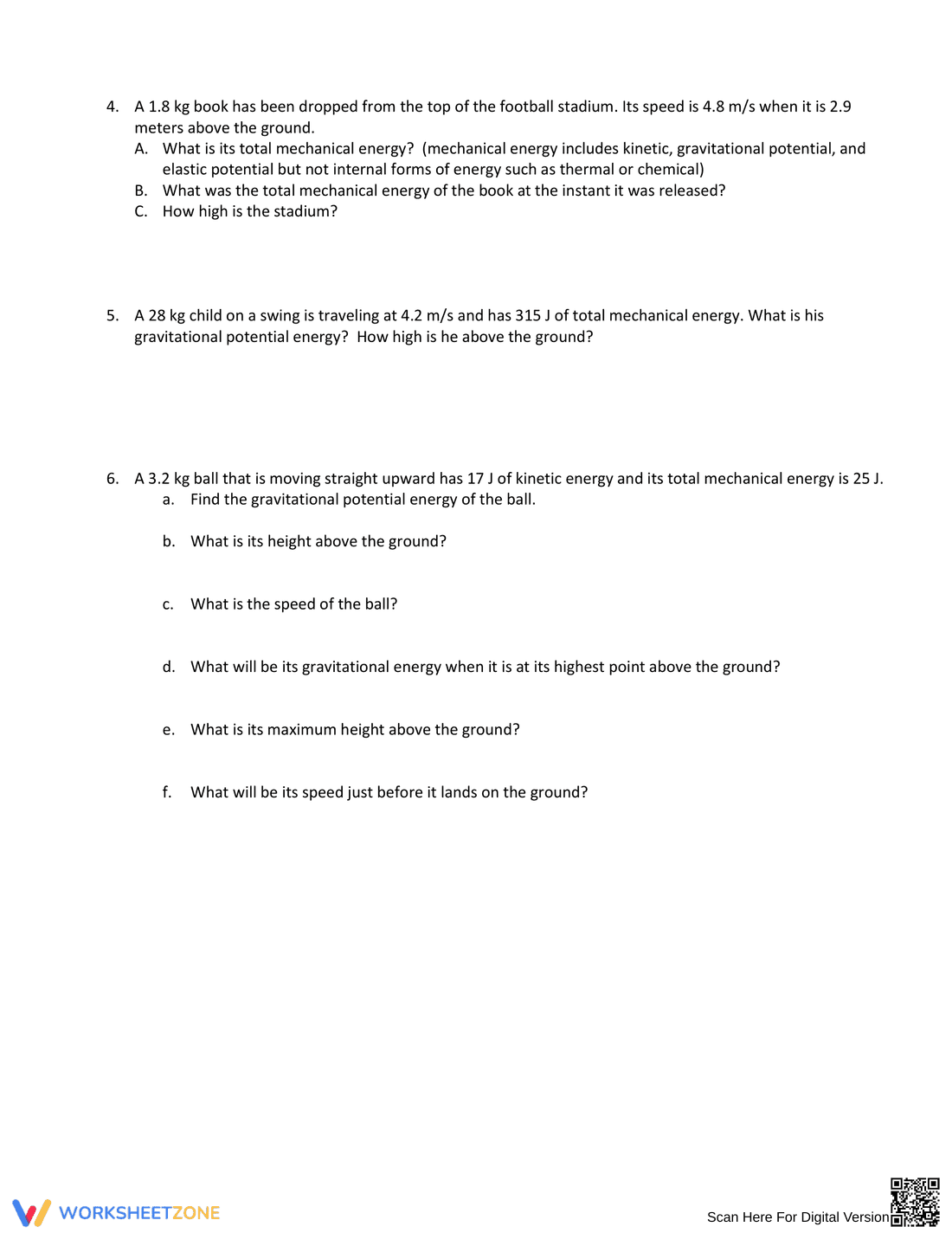
A detailed conservation of energy worksheet where students calculate gravitational potential energy (Eg), kinetic energy (Ek), and total mechanical energy across different points on roller-coaster-style tracks. The worksheet includes diagrams with varying heights, frictionless assumptions, and multi-step problems that reinforce the law of conservation of mechanical energy.
Why Use It:
This worksheet helps learners visualize how energy transfers between potential and kinetic forms as objects move along hills and loops. It strengthens understanding of total mechanical energy, reinforces Eg = mgh and Ek = ½mv², and provides applied practice using real-world examples like roller coasters and motorized hoists.
How to Use It:
• Use during lessons on mechanical energy, potential energy, and kinetic energy.
• Assign as in-class guided practice or homework.
• Pair with hands-on demonstrations such as ramps, balls, or simulation tools.
• Use as review material before physics or physical science assessments.
Grade Suitability:
Designed for Grades 8–10, ideal for physical science and introductory physics learners.
Target Users:
Teachers, students, and homeschool educators studying conservation of energy and mechanical energy transformations.
A detailed conservation of energy worksheet where students calculate gravitational potential energy (Eg), kinetic energy (Ek), and total mechanical energy across different points on roller-coaster-style tracks. The worksheet includes diagrams with varying heights, frictionless assumptions, and multi-step problems that reinforce the law of conservation of mechanical energy.
Why Use It:
This worksheet helps learners visualize how energy transfers between potential and kinetic forms as objects move along hills and loops. It strengthens understanding of total mechanical energy, reinforces Eg = mgh and Ek = ½mv², and provides applied practice using real-world examples like roller coasters and motorized hoists.
How to Use It:
• Use during lessons on mechanical energy, potential energy, and kinetic energy.
• Assign as in-class guided practice or homework.
• Pair with hands-on demonstrations such as ramps, balls, or simulation tools.
• Use as review material before physics or physical science assessments.
Grade Suitability:
Designed for Grades 8–10, ideal for physical science and introductory physics learners.
Target Users:
Teachers, students, and homeschool educators studying conservation of energy and mechanical energy transformations.


