


























Views
Downloads

Essential Ramp and Spring Worksheet | Grade 12 Physics
Paste this activity's link or code into your existing LMS (Google Classroom, Canvas, Teams, Schoology, Moodle, etc.).
Students can open and work on the activity right away, with no student login required.
You'll still be able to track student progress and results from your teacher account.
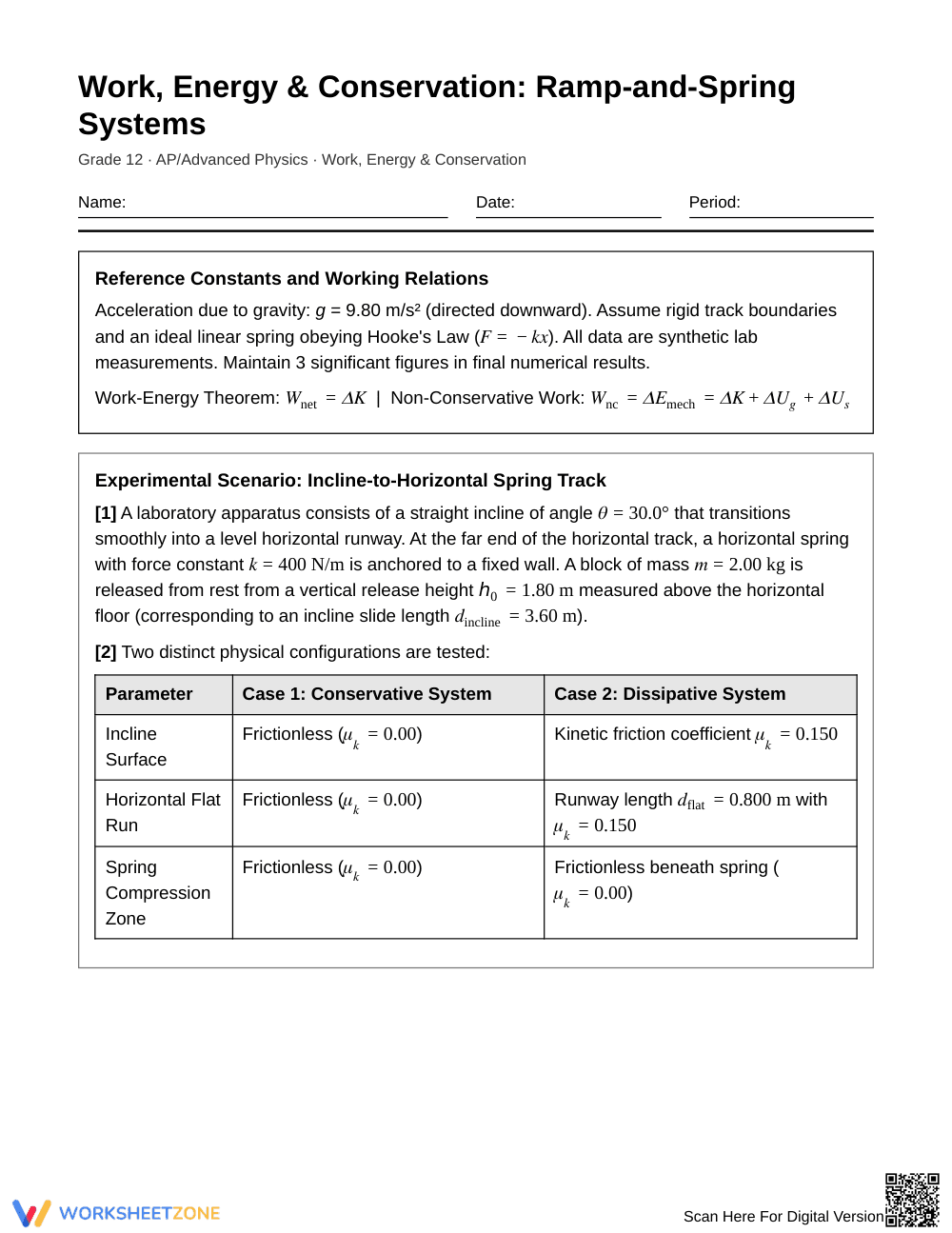
This Grade 12 physics worksheet equips students to master complex work-energy principles through a rigorous incline-to-horizontal spring scenario. Students analyze conservative and non-conservative pathways, calculate mechanical energy transfers, and evaluate theoretical claims using algebraic derivations, building the deep quantitative reasoning necessary for advanced mechanics.
At a Glance
- Grade: 12 · Subject: Physics
- Standard: Advanced Physics Mechanics — Analyze energy transformations and work done by non-conservative forces in multi-stage systems
- Skill Focus: Ramp-and-Spring Energy Analysis
- Format: 5 pages · 10 problems · Answer key included · PDF
- Best For: Advanced mechanics unit review and AP exam preparation
- Time: 45–60 minutes
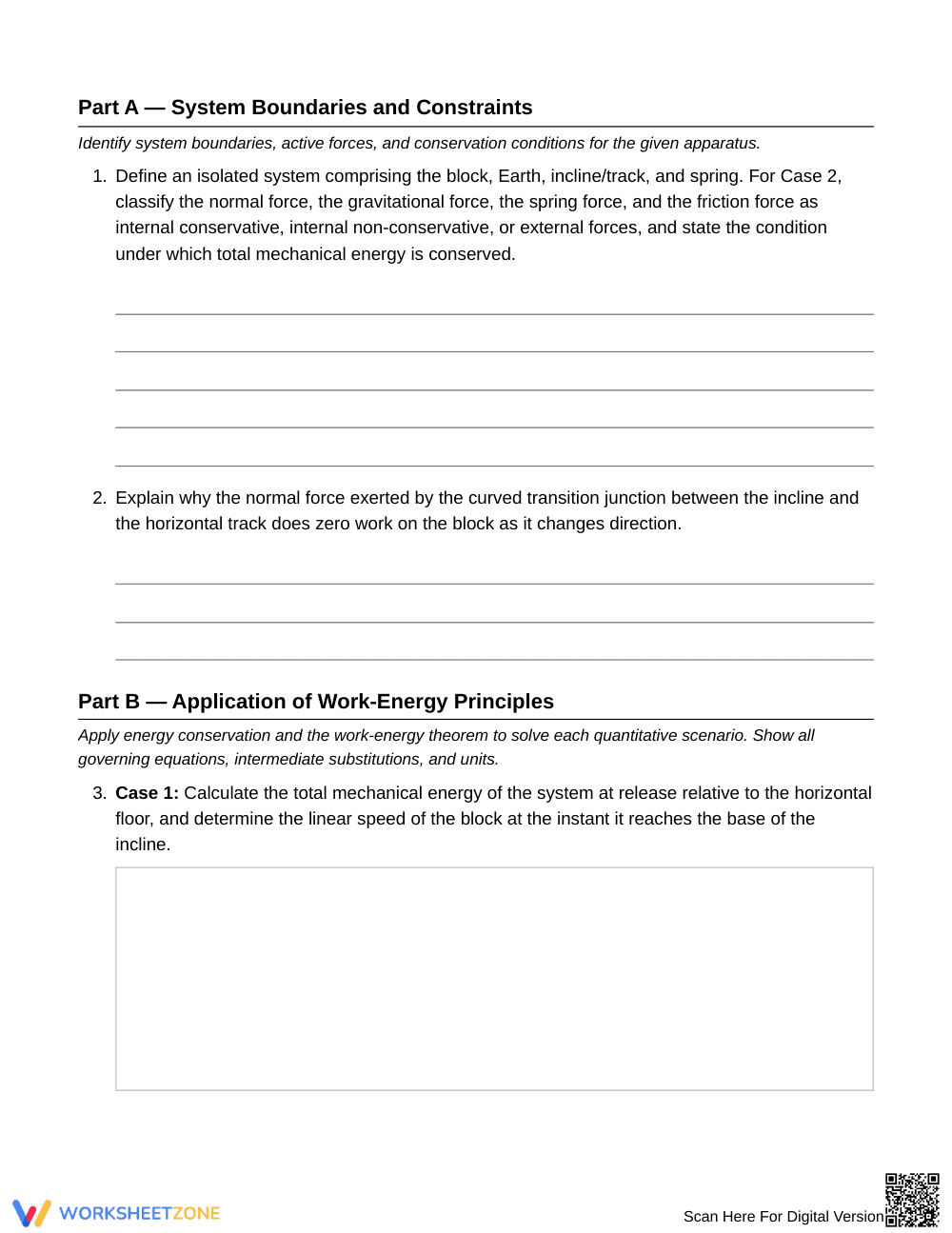
This 5-page printable resource features 10 multi-part analytical tasks organized around a comparative experimental apparatus with a 30.0-degree incline, horizontal flat run, and anchored spring. Students examine both an idealized frictionless track and a dissipative setup with kinetic friction. The packet includes standard working relations, a structured two-case parameter table, and an extensive 3-page step-by-step answer key featuring full algebraic derivations and numerical solutions.
Skill Progression
- Guided practice (Tasks 1–2): Students define system boundaries, classify active forces as conservative or non-conservative, and explain constraint forces such as the zero work done by normal forces along curved junctions.
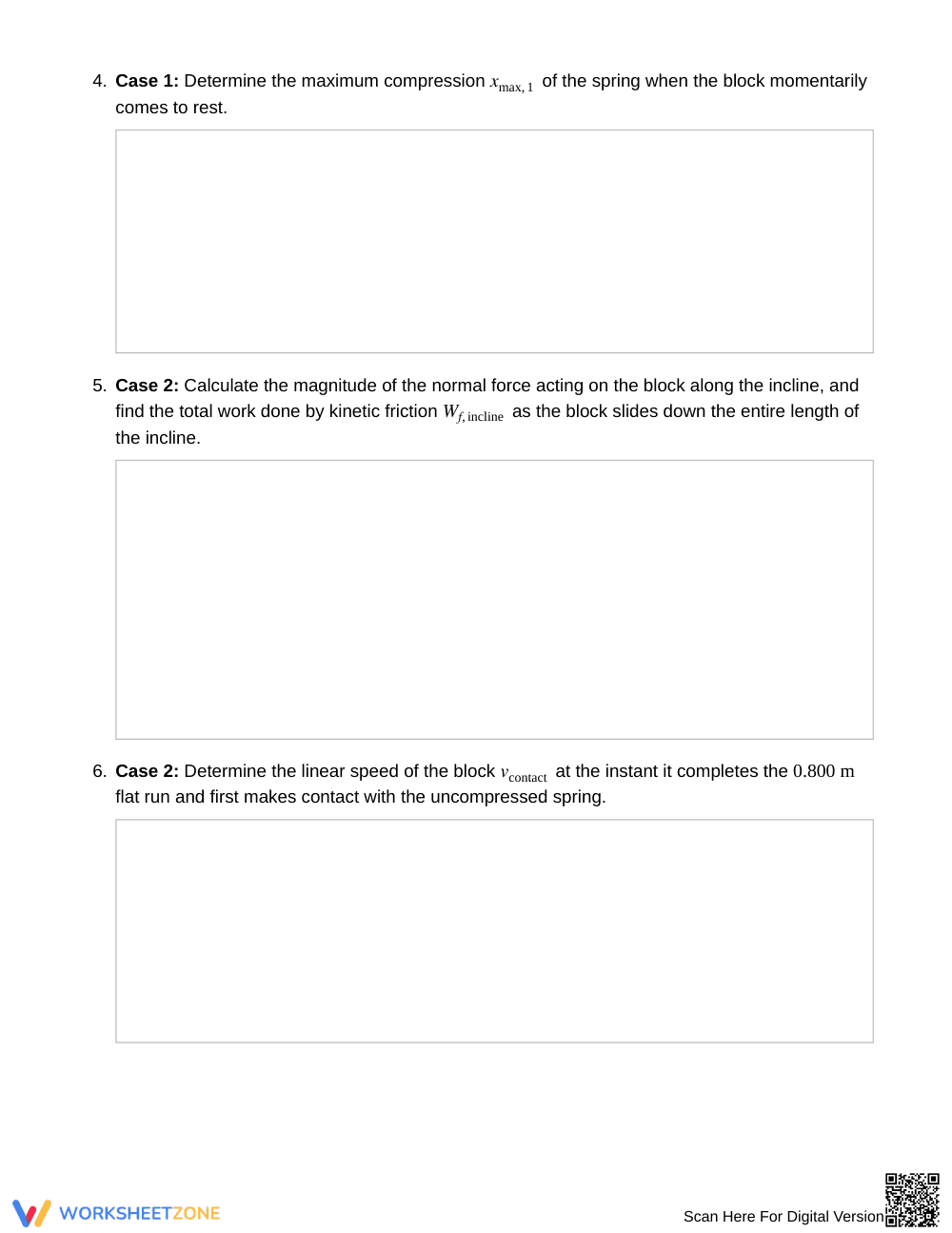
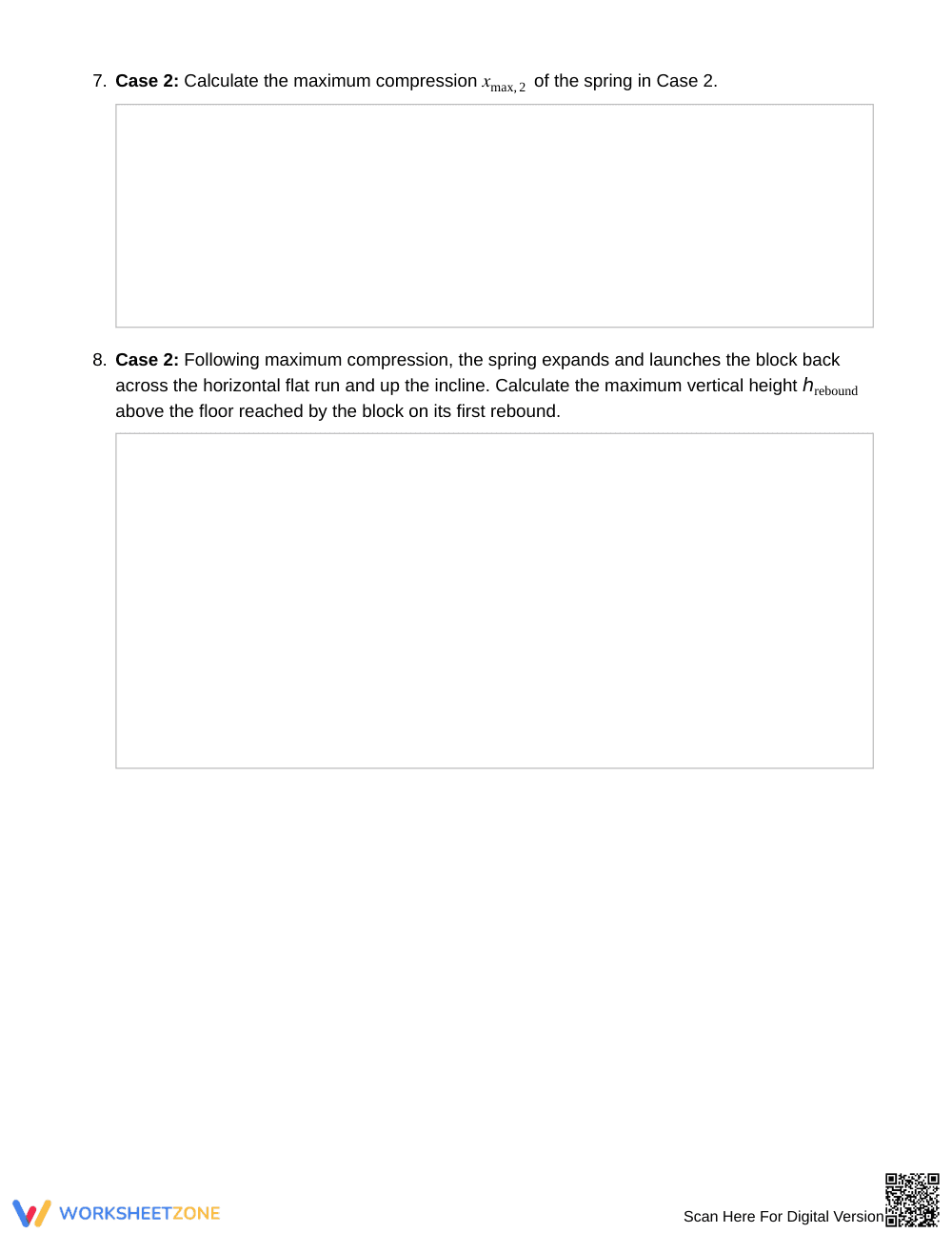
- Supported practice (Tasks 3–8): Students execute quantitative calculations across six progressive problems, finding velocity at the incline base, maximum spring compression in conservative conditions, frictional energy losses, and rebound height.
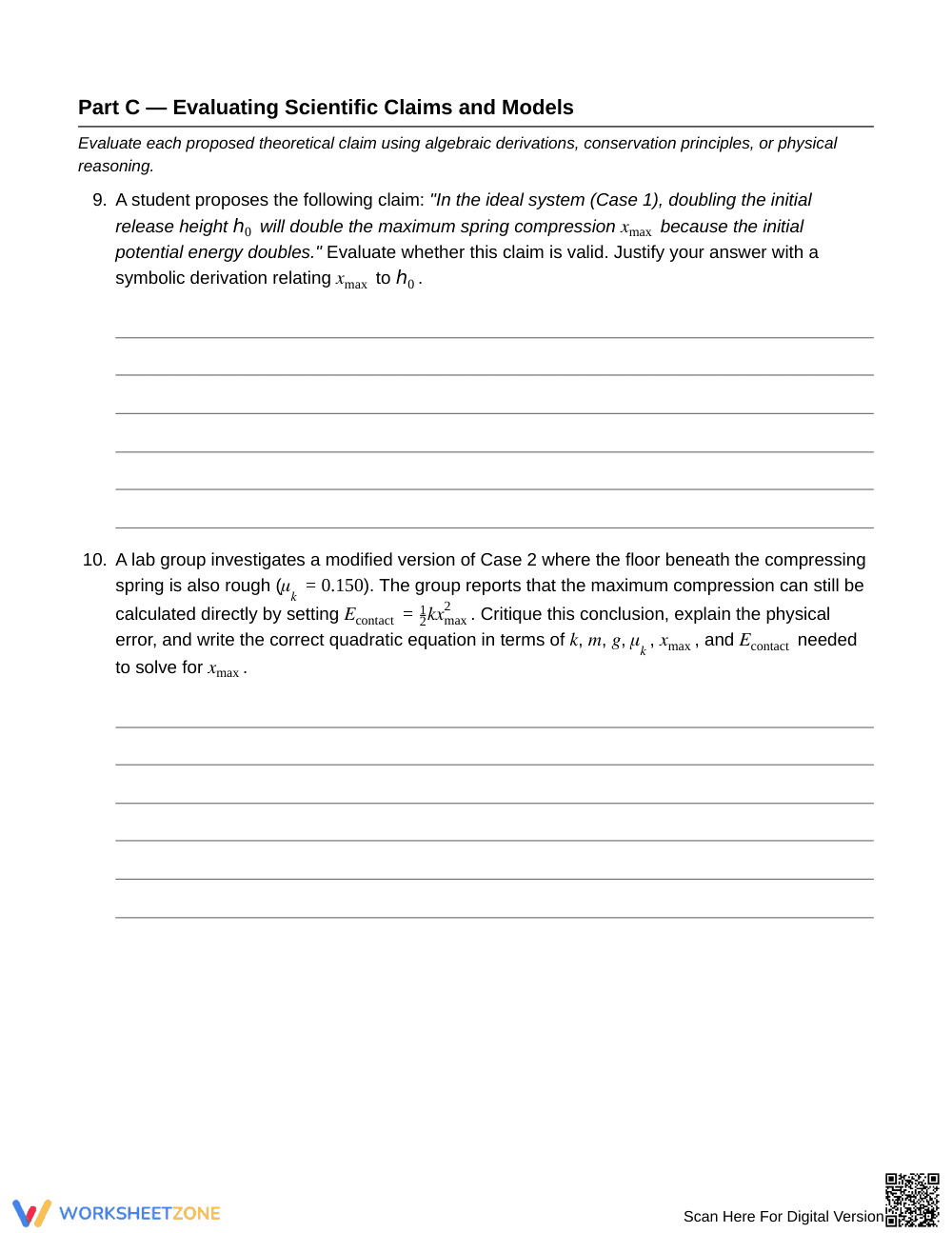
- Independent practice (Tasks 9–10): Students evaluate scientific claims through symbolic derivation and critique experimental models by formulating the correct quadratic equation for compression with friction.
This structured progression reflects the gradual-release framework, guiding students from foundational qualitative system definition to independent mathematical modeling and critique.
Standards Alignment
This activity aligns with high school physics and AP Physics standards focusing on mechanical energy conservation, non-conservative work, and Hooke's Law spring systems. Students quantify kinetic energy, gravitational potential energy, and elastic potential energy changes while applying the work-energy theorem across multi-stage physical paths. Both standard codes can be copied directly into lesson plans, IEP goals, or district curriculum mapping tools.
How to Use It
Deploy this worksheet after direct instruction on the work-energy theorem and non-conservative forces. It functions effectively as a collaborative partner challenge or an intensive AP test preparation review. During class, monitor student work on Task 9 to formatively assess whether students recognize the non-linear square-root relationship between height and spring compression. Students typically complete the 10 tasks in 45 to 60 minutes.
Who It's For
This worksheet is tailored for Grade 12 students in AP Physics 1, AP Physics C: Mechanics, or honors physics. Teachers can scaffold the assignment by providing intermediate free-body diagrams for learners needing calculation support while challenging advanced students to complete symbolic algebraic proofs. Pair this worksheet with an interactive track simulation or an incline-spring laboratory investigation.
According to research by Fisher & Frey (2014) on the gradual release of responsibility, advanced secondary science students achieve significantly deeper conceptual mastery when analytical tasks transition deliberately from qualitative system definition to multi-step quantitative calculation and independent model evaluation. This comprehensive 10-task Grade 12 physics worksheet operationalizes that instructional model by guiding learners through rigorous ramp-and-spring energy transformations. Students identify isolated system boundaries, calculate mechanical energy loss resulting from non-conservative frictional forces, determine maximum elastic spring compression, and evaluate theoretical claims using algebraic derivations. By combining structured multi-stage mechanics problem solving with explicit claim critique and quadratic equation modeling, this 5-page curriculum-aligned physics resource reinforces the mathematical precision and conceptual reasoning demanded by college-preparatory physics curricula, providing educators with concrete, verifiable evidence of student mastery across core work, energy, and conservation learning progressions.


