


























Views
Downloads


Essential Energy vs Force Worksheet | Grade 12 Physics
Paste this activity's link or code into your existing LMS (Google Classroom, Canvas, Teams, Schoology, Moodle, etc.).
Students can open and work on the activity right away, with no student login required.
You'll still be able to track student progress and results from your teacher account.
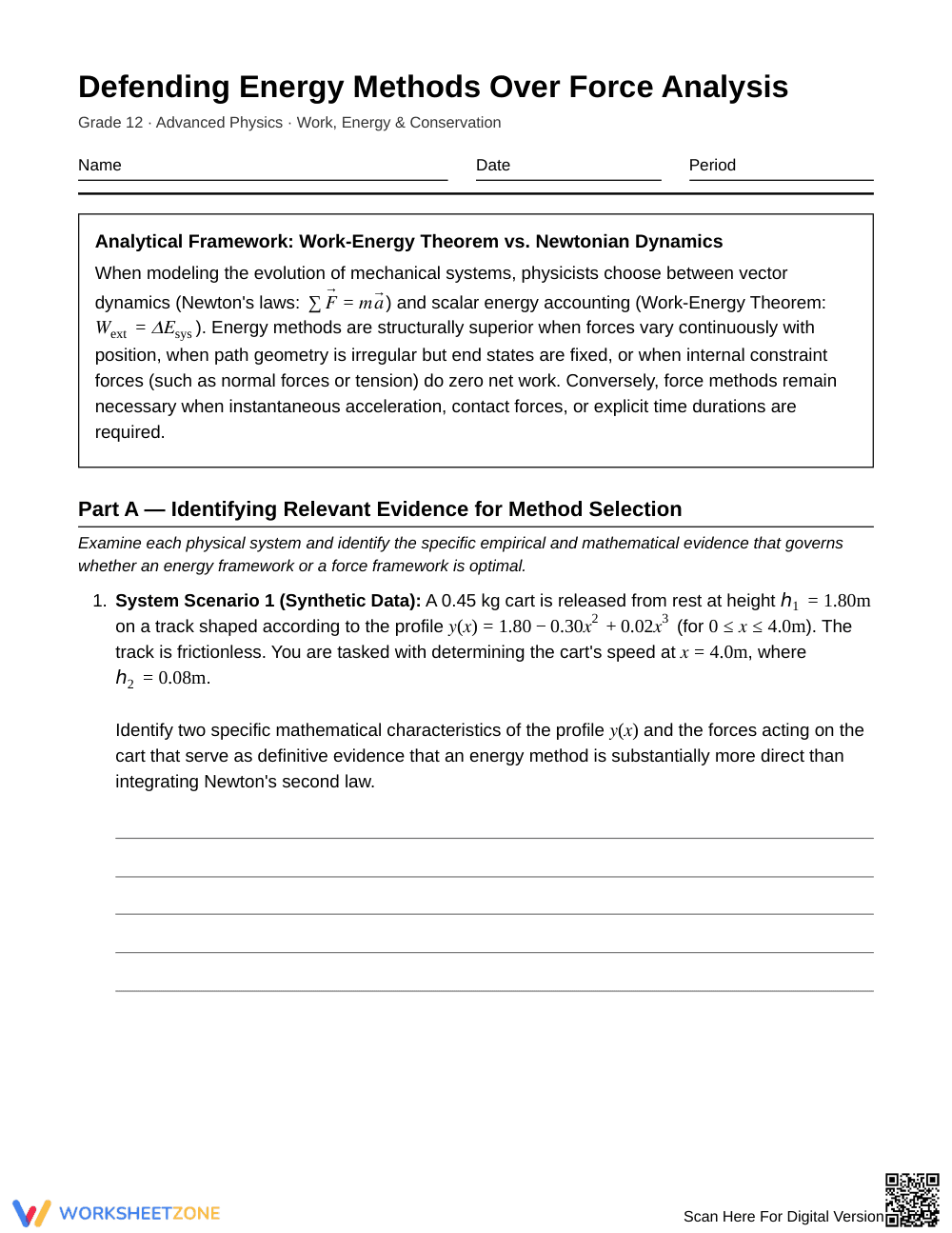
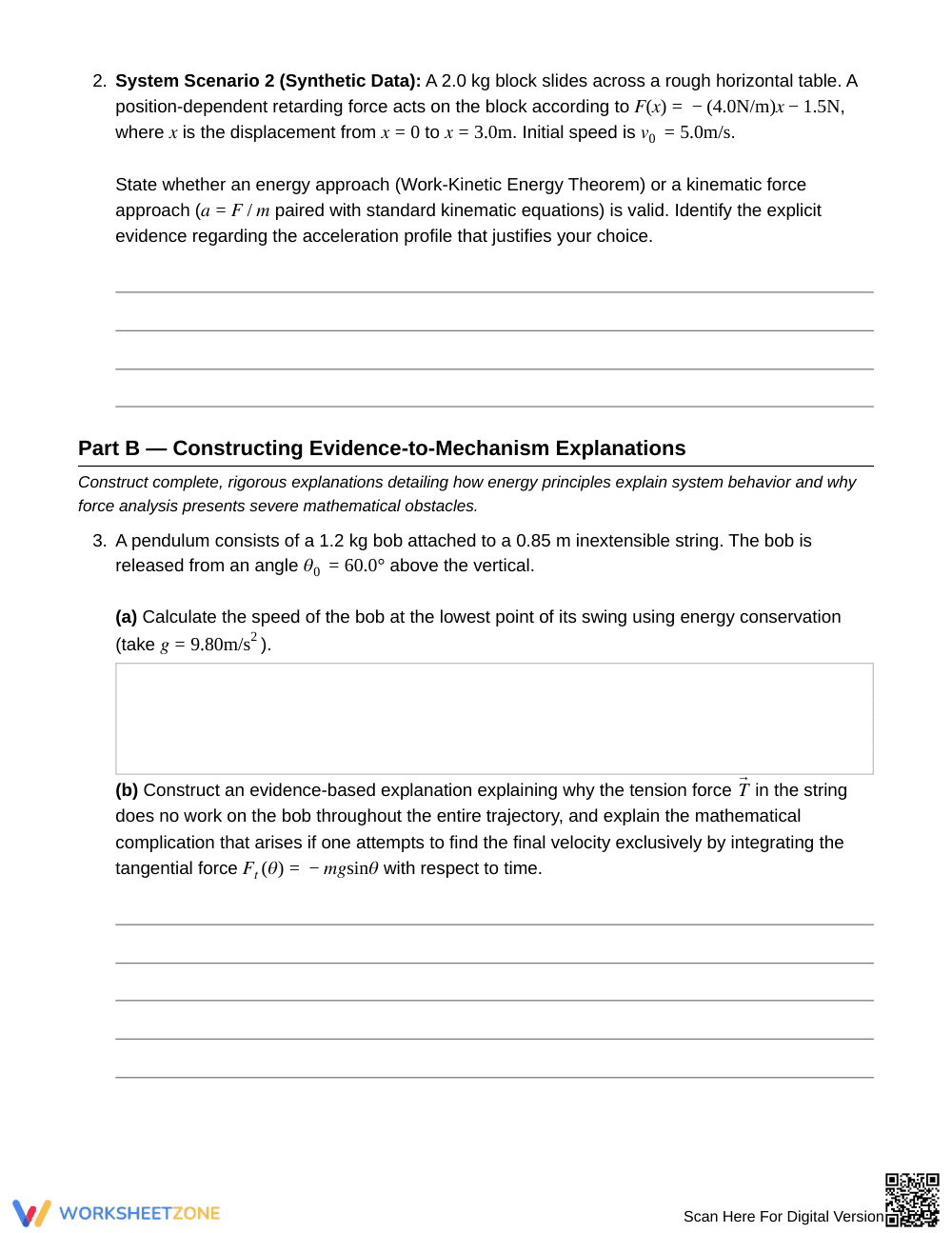
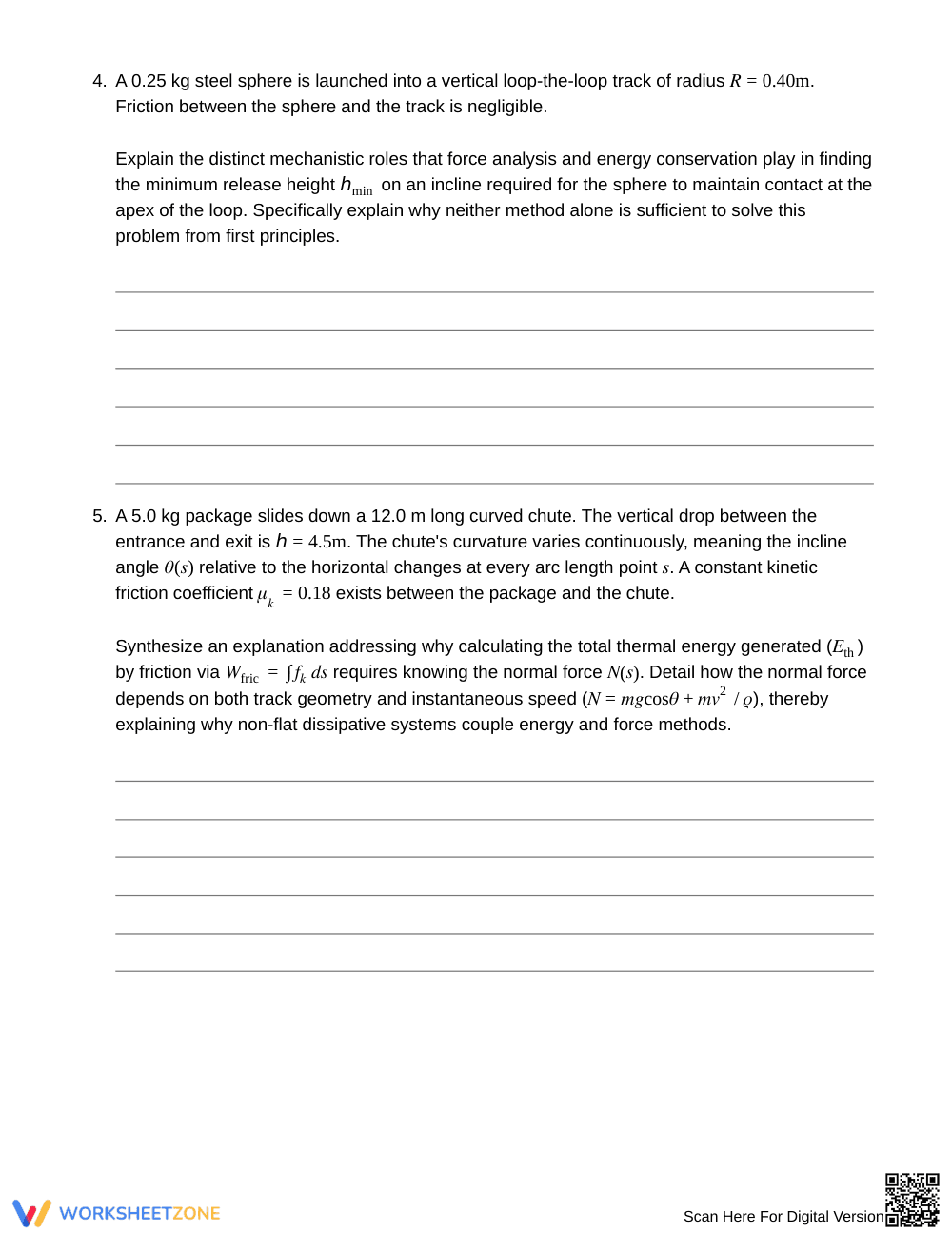
This advanced physics worksheet develops high school students' ability to critically evaluate and defend scalar energy methods over vector Newtonian dynamics. Students analyze complex mechanical systems—including non-uniform curved tracks, variable resistive forces, and coupled dissipative chutes—to articulate when work-energy formulations provide mathematical efficiency over force integrations.
At a Glance
- Grade: 12 · Subject: Physics
- Standard:
Mechanics — Work & Energy— Defend energy methods over force analysis in complex mechanical systems- Skill Focus: Defend an Energy Method Over Force Analysis
- Format: 5 pages · 8 problems · Answer key included · PDF
- Best For: AP Physics mechanics review and analytical reasoning
- Time: 45–60 minutes
Across 5 comprehensive pages, this instructional resource delivers 8 multi-part analytical tasks organized into three distinct methodological tiers. Students examine synthetic kinematic data, evaluate non-linear positional equations, compute work integrals, and analyze coupled normal force dynamics. A detailed 4-page answer key provides complete mathematical derivations and model qualitative explanations for every prompt.
Skill Progression
- Guided Practice (Part A): Students examine 2 targeted system scenarios, identifying mathematical characteristics of continuous track profiles and position-dependent retarding forces to justify selecting work-energy formulations over Newtonian kinematics.
- Supported Practice (Part B): Students complete 4 structured mechanical analyses involving pendulums, vertical loop-the-loop apex thresholds, variable curvature friction chutes, and damped spring buffers, synthesizing mathematical evidence with physical mechanisms.
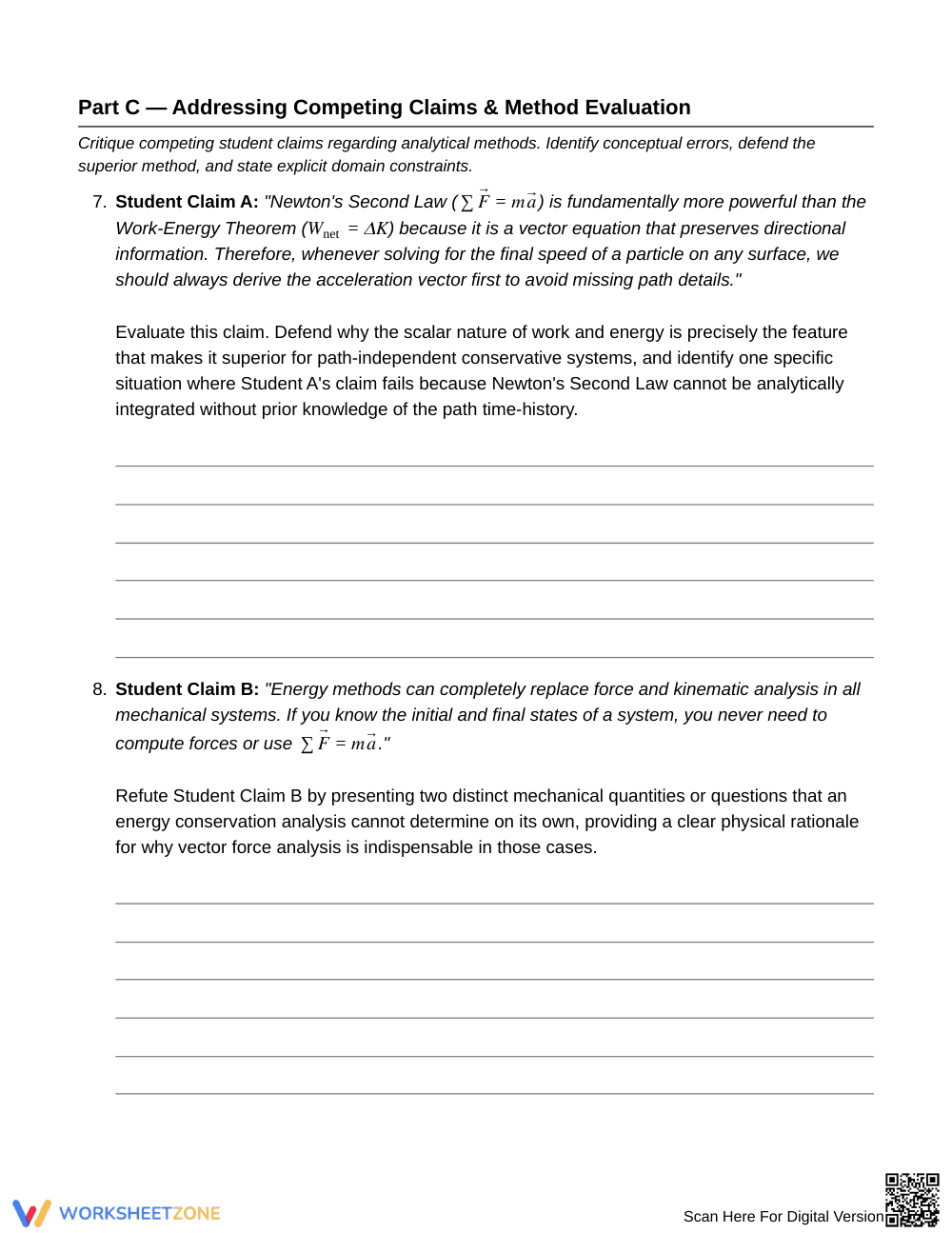
- Independent Practice (Part C): Students critique 2 competing student claims, defending the domain boundaries of vector dynamics versus scalar energy accounting to refute misconceptions.
This sequence implements a gradual-release model (I Do, We Do, You Do) to build analytical autonomy.
Standards Alignment
This worksheet aligns with Grade 12 and AP Physics mechanics standards focusing on the Work-Energy Theorem and Conservation of Energy. Students analyze conservative versus non-conservative forces, path independence, and the mathematical constraints of integrating vector dynamics across curved paths. Standard objectives can be copied directly into lesson plans or curriculum mapping tools.
How to Use It
Deploy this worksheet after direct instruction on work-energy theorems. As a 45- to 60-minute partner activity, students can collaboratively critique the claims in Part C. Alternatively, assign Part B as post-lab synthesis following a kinematics investigation. Formative assessment tip: check whether students recognize that perpendicular normal forces do zero work before attempting differential equations.
Who It's For
This resource is designed for Grade 12 physics students, AP Physics C learners, and introductory mechanics courses. Differentiated tasks scaffold method selection in Part A before tackling advanced friction integrals in Part B. Pair this worksheet with interactive track simulations or force-position graphing activities.
According to research on scaffolded science instruction by Fisher & Frey (2014), structuring complex analytical tasks through progressive cognitive framing significantly enhances students' ability to select appropriate problem-solving representations. In advanced mechanics, novice physics students frequently default to brute-force kinematic formulas even when differential geometry renders vector integration intractable. By explicitly asking Grade 12 students to contrast scalar energy conservation against vector Newtonian dynamics across 8 multi-layered scenarios, this worksheet directly targets common conceptual failure modes in mechanics. Structured evaluation of competing scientific claims reinforces metacognitive monitoring, requiring learners to defend domain applicability rather than merely executing algorithmic algebraic manipulations. Grounding analytical choices in fundamental physical mechanisms—such as normal force work cancellation, potential energy storage, and position-dependent resistance—builds robust schema transfer essential for college-level physics problem solving, quantitative reasoning, and rigorous scientific argumentation.


