


























Views
Downloads


Essential Energy Models Worksheet | Grade 12 Physics
Paste this activity's link or code into your existing LMS (Google Classroom, Canvas, Teams, Schoology, Moodle, etc.).
Students can open and work on the activity right away, with no student login required.
You'll still be able to track student progress and results from your teacher account.
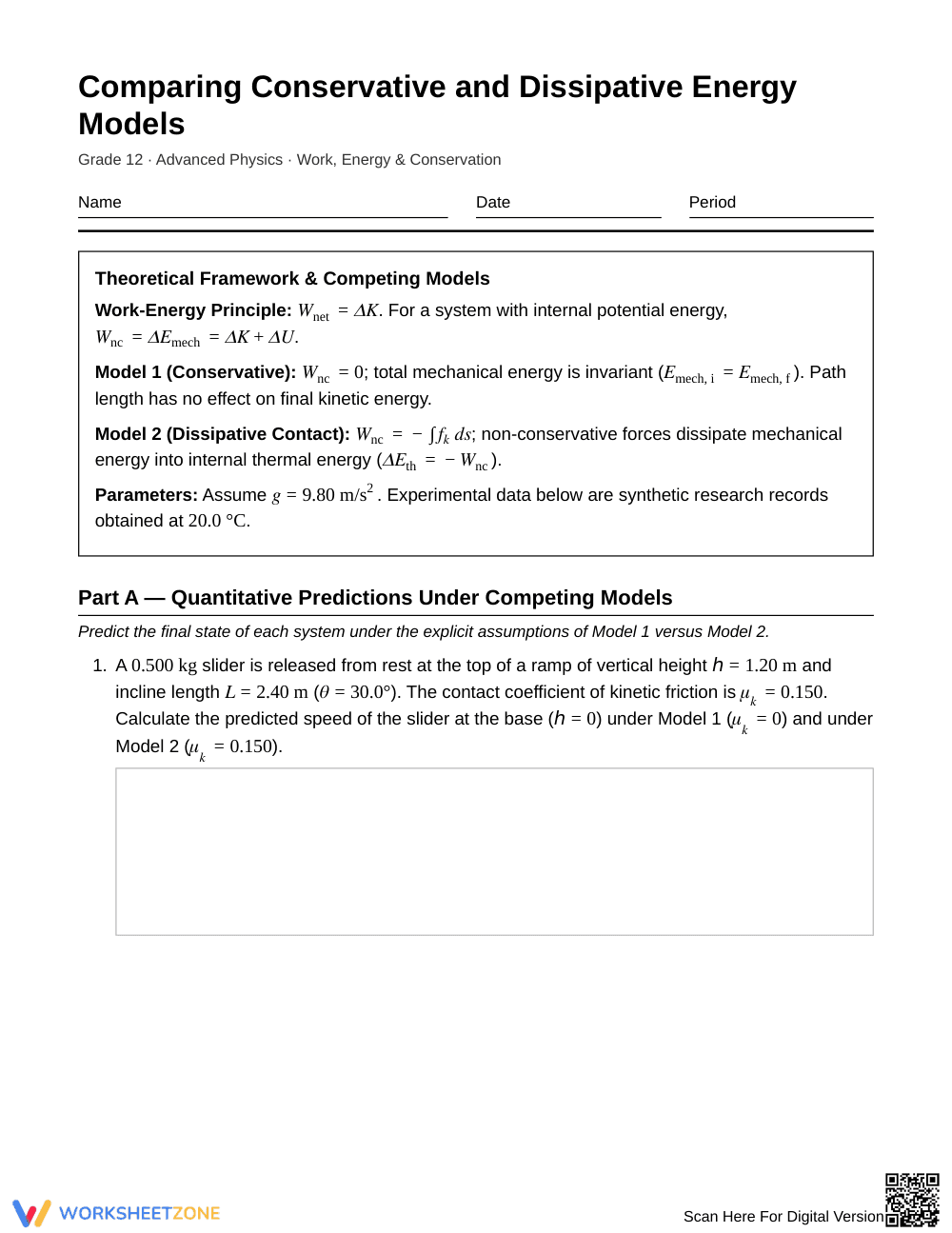
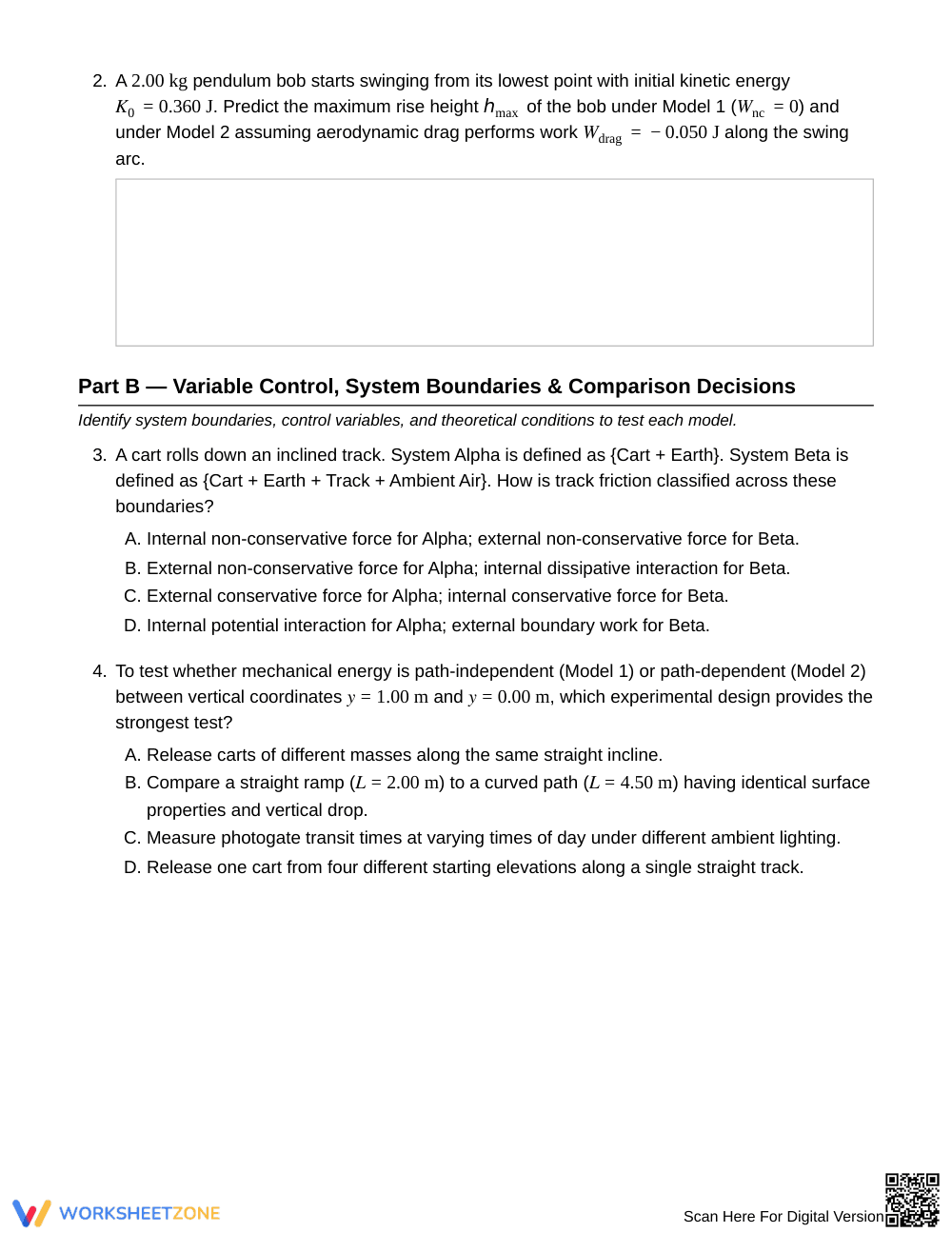
This advanced physics worksheet develops high school students' ability to quantitatively compare conservative and dissipative energy models. Students evaluate theoretical frameworks, analyze work-energy theorem applications, and assess synthetic laboratory data across multi-step scenarios. The resource equips physics learners to distinguish path-independent mechanical conservation from frictional dissipation in realistic physical systems.
At a Glance
- Grade: 12 · Subject: Physics
- Standard: Advanced Mechanics — Analyze energy transfer in conservative and dissipative mechanical systems
- Skill Focus: Compare Conservative and Dissipative Models
- Format: 4 pages · 10 problems · Answer key included · PDF
- Best For: Advanced mechanics work-energy unit review
- Time: 45–60 minutes
What's Inside
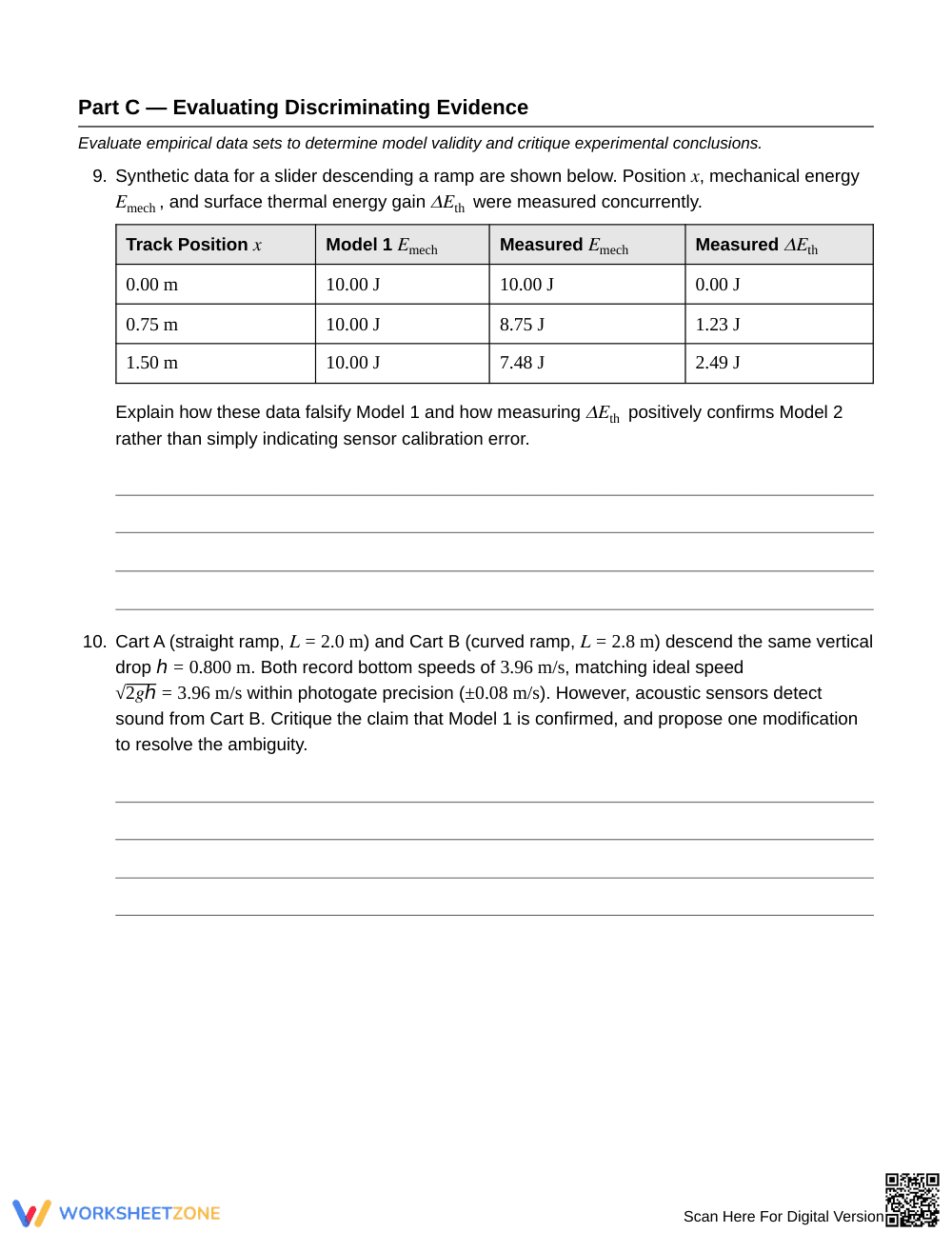
This 4-page physics worksheet includes 10 structured analytical tasks accompanied by a complete 2-page answer key with step-by-step mathematical solutions. Students work with a theoretical reference framework defining conservative invariance and dissipative contact work, multi-variable synthetic data tables, algebraic derivation prompts, and experimental critique items designed to test competing physical hypotheses.
Skill Progression
- Guided Practice (Tasks 1–2): Direct numerical prediction tasks establish foundational calculations for frictionless ramps and air-damped pendulums under explicit baseline and dissipative parameters.
- Supported Practice (Tasks 3–8): Intermediate tasks challenge students to classify system boundaries, isolate experimental variables, derive algebraic dissipation formulas, and interpret empirical friction tables.
- Independent Practice (Tasks 9–10): Complex evaluative prompts require students to critique synthetic calorimetric datasets, assess experimental precision limits, and resolve theoretical ambiguities independently.
This sequence embodies the gradual-release model, transitioning learners systematically from direct formula application to rigorous experimental argumentation.
Standards Alignment
This worksheet aligns directly with high school physics and advanced mechanics standards governing work, kinetic and potential energy transformations, and thermal dissipation via non-conservative forces. Students calculate mechanical work, model frictional drag, and verify conservation laws across closed and open system boundaries. Both standard codes can be copied directly into lesson plans, IEP goals, or district curriculum mapping tools.
How to Use It
Deploy this worksheet after direct instruction on the work-energy theorem and non-conservative forces. Use it during collaborative problem-solving workshops or assign it as an intensive summative review before an advanced mechanics unit exam. For formative assessment, inspect student responses on Task 3 to identify whether learners correctly classify boundary-dependent work versus internal system dissipation. Typical completion time ranges from 45 to 60 minutes.
Who It's For
This resource serves Grade 12 physics and AP Physics C mechanics students needing rigorous analytical practice with open and closed systems. Scaffolding structures benefit students needing clear model contrast, while algebraic extensions challenge advanced learners. Pair this printable worksheet directly with laboratory investigations measuring inclined plane friction or photogate velocity profiles.
Evaluating competing conservative and non-conservative physical models requires students to coordinate theoretical physics principles with empirical laboratory observations. According to research by Fisher & Frey (2014), structured instructional progressions that move systematically from explicit comparative modeling to independent evidentiary critique build deep scientific reasoning and domain-specific problem-solving mastery. In advanced high school physics mechanics, learners frequently struggle to distinguish between internal thermal transformations and external boundary work during energy tracking. This 4-page, 10-task worksheet directly resolves that conceptual hurdle by pairing quantitative work-energy equations with synthetic research data tables, controlled variable isolation tasks, and rigorous hypothesis falsification prompts. By evaluating both invariant mechanical conservation assumptions and velocity-dependent dissipative drag models across diverse physical geometries, students systematically develop the conceptual clarity, analytical discernment, and mathematical precision necessary to evaluate real-world mechanical systems under authentic scientific constraints.


