


























Views
Downloads

Organ Systems Worksheet | Grade 5-6 Essential Science
Paste this activity's link or code into your existing LMS (Google Classroom, Canvas, Teams, Schoology, Moodle, etc.).
Students can open and work on the activity right away, with no student login required.
You'll still be able to track student progress and results from your teacher account.
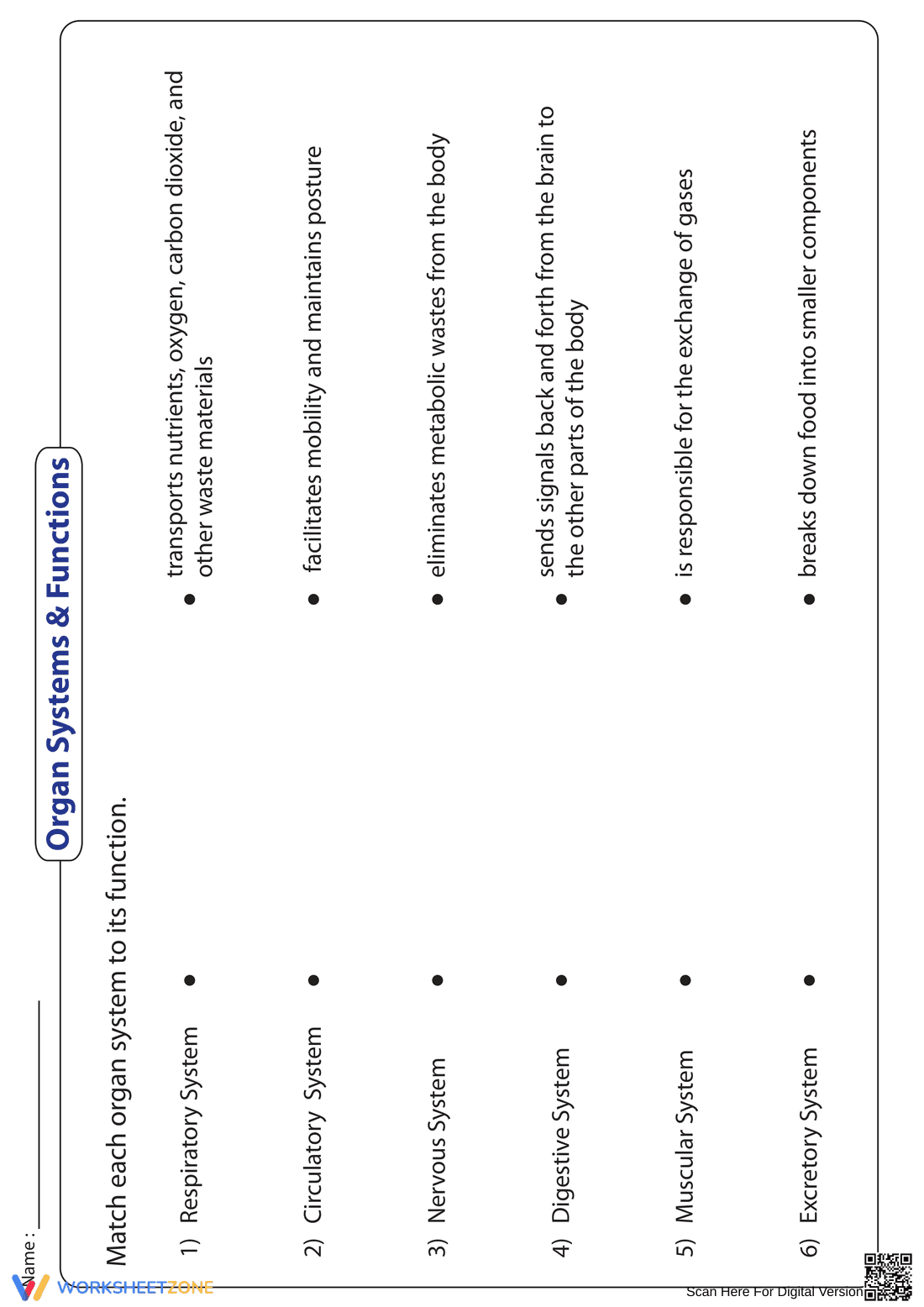
This Grade 5-6 Science worksheet helps students master core concepts of human biology by matching major organ systems to their primary functions. Students demonstrate comprehension of how the respiratory, circulatory, nervous, and digestive systems work together. This focused practice ensures learners can articulate the roles each internal structure plays in supporting life.
At a Glance
- Grade: 5–6 · Subject: Science
- Standard:
MS-LS1-3— Body is a system of interacting subsystems composed of groups of cells- Skill Focus: Human Organ Systems & Functions
- Format: 1 page · 6 problems · Answer key included · PDF
- Best For: Independent practice and quick formative assessment
- Time: 10–15 minutes
What's Inside
This single-page PDF features a high-contrast matching task where students connect six major organ systems to their biological descriptions. The layout is designed for readability and includes the respiratory, circulatory, nervous, digestive, muscular, and excretory systems. A complete answer key is provided to facilitate rapid grading or self-correction, making it ideal for immediate student feedback.
Zero-Prep Workflow
- Print: Generate the single-page document in seconds.
- Distribute: Provide sheets to students for independent work during a human body unit.
- Review: Check answers as a class or using the provided key in under five minutes.
Total teacher preparation time is well under two minutes, making it an excellent candidate for emergency sub plans or quick bell-ringers.
Standards Alignment
The activity aligns directly with `MS-LS1-3`, which requires students to understand that the body is a system of interacting subsystems. By identifying the functions of individual systems, students build the foundational knowledge necessary to explain systemic interactions. This standard code can be copied directly into lesson plans, IEP goals, or district curriculum mapping tools.
How to Use It
Assign this worksheet during the practice phase of a direct instruction lesson on human anatomy. It serves as an effective formative assessment tool to gauge student understanding before moving on to more complex systemic interactions. Teachers should observe whether students can distinguish between the circulatory and respiratory systems. Expected completion typically takes 10 to 15 minutes.
Who It's For
This resource is tailored for upper elementary and middle school students in grades 5 and 6. It is particularly helpful for visual learners and can be easily differentiated by providing an anchor chart for students requiring extra support. It pairs naturally with a classroom passage on human anatomy or a diagram-based lesson on the major organ systems.
Research from EdReports 2024 emphasizes the importance of utilizing high-quality, standards-aligned instructional materials to bridge the gap between abstract biological concepts and concrete student understanding. This worksheet addresses the `MS-LS1-3` standard by requiring students to accurately identify the plain-English functions of major organ systems, such as the exchange of gases and the transport of nutrients. By isolating these functions in a structured matching format, the resource supports cognitive retrieval and reinforces the foundational vocabulary necessary for higher-order science discourse. Studies in ScienceDirect TpT Analysis suggest that focused, low-stakes practice sessions significantly improve retention of anatomical terminology in middle-grade learners. This worksheet provides that precise level of support, allowing educators to verify mastery of the human body as a system of interacting subsystems without the overhead of complex lab setups, ultimately fostering a more efficient and focused classroom environment.


