


























Views
Downloads
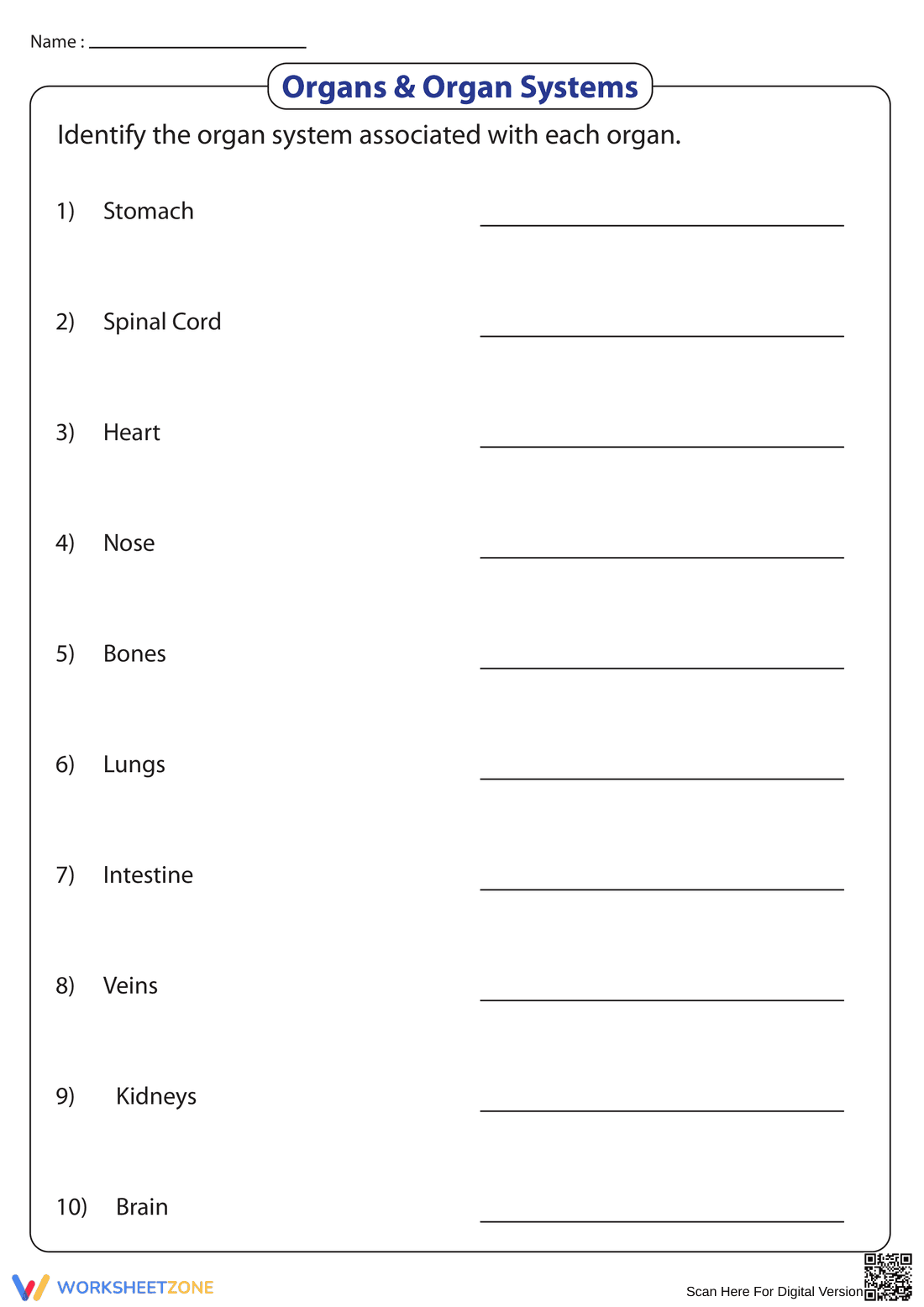

Grade 4 Organs & Organ Systems — Printable No-Prep Worksheet
Paste this activity's link or code into your existing LMS (Google Classroom, Canvas, Teams, Schoology, Moodle, etc.).
Students can open and work on the activity right away, with no student login required.
You'll still be able to track student progress and results from your teacher account.
Identify the relationship between internal organs and their corresponding systems with this focused science worksheet. Students categorize ten major organs, including the heart and lungs, into their respective biological systems to demonstrate understanding of bodily functions. This activity reinforces anatomical knowledge and builds a foundation for understanding how internal structures support survival.
At a Glance
At a Glance
- Grade: 4 · Subject: Science
- Standard:
4-LS1-1— Construct an argument that internal structures function to support animal survival- Skill Focus: Organ System Identification
- Format: 1 page · 10 problems · Answer key included · PDF
- Best For: Independent practice or quick formative assessment
- Time: 15–20 minutes
What's Inside
This one-page printable features ten identification tasks where students match specific organs—such as the stomach, spinal cord, and kidneys—to their correct organ systems. The layout is clean and distraction-free, providing ample space for written responses. A comprehensive answer key is included to facilitate rapid grading or student self-correction, making it ideal for high-volume classroom use.
Zero-Prep Workflow
- Print: Download and print the single-page PDF in under 30 seconds.
- Distribute: Hand out copies for immediate independent work with no teacher setup required.
- Review: Use the included answer key for rapid grading or peer-review sessions.
Total teacher preparation time is targeted at under two minutes, making this an excellent choice for substitute folders or bell-ringer activities.
Standards Alignment
This resource is aligned to 4-LS1-1, which requires students to construct an argument that internal and external structures function to support survival and growth. By identifying the organ systems, students begin to synthesize how specialized parts work together to maintain a living organism. Both standard codes can be copied directly into lesson plans, IEP goals, or district curriculum mapping tools.
How to Use It
Use this worksheet as a mid-lesson check for understanding after introducing the major organ systems (circulatory, digestive, nervous, etc.). It serves as an excellent formative assessment to observe if students can distinguish between systems with overlapping organs. Completion typically takes 15 to 20 minutes depending on prior knowledge, making it a perfect exit ticket.
Who It's For
Designed for students in grades 3 through 5, this handout supports general education science curriculum and provides clear scaffolding for English Language Learners through simple vocabulary. It pairs naturally with a classroom anchor chart detailing the functions of the circulatory, respiratory, and skeletal systems for students needing additional visual support during the task.
Citation Capsule
According to the NAEP Science Framework, understanding the hierarchical organization of living systems is a critical benchmark for upper elementary students. Research in ScienceDirect TpT Analysis suggests that focused, single-concept worksheets like this one improve retention by reducing cognitive load during the initial phase of skill acquisition. By isolating the identification of organs and their systems, educators provide a structured environment that aligns with the principles of direct instruction. This 4-LS1-1 aligned activity ensures that students master the foundational vocabulary required for more complex physiological arguments. Fisher & Frey (2014) emphasize that such guided practice is essential for moving students toward independent mastery of complex biological concepts. This resource provides the necessary repetition to secure these facts in long-term memory, ensuring students are ready for advanced life science units in middle school through structured, standards-aligned identification practice.


