These back muscle worksheets resources give high school anatomy teachers a set of structured, print-ready activities built around one of the unit's most demanding content areas: the posterior musculature. Each worksheet isolates a specific skill — diagram labeling, function recall, or layer comparison — so the set works across the full arc of a unit rather than only at review time.
What Each Worksheet Builds
The worksheets cover the muscles high school anatomy courses consistently test: the trapezius, latissimus dorsi, rhomboid major and minor, levator scapulae, the erector spinae subgroups (iliocostalis, longissimus, and spinalis), and the teres pair. Activity formats vary across worksheets to keep students working in different cognitive modes rather than repeating the same task in the same format.
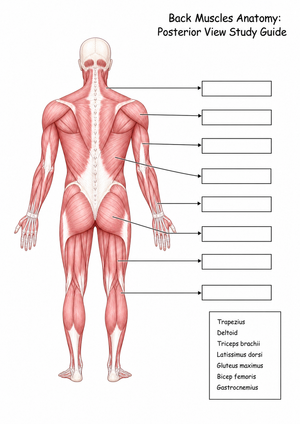
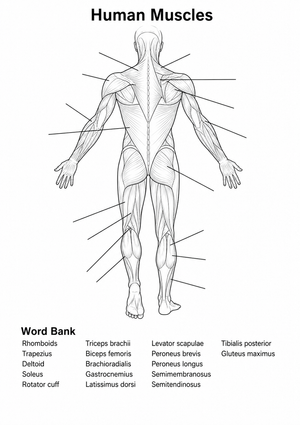
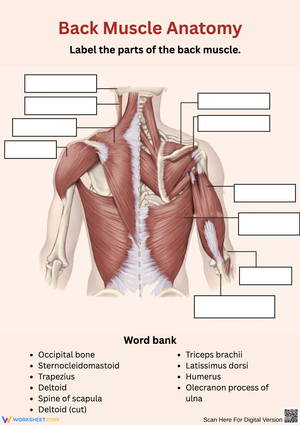
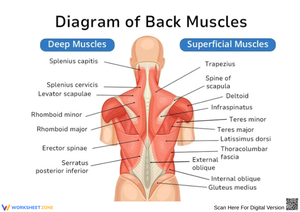
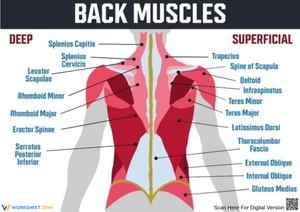
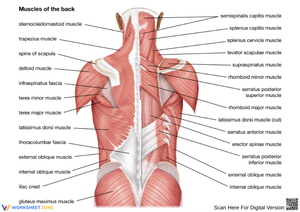
- Posterior-view labeling diagrams — Students write the correct name for each highlighted muscle on a torso outline. Separate worksheets present the superficial layer and the deep layer independently, which lets students see the rhomboids and erector spinae without the trapezius and latissimus dorsi covering them.
- Origin, insertion, and action tables — Fill-in-the-blank tables require students to recall functional details for each muscle. The table format also works as a fold-over self-quiz in the days leading up to a practical exam.
- Muscle-action matching — Students connect muscle names to movement descriptions, reinforcing vocabulary before those terms appear on a written assessment.
- Coloring activities — Students assign a distinct color to each muscle or muscle layer and build a corresponding legend. Color-coding by layer makes the superficial-versus-deep distinction tangible rather than abstract.
- Word-bank and blank versions — Each labeling worksheet comes in two forms so teachers can select the level of support that fits their students on a given day without printing a different resource entirely.
Mistakes Students Consistently Make on Back Muscle Diagrams
The trapezius generates more grading errors than any other muscle on the posterior diagram. Students learn "elevates the scapula" as the trapezius action and stop there. On a practical exam question targeting the lower fibers, they write "elevation" again — missing that the lower fibers depress the scapula, the exact opposite action. A worksheet that presents the trapezius broken into upper, middle, and lower fiber regions forces students to confront that distinction before the exam does it for them.
The latissimus dorsi trips students up at the origin-insertion level. Because the muscle fans upward and appears to terminate at the shoulder, students instinctively write the humerus as the origin rather than the insertion. The anatomical rule — proximal attachment is the origin — is counterintuitive here, and only repeated written practice on a table worksheet reliably corrects it. The rhomboids cause a different problem: students who have only studied superficial diagrams often omit the rhomboids entirely on a labeling task, because the trapezius covers them in every image they have reviewed. When a two-layer diagram shows the rhomboids in isolation, students are often genuinely surprised by where they sit. The erector spinae group compounds all of this — because the three subgroups (iliocostalis, longissimus, spinalis) are typically drawn as one indistinct column, many students treat the entire group as a single muscle and cannot distinguish the subgroups on a matching item.
Lesson-Planning Strategies for Getting the Most From These Worksheets
Coloring worksheets work best as pre-lab preparation rather than post-lab review. When students color-code the superficial and deep layers before a model-building or dissection session, they arrive at the lab station with a spatial map already formed. The worksheet is not a warm-up filler — it is the cognitive groundwork that makes the hands-on work that follows more productive.
The origin-insertion table is most effective when students return to it across multiple sessions rather than completing it once and moving on. Assign the fill-in task as initial practice, then have students fold the answer column under and use the table as a self-quiz during the first ten minutes of independent work in each subsequent class period. Spaced retrieval across three or four sessions produces stronger retention than a single thorough study session the night before the exam — and the table format makes that spacing easy to implement without printing additional materials. A genuinely useful add-on: place a short clinical question at the bottom of each labeling worksheet — which back muscles are most vulnerable during a deadlift, or which muscles contribute to the rounded posture that develops after years at a desk. Students who connect the diagram to a real-world scenario remember the muscle placements longer than students who only practice naming them.
Adapting the Worksheets for a Mixed-Ability Class
The word-bank versions of the back muscle worksheets serve students who are still building anatomical vocabulary. The word bank removes the spelling barrier without removing the identification task — students still have to decide where each name belongs on the diagram, which is the actual learning objective. For students ready for a greater challenge, the blank versions carry no prompts at all: no partial labels, no answer choices, just the posterior outline and the expectation. A third approach for advanced learners is to hand them the completed labeled diagram and ask them to annotate each muscle in their own words with its origin, insertion, and primary action — a task that demands synthesis rather than recognition.
For an 8th-grade life science course running a basic human body unit, the word-bank labeling worksheet transfers well if the teacher narrows the muscle list to the trapezius, latissimus dorsi, and erector spinae group. Reducing the item count keeps the task achievable without altering the worksheet's core structure or requiring any redesign.
Standard Alignment
The back muscle worksheets set aligns most directly with NGSS HS-LS1-2, which asks students to "develop and use a model to illustrate the hierarchical organization of interacting systems that provide specific functions within multicellular organisms." In a posterior-musculature lesson, that standard appears in practice as diagram work: students represent the muscular system visually, distinguish between structural layers, and connect those layers to functional outcomes. Labeling and coloring worksheets are the most common classroom implementation of HS-LS1-2 at the elective anatomy level because they require students to build and interpret a model rather than simply read one.
Frequently Asked Questions
What is the difference between superficial and deep back muscles, and do the worksheets address both?
Superficial back muscles — primarily the trapezius and latissimus dorsi — are extrinsic muscles that act on the shoulder girdle and upper limb. Deep back muscles, particularly the erector spinae group, are intrinsic muscles that act directly on the vertebral column to control posture and spinal movement. Each labeling worksheet in this set addresses one layer specifically, and a side-by-side comparison activity helps students place both groups in context before they are tested on either.
How many times should students work through these worksheets before a practical exam?
For posterior musculature, three to four spaced practice sessions produce better retention than a single review block. Introduce the labeling worksheet after the initial lesson, return to the origin-insertion table mid-unit, and assign a blank version as the final self-assessment. The repetition is the point — each return forces active retrieval from memory rather than passive recognition of already-visible labels.
Can these worksheets be used at grade levels below high school?
The full set targets grades 9–12, where anatomy and physiology is offered as a science elective. Advanced 8th-grade life science courses can use the word-bank versions with a reduced muscle list. The back muscle worksheets format — standard US letter size, clean line diagrams — prints clearly at any grade level, so the same files transfer without modification once a teacher decides which muscles to include for a younger group.
Do the diagrams print clearly in black and white?
Yes. The line diagrams are drawn with sufficient contrast to remain legible without color ink. Coloring worksheets are produced as black-and-white outlines deliberately, because students supplying the color themselves is part of the learning activity. The origin-insertion tables and matching activities contain no background shading that would gray out or become difficult to read on a monochrome printer.