Leg Muscle Printable Worksheets for Anatomy Class
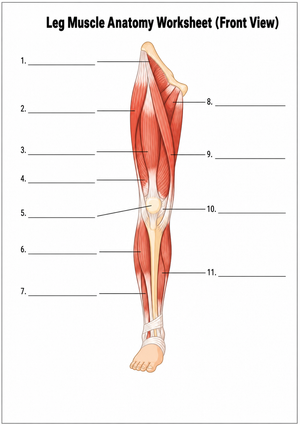
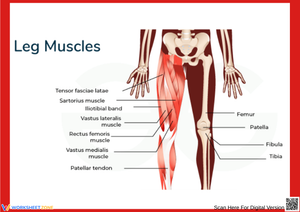
Leg muscle printable worksheets earn their place in an anatomy unit when they push students past name recognition toward something harder: understanding what each muscle actually does. This set covers six structures that appear in every K–12 science sequence — quadriceps, hamstrings, gastrocnemius, soleus, gluteals, and tibialis anterior — and every worksheet pairs a clean diagram with a task that requires students to connect location to function. Answer keys are included, which makes the set workable for stations, sub plans, and homework review without extra prep.
The Muscles Worth Teaching and Why These Six
The decision to stop at six structures is deliberate. Anatomy content becomes unmanageable fast when every lower-body muscle appears on the same worksheet, and what students need first is a coherent vocabulary they can actually use. These six structures form a logical group: they span the thigh, calf, hip, and lower leg; each one connects to a movement students can produce on command; and together they explain the mechanics of walking, running, jumping, and standing. That kind of internal logic — where each term links to the others through function — is what makes vocabulary stick in memory rather than disappearing the night after a quiz.
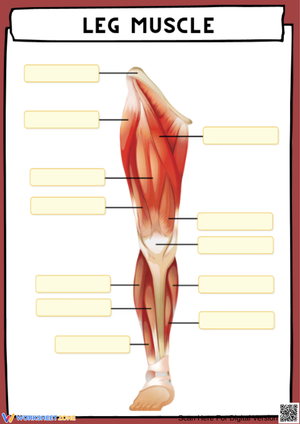
Each worksheet in this set asks students to do something specific with that vocabulary. The labeling pages ask students to place names on anterior and posterior diagrams. The function-matching worksheet pairs each muscle with a movement phrase — "extends the knee," "plantar flexes the foot," "lifts the forefoot during walking" — and asks students to sort them correctly. A vocabulary review worksheet requires students to write each term in a sentence that includes both the muscle's location and its action. These tasks build toward genuine understanding rather than surface recall.
Anatomy Errors Students Reliably Make at This Stage
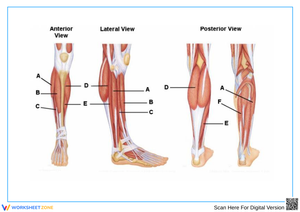
The most consistent error is placing quadriceps and hamstrings correctly on the anterior view and then reversing them on the posterior view. Students carry a mental shortcut — "thigh muscle = front" — that works on one diagram and fails on the next. The correction requires explicit attention: during instruction, pointing out that the posterior thigh is dominated by hamstrings while the anterior is dominated by quads, and then asking students to mark both on the same page rather than in sequence, breaks the shortcut faster than explanation alone.
Gastrocnemius and soleus produce a second reliable error: students know the calf has two muscles, write both labels in the same general zone, and then can't articulate which one sits superficial to the other. On worksheets that show only one view, students often just choose whichever name they remember first. The side-view diagram in this set, which shows the two muscles in a layered relationship, handles this directly — the image is more durable than the verbal distinction. Tibialis anterior is a different problem: it has no common nickname, and students who can supply all five other labels will often leave that location blank. Two exposures in different diagram orientations, which these worksheets provide, significantly reduce that blank-answer rate.
Where These Worksheets Fit in a Typical Anatomy Unit
The anterior labeling worksheet works best on the day of first instruction, used twice: once as a cold attempt before the lesson — students fill in whatever they already know — and once immediately after direct instruction. The gap between those two attempts shows exactly what the lesson moved. Leg muscle printable worksheets also fit well into a three-station rotation where one station handles diagram labeling, a second runs the function-matching sort, and a third asks students to physically perform a movement and then name the primary muscle responsible. That sequence runs in a standard 45-minute period without any technology.
For review days, the blank diagrams become retrieval practice rather than rereading — which is the right move from a spaced retrieval standpoint. Two minutes of independent recall on a blank diagram, followed by partner comparison and one correction round, accomplishes more than a full re-teach and generates a visible record of remaining gaps. Teachers who use these worksheets as warm-ups two or three days before the unit assessment consistently see cleaner quiz results than those who save review for a single block the day before.
Matching the Difficulty to Where Students Actually Are
The labeled and unlabeled versions of each diagram make it possible to run the same lesson at two demand levels without building separate materials. Students who need vocabulary support get the full word bank. Students working at grade level get a first-letter prompt list. Students ready for an additional challenge label from memory and then write one movement phrase per muscle in the diagram margin — "bends knee" next to hamstrings, "lifts foot" next to tibialis anterior. That last step turns a completed diagram into a personal study tool, which is more useful than a highlighted textbook definition for most students.
For multilingual learners and students who need additional structure, pairing each term with a directional arrow showing how the muscle moves the limb reduces language load without changing the anatomy content. These leg muscle printable worksheets include that arrow notation on the function-matching version, and the convention stays consistent across every worksheet in the set so students build a visual reference system rather than decoding each new page independently.
Standard Alignment
These worksheets align with NGSS MS-LS1-3, which requires students to use evidence-based argument to explain how the body operates as a system of interacting subsystems built from groups of cells. In classroom terms, that standard lands mid-unit — after cell structure and tissue types, before the body systems overview — which is exactly where a labeling-and-function worksheet does its most useful work. Students move from "muscle cells form muscle tissue" to "muscle tissue makes up the quadriceps" to "the quadriceps extends the knee," and the worksheet makes that progression visible in one place. For high school courses working toward HS-LS1-2, which asks students to model how interacting systems within multicellular organisms perform specific functions, these worksheets serve as the concrete foundation before model-building begins: students need to know what muscles do before they can reason about how those muscles interact with bones, nerves, and joints in a larger system.
Frequently Asked Questions
Which muscles should come first in a leg anatomy sequence?
Quadriceps and hamstrings are the natural starting point because most students arrive with informal names for them and can locate both by touch. From there, gastrocnemius and soleus pair well as a calf group since the distinction between superficial and deep is easier to teach visually than verbally. Gluteals and tibialis anterior fit at the end of the sequence: the gluteals because their role in locomotion and posture is conceptually richer than a single movement label suggests, and the tibialis anterior because it takes the most repetitions to stick.
Can these worksheets serve as an assessment, or are they only for practice?
Both. Removing the word bank from any labeling worksheet shifts it from guided practice to recall-level assessment with no other changes required. The function-matching worksheet converts easily into a short quiz by presenting unlabeled structures and asking students to supply both the muscle name and one associated movement. Teachers who use the blank diagram as a formative check on day two of instruction and again as a summative item at the end of the unit have a clean before-and-after record of individual student growth.
Do these work in health class or PE, or only in science?
These leg muscle printable worksheets work across all three. Health teachers find the function-matching worksheet useful when covering injury prevention — connecting muscle name to movement makes the cause of common strains and pulls clearer to students. PE teachers use the labeling pages during fitness units when students track which muscles a specific exercise targets. The primary design context is science-class anatomy instruction, but the content and format transfer directly to either setting without modification.
Clear All