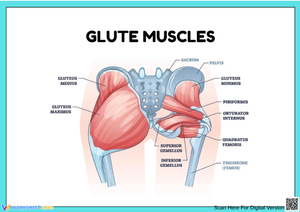
Butt Muscle worksheets: Printable Gluteal Anatomy Activities for the Classroom
These butt muscle worksheets resources give anatomy, life science, and physical education teachers a print-ready way to move students beyond textbook description into active, structured engagement with one of the most functionally significant muscle groups in the human body. The set covers all three gluteal muscles — gluteus maximus, gluteus medius, and gluteus minimus — through labeling tasks, movement-function matching, and structure-to-biomechanics connections that hold up across middle school and high school coursework.
What Students Practice Across the Set
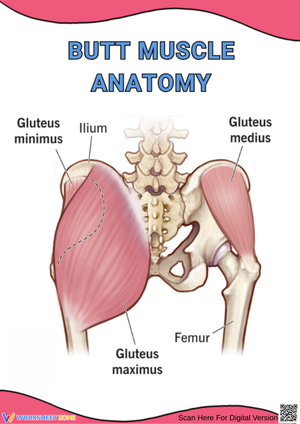
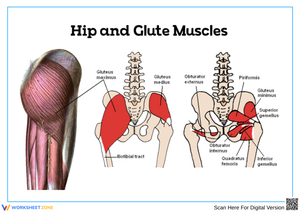
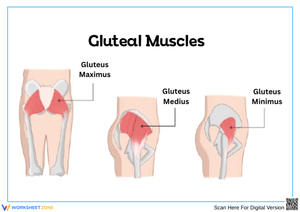
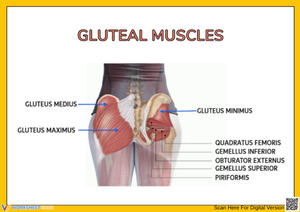
Each worksheet targets a distinct layer of anatomical understanding rather than rehearsing the same task repeatedly. Students label a posterior-view diagram of the gluteal region from memory or from a word bank, identify the primary mover for given scenarios — stair climbing, single-leg balance, lateral stepping — and explain why each muscle occupies its position in the layered sequence: maximus superficial, medius mid-layer, minimus deep. One worksheet asks students to trace the origin and insertion of each muscle and predict what movement that line of pull produces, which reveals whether they understand how muscle attachment determines function or have simply memorized names without connecting them to mechanics.
The set also includes a graphic organizer linking gluteal function to outcomes like upright posture, knee tracking during running, and pelvic stability on a single leg. That organizer works especially well in physical education contexts, where clinical anatomical language needs a bridge to something students have actually felt in their own bodies.
Mistakes Students Make That These Worksheets Help Surface
The most consistent error in student work is conflating the gluteus medius and gluteus minimus — not because students haven't read, but because both muscles share abduction as a primary function and many textbook diagrams show only a sliver of the minimus peeking out beneath the medius. Students write "gluteus medius" for both on the label diagram, then repeat the error on the movement-function section. The worksheets address this directly with a task that distinguishes the two muscles by anatomical depth and asks students to describe the minimus's additional role in internal rotation, which the medius does not share. That distinction — small, specific, anatomically consequential — is exactly what separates a passing answer from a complete one.
A second pattern worth watching: students regularly describe the gluteus maximus as the muscle that moves the leg forward, confusing extension with flexion. They observe that walking uses the gluteals and make the intuitive but wrong inference that the forward leg swing is what the maximus powers. Having students stand and push a leg backward while resting one hand on their gluteal region corrects this faster than re-reading the definition. The check takes two minutes and the correction sticks.
Building These Worksheets Into Your Anatomy Unit
Labeling worksheets work best as retrieval practice after initial instruction, not as the introduction to new content. Run the direct instruction or textbook reading first, then distribute the blank diagram the following day. The 24-hour gap forces memory consolidation and makes the labeling task genuinely formative — you see clearly who retained the information and who is guessing, rather than measuring whether students can copy from an open textbook lying next to the worksheet.
The movement-function matching worksheet pairs naturally with a short station rotation. Four stations work well: a squat, a lateral band walk, a chair sit-to-stand, and a single-leg hold. Students perform each movement before completing the corresponding row on the worksheet. This approach keeps the physical education period from feeling like a lecture hall and gives life science students a concrete anchor for abstract anatomical language. The stations take roughly 12 minutes — a workable fit for the mid-class window after warm-up and before the closing debrief.
For teachers running a comparative anatomy extension, one worksheet prompts students to consider why the human gluteus maximus is proportionally far larger than the same muscle in a chimpanzee. Students who can answer that question — connecting the enlarged maximus to the demands of sustained upright locomotion — demonstrate the structure-to-function reasoning that separates surface memorization from actual biological understanding. Save that one for the end of the unit, once foundational anatomy is in place.
Standard Alignment
These worksheets align with NGSS MS-LS1-3, which asks middle school students to use evidence to argue that body systems interact to support life functions. The gluteal muscle group makes that argument concrete: three structurally distinct muscles, each with a specific mechanical role, that together enable the bipedal locomotion defining human anatomy. At the high school level, HS-LS1-2 asks students to develop models of how specialized structures carry out body functions — and the butt muscle worksheets in this set map directly onto that expectation through tasks requiring students to trace attachment points and predict resulting movements. Teachers who need to document alignment for curriculum reviews will find the structure-to-function thread running through every worksheet in the set.
Adapting the Worksheets for a Range of Learners
The labeling worksheet comes in two versions: one with a full word bank listing all three muscle names plus origin, insertion, and action for each; one with blank labels only. The word-bank version reduces working memory load for students still building anatomical vocabulary, letting them concentrate on spatial recognition rather than spelling retrieval. The blank version suits students who have already demonstrated basic identification and are ready to work from long-term memory without that support structure.
Students who need additional help beyond the word bank can complete the worksheet with a textbook diagram open alongside — the task then becomes meaningful practice in reading and accurately transferring information, which is a real skill at this stage. Students who move through the standard tasks quickly find genuine challenge in the comparative anatomy and structure-to-function prediction worksheets. Explaining why the gluteus maximus enlarged through human evolutionary history requires synthesis that keeps strong students working rather than waiting.
Teaching This Topic Professionally in Middle School
Middle school teachers know that the anatomical region being studied here carries social risk the moment it's introduced. Using scientific terminology from the first moment — "gluteal muscles," "gluteal region," "posterior aspect of the hip" — sets the register for the lesson. A brief, matter-of-fact acknowledgment ("This is standard anatomy, and we're using clinical terms throughout") followed by an immediate pivot to the diagram moves students into the science without giving the awkwardness room to expand. Line-art anatomical illustrations keep the visual focus on muscle structure and sidestep any discomfort associated with photographic references. The clean black-and-white format also means there are no printer ink conversations to manage before class starts.
Framing the content around athletic performance and injury prevention gives students who are indifferent to anatomy a concrete reason to pay attention. Weak gluteal muscles contribute to knee cave during squats and landings — a consequence that student athletes recognize immediately and take seriously. The butt muscle worksheets in this set include a graphic organizer that makes those clinical connections explicit, which anchors the unit for students who otherwise disengage from memorization-heavy lessons.
Frequently Asked Questions
What grade levels are these worksheets appropriate for?
The set works across grades 6–12 depending on course context. Middle school life science classes typically use the labeling and movement-function worksheets within a body systems unit. High school anatomy and physiology courses get more use from the origin-insertion and structure-to-function worksheets. Physical education and health classes at both levels work well with the graphic organizer connecting gluteal strength to athletic and postural outcomes.
Do the worksheets need to be used in a specific sequence?
Each worksheet stands alone — teachers can select the two or three that fit their current unit without working through the full set. The labeling worksheet is the natural entry point, but the movement-function and graphic organizer worksheets work independently once students have had introductory instruction on the three gluteal muscles and their basic roles.
Can these work as assessment tools rather than just practice?
The blank-label version of the diagram worksheet functions well as a quiz. The movement-function matching worksheet makes a solid short-answer assessment once students have practiced with the word-bank version. These butt muscle worksheets use identical task structures across both practice and assessment formats, so students who have worked through the practice activities are not caught off guard by the format when it appears on a quiz or unit check.
Do these worksheets treat the gluteal muscles in isolation, or do they connect to the broader lower body?
The primary focus is the gluteal group — gluteus maximus, medius, and minimus — but several worksheets reference adjacent structures like the hip flexors and the iliotibial band where those connections clarify gluteal function. The graphic organizer in particular traces how gluteal weakness affects knee and lower back mechanics, giving students a systems-level view without pulling focus from the target muscles.
Clear All