These quad muscle printable worksheets resources give anatomy, biology, and physical education teachers a precise instructional path from "the quads are in the front of the thigh" to confident identification of four distinct muscles, their attachment points, and the biomechanical actions they produce at two separate joints. Each worksheet targets one dimension of quadriceps instruction — labeling, function-matching, depth relationships, or antagonist pairing — so the set moves across a unit as a sequence rather than landing all at once in a single lesson.
What Students Work Through in Each Worksheet
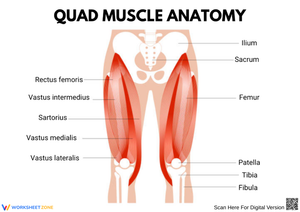
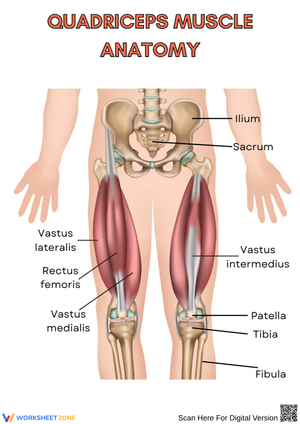
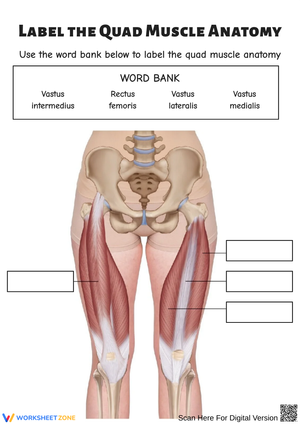
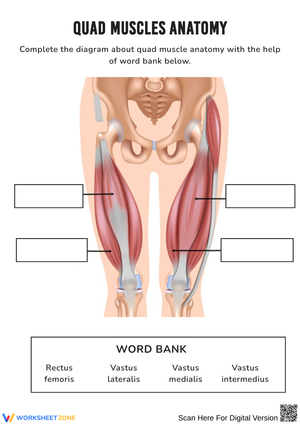
The labeling worksheets present anterior views of the thigh with the four constituent muscles — rectus femoris, vastus lateralis, vastus medialis, and vastus intermedius — indicated by leader lines. Students write the muscle names, identify the quadriceps tendon's insertion point at the patella, and note which muscle is the only one that crosses the hip joint. A separate diagram asks students to trace the origin and insertion of each muscle, which forces them to distinguish between the anterior inferior iliac spine origin of the rectus femoris and the linea aspera origins of the vasti.
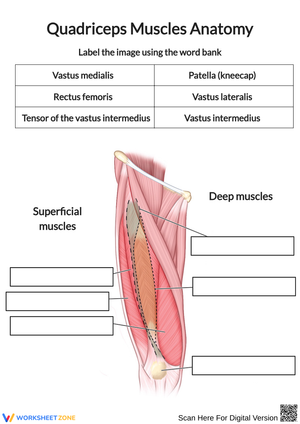
Function-matching worksheets pair specific movements — knee extension during a stair climb, hip flexion during a high-knee sprint drill — with the muscle or muscles primarily responsible. One worksheet presents a layered cross-section of the mid-thigh, showing the vastus intermedius sitting deep to the rectus femoris rather than beside it. Students shade each muscle in a distinct color to build a three-dimensional mental model that a flat anterior diagram cannot convey on its own. Another worksheet maps the antagonist relationship between the quadriceps and hamstrings, asking students to annotate which group is contracting and which is relaxing at each phase of a walking gait cycle.
Student Misconceptions Worth Anticipating Before the Lesson
The most persistent error involves the vastus intermedius. Because it sits beneath the rectus femoris on the anterior thigh, students who work only from standard anterior diagrams conclude that all four quad muscles lie side-by-side on the same surface layer — they draw the intermedius as a narrow strip wedged between the medialis and lateralis. The quad muscle printable worksheets diagrams that include cross-sectional views correct this directly. Once a student has shaded the intermedius in the deep layer of a cross-section, the misconception rarely resurfaces on assessments.
A second reliable error: students understand that the rectus femoris crosses two joints but then write that it assists in hip extension rather than hip flexion. The logic feels intuitive — the rectus femoris is on the anterior thigh, so students reason it must pull the leg back like a posterior muscle would. Tracing the muscle from its origin at the anterior inferior iliac spine to its distal insertion at the patella, on paper, makes the direction of pull visible in a way that corrects the error. A third pattern worth watching: students consistently underestimate the vastus medialis, labeling it as a minor stabilizer rather than recognizing its specific role in keeping the patella tracking properly during terminal knee extension. Connecting that detail to runner's knee generates genuine interest and anchors the information in long-term memory.
Building These Worksheets Into Your Week
The labeling worksheet works well as an opener on the first day of a quad unit — not as a pre-test but as a guided note-taking activity run alongside a projected diagram. Students fill labels in real time as the teacher talks through each muscle. This keeps cognitive load manageable: students are not trying to memorize names from a lecture and then retrieve them from scratch twenty minutes later. The function-matching and cross-section worksheets follow naturally on days two and three, after the names are anchored. The antagonist-pairing worksheet is best saved for the end of the unit, when students can bring their understanding of both muscle groups to the task simultaneously.
In physical education settings, the quad muscle printable worksheets set pairs effectively with a brief kinesthetic sequence: students perform a slow, controlled quarter-squat while palpating the anterior thigh, then complete the corresponding diagram immediately afterward. The ten minutes of hands-on movement before the paper task dramatically increases the accuracy of students' labels — they have a proprioceptive anchor for the muscle they are being asked to name. For sports medicine electives, the injury-focused worksheet fits naturally into a case-study format, where students identify which specific quad muscle is most vulnerable in a described athletic scenario and explain why using their anatomical knowledge.
Standard Alignment
These worksheets align directly with NGSS HS-LS1-2, which asks students to develop and use a model to illustrate the hierarchical organization of interacting systems that provide specific functions within multicellular organisms. The quadriceps group is a strong teaching vehicle for this standard because it demonstrates system organization at multiple levels simultaneously: individual muscle fibers, discrete muscles with distinct origins and insertions, a coordinated muscle group, and that group's integration into the knee and hip joints. Teachers working within the National Standards for Physical Education will find the biomechanical function worksheets aligned with the movement concepts strand, particularly the expectation that students understand force production and joint mechanics in the context of physical activity.
Adjusting the Work for Mixed-Ability Learners
For students still building basic anatomical vocabulary, the labeling worksheet runs effectively as a word-bank activity — all four muscle names are listed, and students match rather than generate from memory. This removes the recall burden and lets them focus on spatial reasoning: which muscle sits medially, which sits deep, which is largest. At the other end of the range, the quad muscle printable worksheets set supports extension through a biomechanics annotation task, where students draw force arrows on a running figure, label the contracting and relaxing muscle groups at each gait phase, and identify which quad muscle is working hardest at a given moment and explain why. Students in sports medicine tracks who have already memorized the names can move directly to the injury and rehabilitation worksheet, which asks them to apply anatomical knowledge to clinical scenarios rather than simply labeling structures.
Frequently Asked Questions
Why is the vastus intermedius harder for students to learn than the other three quad muscles?
The vastus intermedius does not appear as a distinct surface structure on a standard anterior view of the thigh. It lies deep to the rectus femoris, which means typical labeling diagrams either omit it or show it as a small sliver, and students cannot palpate it the way they can feel the vastus lateralis contracting during a squat. Cross-sectional diagrams and layered coloring activities are the most effective tools for making its position concrete.
Can these worksheets be used in physical education classes, or are they intended for biology?
They work in both settings without modification. PE and sports medicine teachers use the function-matching and injury-focused worksheets to connect muscle anatomy to athletic performance and injury prevention. Biology teachers tend to weight the structural labeling and cross-sectional worksheets more heavily. The two curricular emphases draw on different parts of the set naturally.
How long does a typical worksheet take to complete in class?
A guided labeling worksheet, completed alongside direct instruction, typically takes 12–15 minutes. Independent function-matching activities run closer to 20 minutes when students work without reference materials. The cross-section coloring worksheet — because it involves shading multiple overlapping layers and writing a brief explanation of depth relationships — can extend to 25 minutes if you include the written annotation component.
Is prior knowledge of the muscular system required before using these worksheets?
Students benefit from a brief overview of skeletal muscle structure — muscle fibers, tendons, origin versus insertion — before working through the labeling and function activities. Without that foundation, terms like "proximal attachment" will slow students down and shift attention away from the quadriceps content itself. One or two lessons on general muscular system vocabulary is sufficient preparation for the full set.