Arm Muscle printable worksheets
These arm muscle printable worksheets resources give anatomy teachers a structured way to move students through the upper limb without losing them in Latin terminology before they've seen the structures in context. Each worksheet targets a specific region or skill — shoulder, anterior upper arm, posterior upper arm, forearm compartments — so teachers can sequence the set across a unit rather than presenting the entire muscular system at once.
Skills and Concepts Covered Across the Set
Each worksheet focuses on a distinct anatomical region or task. Students work through labeling exercises, compartment-sorting activities, and movement-analysis questions that require applying muscle names rather than simply recognizing them on a multiple-choice item.
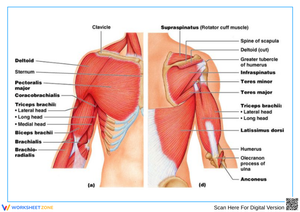
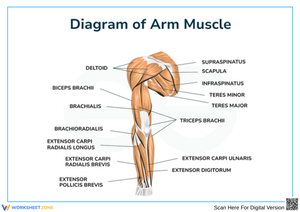
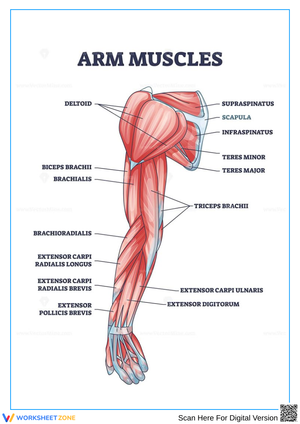
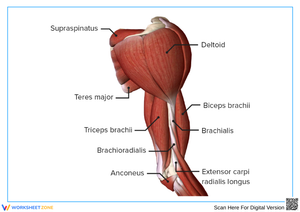
- Deltoid and shoulder region: Students label all three heads of the deltoid — anterior, lateral, and posterior — and match each head to its primary movement. This introduces the principle that a muscle's fiber orientation predicts its mechanical action, a concept students carry through the rest of the unit.
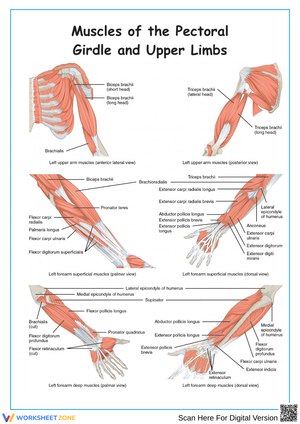
- Anterior upper arm: Labeling and distinguishing the biceps brachii and brachialis on the same diagram. Students also identify the biceps brachii's role in forearm supination, which separates it functionally from the brachialis and prevents the conflation that shows up constantly in early student work.
- Posterior upper arm: Triceps brachii identification across anterior, posterior, and lateral views, paired with questions on antagonistic function relative to the biceps brachii.
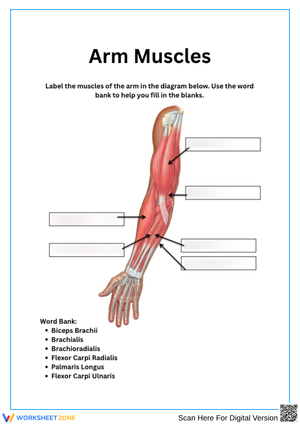
- Forearm compartments: Sorting major flexors — flexor carpi radialis, palmaris longus, flexor digitorum superficialis — and extensors — extensor carpi ulnaris, extensor digitorum — by compartment, then predicting the movement each muscle produces.
- Functional movement analysis: Diagrams of elbow flexion, extension, forearm supination, and pronation. Students annotate which muscles are shortening and which are lengthening — the step where conceptual understanding becomes visible in student work.
Mistakes Students Make That These Worksheets Help You Catch
The most consistent error in early arm anatomy work is treating the entire anterior upper arm as "biceps." On a standard lateral diagram, the brachialis lies deep to the biceps brachii and is partially hidden — students routinely leave it blank or label it as an extension of the biceps. Worksheets that pair a transverse cross-section with the standard anterior view force students to confront the depth relationship directly, because the cross-section makes the two muscles visually distinct in a way the surface diagram cannot.
The agonist-antagonist questions produce a second, more conceptual misconception. When asked what the biceps brachii does during controlled lowering of a forearm curl, most students write "relaxes" — because lowering doesn't feel like muscular effort. They haven't yet internalized eccentric contraction: a muscle lengthening while still producing force to control movement speed. Worksheets that require students to distinguish concentric, isometric, and eccentric states give them the vocabulary to answer that question correctly on a summative assessment, rather than guessing based on physical sensation.
Spelling errors follow a specific, correctable pattern. Students write "bicep" and "tricep" — dropping the s as though it were a plural suffix. It isn't: "biceps" and "triceps" are complete singular Latin terms meaning two-headed and three-headed respectively. One explicit mention of this on the first day of the unit eliminates it from most assessments. A related error: students swap "radialis" and "ulnaris" on forearm diagrams because they haven't anchored "radius = thumb side" in memory. A brief review of forearm bone orientation before introducing the forearm worksheet clears most of these transpositions.
How to Work These Worksheets Into Your Anatomy Unit
The most reliable sequencing approach is region-by-region with a 24-hour gap between introduction and worksheet completion. Introduce the shoulder muscles one day, use the deltoid worksheet as a 10-minute spaced retrieval exercise the following morning, then move to the upper arm. Returning to labeled diagrams the day after instruction — rather than completing the worksheet in the same class period as the lecture — produces measurably stronger retention, particularly for students who struggle with Latin terminology under time pressure.
These arm muscle printable worksheets resources also work as exit checks at the close of each lesson. Asking students to label three specific muscles before dismissal takes under five minutes and gives immediate formative data — who has the brachialis, who is still conflating it with the biceps brachii, who cannot yet locate the triceps heads on a posterior view. That information shapes the next day's warm-up rather than surfacing for the first time on a unit exam.
For kinesthetic reinforcement, pair worksheet labeling with in-seat movement. Have students flex and extend their elbow, then locate the biceps brachii and triceps brachii on their diagram while both muscles are still activated. Repeat with wrist flexion and extension during the forearm worksheet. Students who feel a contraction while simultaneously marking it on paper show stronger transfer to novel movement questions than students who label from diagrams alone.
Why Paper Diagrams Work for This Topic Specifically
Writing a muscle name by hand — locating it on a diagram, tracing an arrow to the correct structure, spelling it out in full — engages retrieval in a way that clicking a label in a digital interface does not. Digital drag-and-drop formats allow students to hover and retry with no cost; on paper, the commitment is immediate and the error is visible. For a topic where spelling and spatial placement are both part of the learning goal, that commitment matters.
Arm anatomy also benefits from working across multiple diagram orientations in a single sitting. A student who can label the biceps brachii on an anterior view but not on a lateral or cross-sectional view hasn't yet learned the muscle's three-dimensional position — only one angle of a flat image. Worksheets that present anterior and posterior views side by side support spatial consolidation without requiring students to manage screen-switching or navigate between tabs.
Standard Alignment
These worksheets align to NGSS HS-LS1-2, which asks students to develop and use a model to illustrate the hierarchical organization of interacting systems that provide specific functions within multicellular organisms. In classroom terms, labeling arm muscles is the "develop a model" step — students construct an annotated diagram representing tissue-level structure within the musculoskeletal system. The movement-analysis questions address the "specific functions" component by requiring students to connect structural position to mechanical action. Most state anatomy and physiology elective standards for high school map to this same framework, particularly for courses organized around organ systems and physiological function rather than cellular biology alone.
Adjusting the Worksheets for the Range of Learners in Your Class
The arm muscle printable worksheets set includes a natural tiering point at the word-bank option. Students who are not yet secure with Latin anatomical terminology can work from a provided list of muscle names, which reduces the retrieval demand enough to let them focus on spatial placement and functional reasoning. Removing the word bank for students who have demonstrated basic recall pushes them into full retrieval practice, which produces stronger long-term retention than supported labeling.
For students working above grade level, two extensions are worth building in. First, add origin and insertion labeling: instead of just naming the biceps brachii, students mark its proximal attachments — coracoid process and supraglenoid tubercle — and its distal attachment at the radial tuberosity. Second, introduce clinical application prompts. What movement becomes impossible if the long head of the biceps brachii tendon ruptures? Which triceps head is most affected by shoulder position during elbow extension? These questions require students to reason from structure to consequence rather than recall a name, which is the level of thinking that shows up in advanced biology coursework and on standardized science assessments.
Frequently Asked Questions
What grade levels are these worksheets appropriate for?
Basic muscle identification — deltoid, biceps brachii, triceps brachii — is appropriate for grades 6 through 8 in life science or health contexts. Detailed forearm compartment work, including flexor and extensor group sorting and functional analysis of supination and pronation, is more appropriate for high school anatomy or advanced biology, typically grades 10 through 12. Many teachers use the shoulder and upper arm worksheets in middle school and reserve the forearm compartment worksheets for secondary elective courses.
Do I need a strong anatomy background to teach from this set?
Not for the core content. The major muscles covered — deltoid, biceps brachii, brachialis, triceps brachii — appear in any standard biology or health textbook, and the worksheet structure guides the instruction. Teachers don't need to have the entire forearm flexor group memorized to facilitate a compartment-sorting activity; the worksheet provides the organizing framework. A focused read of the relevant textbook chapter the night before is sufficient preparation for most of the lessons.
How do I sequence these worksheets across a multi-week unit?
One reliable approach: introduce the skeletal structure of the arm first — humerus, radius, ulna, carpals — so students have attachment landmarks before they encounter muscle names. Then sequence the arm muscle printable worksheets resources region by region: shoulder, anterior upper arm, posterior upper arm, forearm compartments. Save the functional movement-analysis worksheet, which requires students to annotate agonist-antagonist pairs in action, for the end of the sequence. Students need enough vocabulary already in place to reason through those questions rather than guess from context.
Can these worksheets serve as formal assessment tools?
The blank-label versions work reliably as quiz formats. A 10-muscle identification quiz using an anterior-view diagram takes most students 8 to 12 minutes and produces clear data about retention without requiring extended class time. For summative purposes, pairing a labeling worksheet with two or three written analysis questions — asking students to explain a movement in terms of agonist, antagonist, and contraction type — gives a more complete picture of conceptual understanding than identification alone and is harder to pass through memorization without genuine comprehension.
Clear All