


























Views
Downloads
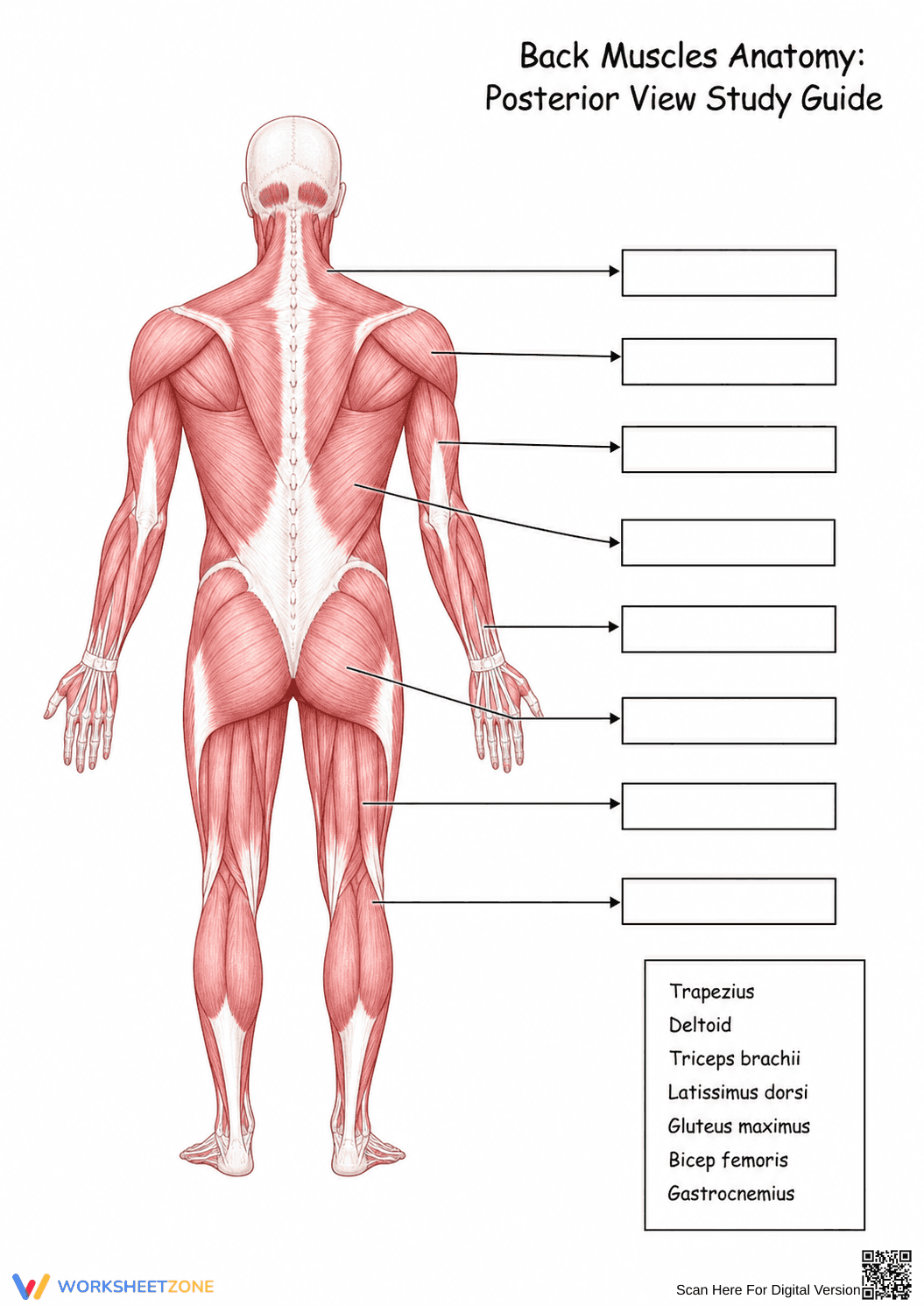

Grade 7 Back Muscles — Printable No-Prep Worksheet
Paste this activity's link or code into your existing LMS (Google Classroom, Canvas, Teams, Schoology, Moodle, etc.).
Students can open and work on the activity right away, with no student login required.
You'll still be able to track student progress and results from your teacher account.
This printable back muscles anatomy worksheet helps students identify and label the major posterior muscles of the human body. By matching anatomical terms to a detailed diagram, learners build foundational knowledge of the muscular system and its structural organization, preparing them for advanced biology and physical education topics.
At a Glance
- Grade: 7 · Subject: Biology
- Standard:
MS-LS1-3— Identify body subsystems and their structural functions- Skill Focus: Labeling posterior muscles
- Format: 1 page · 7 problems · Answer key included · PDF
- Best For: Independent practice or review
- Time: 10–15 minutes
Inside this resource, educators will find a single-page, highly visual diagram of the human muscular system from a posterior view. The worksheet features seven distinct labeling tasks with clear arrows pointing to key muscle groups, including the trapezius, latissimus dorsi, and gluteus maximus. A comprehensive word bank is provided at the bottom of the page to support student accuracy and reduce spelling errors, alongside a complete answer key for quick grading.
Zero-Prep Workflow
- Print (1 minute): Simply download the PDF and print a class set. The high-contrast diagram ensures clear copies every time.
- Distribute (1 minute): Hand out the worksheet as a bell-ringer or independent assignment. The included word bank means students can begin immediately without additional instruction.
- Review (3 minutes): Use the provided answer key to quickly check student work or project it on the board for self-grading. Total teacher prep time is under two minutes, making this an ideal emergency sub plan.
Aligned to primary standard MS-LS1-3, this activity supports students as they explore how the body is a system of interacting subsystems composed of specialized tissues. By mapping specific muscles, students visualize the structural organization required for human movement. Both standard codes can be copied directly into lesson plans, IEP goals, or district curriculum mapping tools.
This worksheet serves as an excellent formative assessment during a broader unit on human body systems. Assign it immediately after direct instruction on the muscular system to reinforce new vocabulary, or use it as a quiet, focused station activity during a lab rotation. As students work, teachers can circulate and observe whether learners are correctly distinguishing between adjacent muscle groups like the deltoid and triceps brachii. Expect students to complete the labeling within 10 to 15 minutes.
Designed primarily for middle school and early high school biology or physical education students, this resource is highly accessible. The built-in word bank provides essential scaffolding for English Language Learners and students needing vocabulary support. It pairs perfectly with a 3D anatomical model demonstration or a textbook reading on the musculoskeletal system.
Integrating visual diagrams with targeted vocabulary practice is a highly effective strategy for teaching complex anatomical structures. According to a ScienceDirect TpT Analysis, students demonstrate significantly higher retention of biological terms when required to actively map them onto spatial representations rather than memorizing lists in isolation. This worksheet directly applies that principle by requiring students to identify body subsystems and their structural functions (MS-LS1-3) using a detailed posterior view of the muscular system. By connecting terms like gastrocnemius and bicep femoris to their exact physical locations, learners transition from rote memorization to structural comprehension. This spatial mapping exercise not only reinforces the immediate lesson but also builds the foundational cognitive frameworks necessary for advanced physiological studies in high school and beyond.


