Hip Muscle worksheets
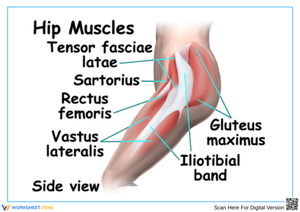
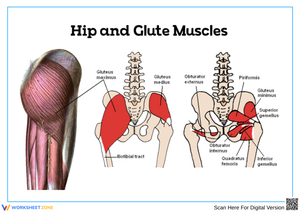
These hip muscle worksheets give high school anatomy teachers a set of targeted exercises — anterior and posterior labeling diagrams, origin-insertion tables, color-coded layering activities, and movement-matching tasks — built around the four muscle groupings that students consistently conflate or misplace during the lower body unit. Each worksheet addresses a distinct anatomical perspective or functional category, so the set drops into any point in the unit without requiring a complete restructure of existing lesson plans.
The Specific Skills Each Worksheet Targets
The worksheets in this hip muscle worksheets set cover the gluteal group, the iliopsoas complex, the medial adductors, and the deep lateral rotators — sequenced from most spatially accessible to most spatially demanding. That order matters: students who correctly orient the gluteus maximus on a posterior diagram carry that spatial anchor into the iliopsoas work, and the anterior-view iliopsoas worksheet builds directly on that prior orientation rather than restarting from scratch.
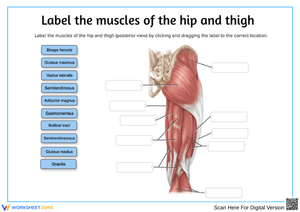
Each labeling worksheet presents one anatomical view — anterior, posterior, or lateral — with blank lines and arrows pointing to specific structures. Students write the name rather than select from a list, which produces stronger retention than recognition-based tasks. The origin-insertion table accompanying each muscle group asks students to complete entries independently and then cross-reference a diagram they have already labeled, linking spatial location to functional description within the same exercise. The adductor matching worksheet is the most vocabulary-dense task in the set, testing five muscles against their primary actions and nerve supply — appropriate for AP-level courses at full difficulty and workable for standard anatomy courses with a word bank provided.
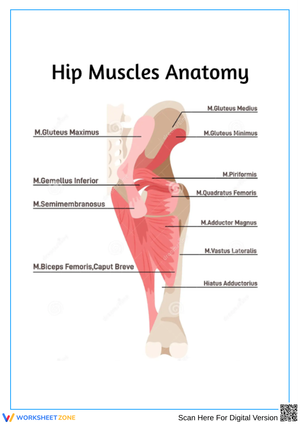
- Gluteal group: labeling and action comparison for the maximus, medius, and minimus, with specific attention to the medius as an abductor rather than an extensor — the distinction students most often miss on first contact with the material
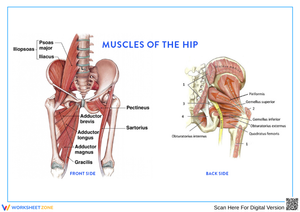
- Iliopsoas complex: anterior-view diagram tracing the iliacus and psoas major from their separate origins to the lesser trochanter, a route that is invisible in any posterior-only view
- Adductor group: five-muscle matching exercise covering the longus, brevis, magnus, pectineus, and gracilis, with the gracilis flagged as the only two-joint muscle in the group
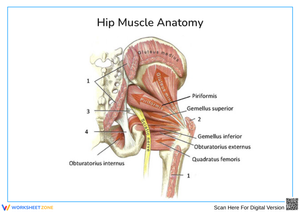
- Deep lateral rotators: layered diagram requiring students to identify the piriformis, gemelli, obturators, and quadratus femoris beneath the gluteal layer, using a removal technique that mirrors the logic of cadaveric dissection
Why This Format Works for This Particular Region
The hip is where high school anatomy students first encounter a region where position does not reliably predict function. The gluteus medius sits laterally but stabilizes the pelvis during single-leg stance — a functional role that contradicts the spatial reasoning students used successfully in the shoulder and arm units. Labeling and matching exercises that require active retrieval, rather than passive re-reading of class notes, put that kind of counterintuitive material into memory through effort rather than exposure. Attempting recall before confirming an answer produces more durable learning than reviewing correct information repeatedly, and these worksheets exploit that effect at every stage of the unit.
Color-coding serves a specific categorical function here, not a decorative one. When students assign the same shade to hip flexors across multiple worksheets in the unit — and hold to that system into the knee and ankle units — they build an automatic retrieval category that fires faster than label recall under timed exam conditions. The layered lateral-rotator diagram operates on the same principle: physically working out the spatial relationship between the piriformis and the gluteus maximus produces a mental image that a list of facts does not.
Errors in Student Work That These Worksheets Surface Early
The most reliable error is group-level generalization within the gluteals. Students who learn "gluteus maximus = extension" apply the same action to the medius and minimus because they memorized a label for the group rather than distinguishing individual functions. The matching exercise requires a separate action entry for each of the three muscles, which pushes students past the group label and into specific distinctions. Teachers who score these worksheets before moving to the iliopsoas unit catch and correct this before it becomes part of a student's working mental model of the hip.
On origin-insertion tables, students regularly list the lesser trochanter as the insertion for the gluteus maximus. The error is predictable: students see "trochanter" in their notes and attach it to whichever hip muscle they happen to be writing about at the time. The table format catches this because it places gluteus maximus and iliopsoas in adjacent rows, making the conflation visible at a glance in a way that a diagram reference alone does not.
The deep lateral rotator diagram surfaces a spatial reasoning gap worth addressing explicitly. Students who understand that the piriformis lies beneath the gluteus maximus often draw its course running along the lateral femur rather than spanning from the sacrum to the greater trochanter. The correct origin on the anterior sacrum is not visible on any standard posterior diagram, which is why this worksheet includes a dedicated anterior sacral view — without it, students guess based on incomplete visual information, and the guess runs in the same wrong direction almost every time.
Lesson-Planning Strategies for Getting Real Mileage From These Worksheets
The labeling diagrams work best as openers during the introduction phase of each muscle group — 10 to 12 minutes at the start of class while attendance is taken. Students attempt labels from memory or prior reading, which primes retrieval and signals immediately which structures need the most explicit attention that day. A teacher who scans completed opener worksheets before beginning direct instruction has formative data in hand before the lesson proper starts, which is more efficient than discovering gaps after the fact during whole-class review.
The color-coding worksheets belong mid-unit, after all four groups have been introduced but before any summative assessment. Assigning a consistent color system — flexors in one shade, extensors in another, abductors in a third — and holding to that system across every hip muscle worksheets in the set reinforces categorical thinking over isolated memorization. Students who enter the practical exam with automated color associations retrieve information faster under timed conditions than students who memorized muscle names in sequence without functional grouping.
Matching and clinical-scenario worksheets fit the last 15 minutes of a review session or the Friday block before a unit exam. They require synthesis rather than recall, and they surface gaps in understanding that students often cannot self-identify through re-reading notes. Teachers who pair a completed clinical-scenario worksheet with a brief whole-class debrief — asking two or three students to explain their reasoning aloud — convert a solo exercise into a peer-teaching moment without adding meaningful preparation time.
Differentiating These Worksheets Across Ability Levels in the Same Classroom
For students still building anatomical vocabulary, adding a word bank to the labeling worksheets removes the recall barrier without removing the spatial reasoning task. The student still maps names to arrows — the goal is accurate spatial orientation, not unassisted spelling of "quadratus femoris." Remove the word bank once a student demonstrates consistent accuracy across two successive worksheets; maintaining that support structure indefinitely prevents the transition to independent recall that the material eventually demands.
Students who move quickly through labeling tasks extend into the clinical-scenario exercises without requiring teacher intervention. Asking a student to explain in writing why a piriformis injury produces difficulty with external rotation — rather than just diffuse hip pain — requires applying origin-insertion logic rather than reproducing memorized terms. That distinction between application and recall is visible in student writing and gives teachers precise diagnostic information about where a student's understanding actually sits.
For students who struggle specifically with spatial reasoning on 2D diagrams, pairing the worksheet with a brief digital 3D model exploration before labeling begins separates two distinct difficulties: spatial orientation and anatomical vocabulary. Anatomy regularly conflates these two problems, and students who are strong on vocabulary but weak on spatial reasoning consistently underperform on labeling tasks relative to their actual knowledge of the material. Isolating the orientation challenge first produces more accurate diagnostic data from the worksheet itself.
Standard Alignment
These worksheets align with NGSS LS1-2, which asks students to develop and use models to illustrate how interacting body systems provide specific functions. In anatomy and physiology courses that use NGSS as their framework, the musculoskeletal system unit is typically where the "develop and use models" science practice receives its most sustained instructional attention — making hip diagrams a direct application of the standard rather than a supplementary activity. Students who label and color-code hip diagrams are constructing representations of structure-function relationships, which is precisely what LS1-2 describes.
State health science curricula referencing the National Health Science Standards — specifically Standard 1 (Academic Foundation) — expect students to apply anatomical and physiological knowledge to health-related contexts. The clinical-scenario exercises address this standard directly by placing muscle identification within injury and movement analysis scenarios, treating anatomy as functional knowledge rather than isolated vocabulary acquisition.
Frequently Asked Questions
Are these worksheets appropriate for sports medicine or physical education courses, or only for anatomy and physiology?
Sports medicine and PE teachers use the movement-analysis and clinical-scenario exercises regularly; the matching tasks connecting muscle names to joint actions transfer directly into injury assessment language. The labeling diagrams are more anatomy-specific, but they supply the vocabulary grounding that makes the functional exercises usable in those contexts. Most sports medicine teachers assign the labeling worksheets during a foundational unit and return to the clinical-scenario exercises when covering specific injury patterns later in the course.
How long does each worksheet take to complete?
Labeling diagrams run 10–15 minutes for most students at a mid-unit point. Color-coding exercises run closer to 20 minutes because students make active decisions about overlapping muscle regions. The clinical-scenario worksheets run 20–25 minutes and pair well with 25 minutes of direct instruction as the second half of a 50-minute period. Teachers using these as bell-ringers typically pull the shorter labeling or matching tasks and reserve the clinical scenarios for a full review day.
How do I handle students who use image searches to fill in labels rather than working from memory?
A hip muscle worksheets used as a closed-recall assessment requires the same enforcement conditions as any in-class quiz — phones away, expectations stated before the worksheet is distributed. For homework assignments, the more effective approach is to permit open notes explicitly and then use the completed worksheet as a discussion entry point the following day: asking students to identify the two structures they were least confident about and explain why converts the exercise from a recall product into a metacognitive tool, and that conversation often surfaces the same misunderstandings that closed-book conditions would only have hidden.
Clear All