


























Views
Downloads

Human Muscles Back View Worksheet | Grade 5 Essential
Paste this activity's link or code into your existing LMS (Google Classroom, Canvas, Teams, Schoology, Moodle, etc.).
Students can open and work on the activity right away, with no student login required.
You'll still be able to track student progress and results from your teacher account.
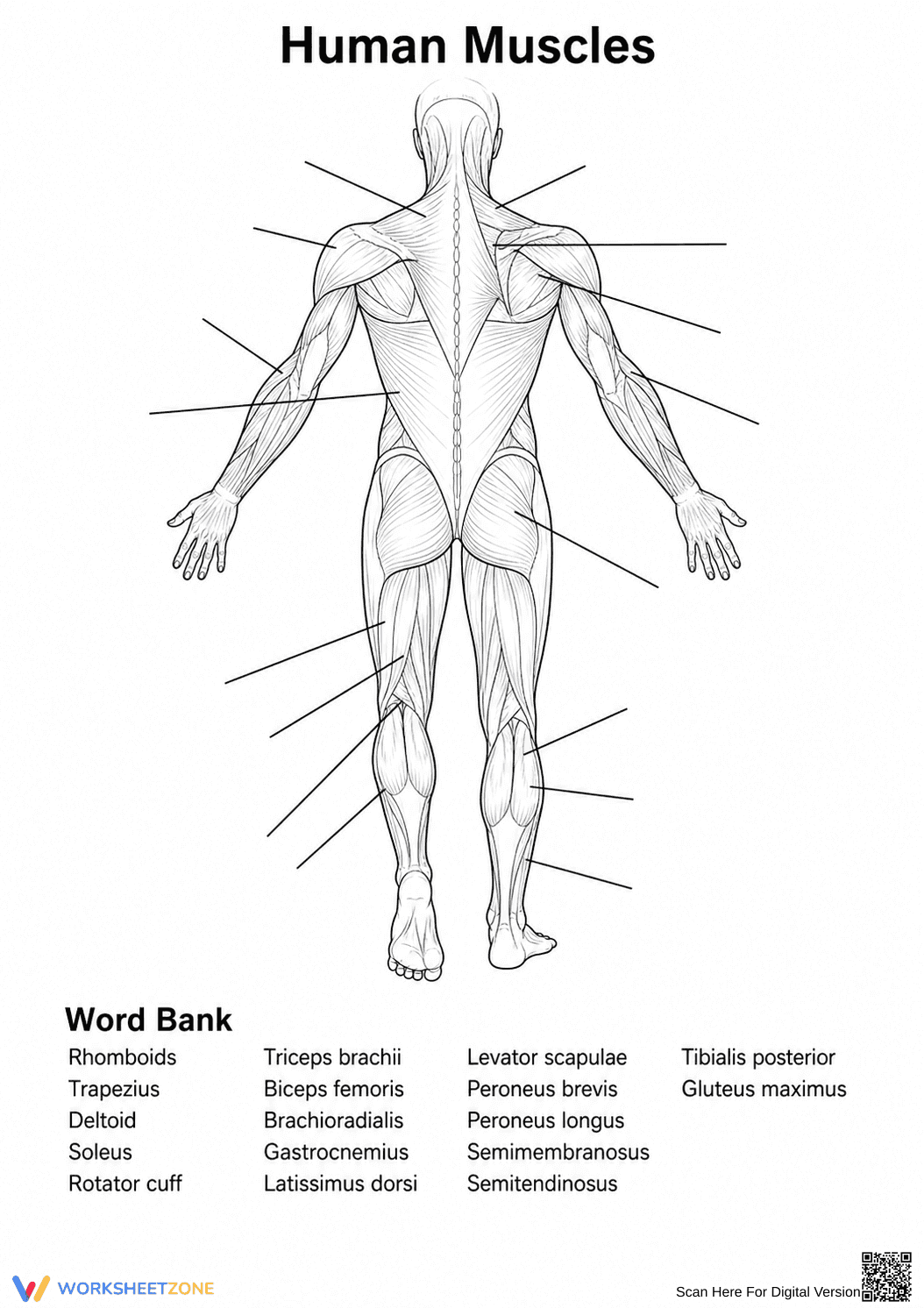
This human muscles back view worksheet provides a comprehensive labeling activity for students to master the posterior anatomy of the muscular system. By connecting technical terms to a clear visual diagram, learners develop a precise understanding of muscle placement and nomenclature. This resource ensures students can accurately identify major muscle groups, supporting foundational knowledge in human biology.
At a Glance
- Grade: 4-6 · Subject: Science
- Standard:
4-LS1-1— Identify internal and external structures that support survival and growth- Skill Focus: Posterior muscular anatomy
- Format: 1 page · 17 problems · Answer key included · PDF
- Best For: Quick anatomy review or assessment
- Time: 15–20 minutes
The worksheet features a high-quality anatomical illustration of the human body from the back view, with 17 distinct leader lines pointing to major muscle groups. Below the diagram, a comprehensive word bank includes terms ranging from the deltoid and triceps brachii to the semitendinosus and gastrocnemius. The single-page layout is designed for clarity, ensuring that students can easily match the vocabulary to the correct anatomical location.
The zero-prep design allows for immediate classroom integration. First, print the single-page PDF (30 seconds). Second, distribute the worksheet to students as a bell-ringer or independent practice activity (1 minute). Finally, use the included answer key to review the 17 muscle locations as a whole-class check or for rapid grading (5 minutes). This streamlined workflow makes it an ideal choice for substitute teacher folders.
This resource is primarily aligned with 4-LS1-1: "Construct an argument that plants and animals have internal and external structures that function to support survival, growth, behavior, and reproduction." By identifying the muscular system as a critical internal structure, students gain insight into how these components facilitate movement and physical stability. This standard code can be copied directly into lesson plans, IEP goals, or district curriculum mapping tools.
Use this worksheet during the "Explain" phase of a 5E lesson cycle to reinforce direct instruction on the muscular system. It serves as an excellent formative assessment tool; as students work, walk around to observe if they are confusing the various muscles of the leg, such as the biceps femoris and the semimembranosus. This task provides a clear snapshot of student mastery regarding anatomical positioning.
This activity is designed for upper elementary and middle school students in grades 4 through 6 who are beginning their study of human body systems. It is particularly effective for visual learners who benefit from spatial associations. The worksheet pairs naturally with a muscular system anchor chart or a 3D torso model, providing a tactile writing component to supplement visual instruction.
This anatomy resource aligns with the 4-LS1-1 standard, focusing on how internal and external structures function to support survival and growth. By requiring students to identify 17 specific muscle groups from a posterior perspective, the worksheet facilitates the transition from general body awareness to technical biological nomenclature. According to the RAND AIRS 2024 report on science literacy, visual-spatial tasks like diagram labeling significantly improve long-term retention of complex physiological systems compared to rote memorization alone. This worksheet provides a structured environment for students to practice precise identification of the trapezius, latissimus dorsi, and gluteus maximus, among others. The inclusion of a word bank serves as a scaffold, reducing cognitive load while maintaining academic rigor. Educators can utilize this tool to establish a baseline for muscular system units or as a summative check for anatomical positioning. The clear, high-contrast diagram ensures accessibility for all learners in a standard classroom setting.


